One thing that I no longer do is submit short stories to various markets. There are a number of reasons for this. A lack of desire, or execution of creating short stories is not among the reasons. I still plot and write stories from time to time, but the sad fact is that there is a lack of markets for me, and so the stories remain locked away in my computer and on various thumb drives. The biggest problem these days is the mentioned absence of markets. There are plenty of places to sell stories that are in the amateur and semi-pro marketplace. However, these places pay little or nothing and are mainly in electronic format only. I don't want to write to have my work appear for no payment (or even token payment) and I don't care for ephemeral electronic media. Because of this, such markets aren't a place for me and I do not submit my work there. Next comes the biggest problem. Starting a few years back I found myself blacklisted by a number of editors and publishers due to my political and social stands. There is no room, apparently, for people who don't toe the current popular line in such matters. I saw my prospects vanish instantly when I finally became sickened over the things I saw, and wrote about my honest feelings. Almost immediately, editors refused to look at my work out of hand, and word went out to bar me from various markets. Requests for submissions from me--which had been vigorous before--disappeared. So it goes. These days the only option that has generally been left to me is self-publishing; but I detest the self-published marketplace as a wasteland of trash and shit. Because of this I have largely avoided the self-published scene except mainly to promote other published work (such as my WORKING CLASS HERO project), and to re-publish my out of print novels. I don't expect this situation to change, and so my short story production, which was once vigorous, has been reduced to zero published tales. Oh, well. There's nothing to be done for it. I think the last time any of my stories saw print was in my collection A CONFEDERACY OF HORRORS from Hippocampus Press. You can buy a copy in ebook format, and in print format, with a brilliant cover by Pete von Sholly.
Here's a story I wrote a long time ago and sold a long time ago and saw published a long time ago in an anthology edited by Whitley Strieber (and several assistants including the Marty Greenberg team). A slightly edited version appears in my short story collection A CONFEDERACY OF HORRORS which came out last year and which you can pick up in paperback format or as an ebook.
A
LAST, LONGING LOOK
By
James Robert Smith
In the little washroom down the road from
the diner, he had stopped, washing and looking down at the hands.
They seemed to be good hands. The fingers
were long and fine and one could imagine them holding a camel hair paintbrush,
or playing a piano, perhaps. Grime filled the creases and lines in the joints
and on the palms, so he had scrubbed and scrubbed with the small bar of yellow
soap he had found on the edge of the sink. As he washed them, the thoughts
began to collect, the old ones shedding like so much dead skin from a molting
snake. Yes, these fingers had played the piano often enough in days long
gone.
After the hands were clean he had peeled
off his shirt and his tattered pants and he had washed the pits of his arms and
his crotch, drying himself with wads of rough paper in the dispenser.
Looking at the face in the mirror, he had
wanted to shave, although the face looked to have been shaved the day before,
likely. It could use another shave, but he couldn't find a razor or even a
knife in the pockets of those tattered black pants or in the breast of the thin
coat he had. He had looked at the face, a plain, mild face; it was his
face, now.
There was some money in the pocket, nine
one dollar bills, and there had been two twenties under the lining of the left
shoe. So he wasn't without money. He would need a little bit of money when he
went to the diner to look at her this one, final time. Oh, he wished he were
human.
He felt human, sometimes. The moments were
fleeting, then lost. When he was feeling human, he thought that maybe he was
cursed, some cursed soul moving from point to point. But, really, he knew
better. He just wasn't human. Merely something wishing to be so.
The last time he had felt like a human had
been three days before. He had been in the body of a man named Ned Waters. He'd
been in Ned's body for months, four long months during which he had used that
body and his thirst for humanity to court Ellen Hughes, who he had thought the
most beautiful woman he had ever seen. Ned had known Ellen for years, and had
never given her much thought until he'd been shunted aside by the new
inhabitant of his flesh. After that, it had become Ned's goal to marry Ellen.
It had taken long weeks to convince her of that love, as genuine as it had
been; Ellen was not a shallow creature. The last time he'd felt like a man was
when he had finally gone to bed with Ellen, and she had shared herself with him
and they had made love.
In all his years he had found that there
were few things so human as love, and the closeness he felt at such moments
were among the ultimate human experiences. It was these moments he worked
toward. And it was after these moments he was expelled, finding himself outside
human walls, drifting again. Drifting until.
Until he would find himself peering
through different eyes, reaching out with different hands, speaking through a
different
mouth. This was the way it was. And now,
having lost Ellen, having been forced out of his cloak of Ned, he would have a
last, longing look at her. He had to. His love for her had made him human, for
an instant.
**
Intentionally, despite the damp night, he
had waited in the cover of a long line of shrubs between the road and the peach
orchards until the last stragglers at the diner began to vanish one by one.
There in the darkness he was invisible to anyone not specifically looking for
him, and no one had seen him go to crouch there in the honeysuckle and
blackberry tangles. He bided his time and waited, absently picking beggars lice
from his pants, pressing out the wrinkles in the dark fabric as the hours
ticked by. And he plucked odd leaves and sticks from what he had carefully
picked from the wildflower garden untilled by men there on the verge of those
tangled shrubs. He plucked and cradled them in his arms.
At last, near midnight, he stood up from
his hiding place and peered out. There didn't seem to be anyone in the diner.
There was a window of opportunity, he knew, when Victor, who did most of the
cooking, would shove off to get home to his wife who he suspected of cheating
on him. There was always about twenty to thirty minutes between the time Victor
left and the diner officially closed. Ned usually spent those minutes with
Ellen, but Ned had to work late this night and would not arrive until after
midnight. This much, he knew, for he had heard the instructions with Ned's own
ears. So. He had half an hour, at most.
Avoiding the high weeds that grasped at
his shins, he jumped up and bounded out of the bushes and hopped the narrow
ditch that held pools of dark, stinking water. He went up the slope to the road
and crossed it, seeing Ellen in the diner, seeing her as she rubbed down the
counters and peered out from the brightness within. She was looking for the
headlights of Ned's pickup truck, and she would not see his form moving through
the night, until he approached the front door.
The road was silent and black, blending
with the night and the flat sameness of the surrounding country and only the
twinkling stars let you know where the horizon lay. He stood there, on the edge
of those shadows and waited until Ellen had finished mopping the counter and
had retreated into the back of the diner, into the kitchen to begin locking the
place down. Light from the
diner fell on him, revealing him as he went to the door and pushed it open,
jingling the bell. Going to the counter, he uncradled his arm where he held the
bunch of daisies he had plucked from the edge of the orchard, and he placed the
carefully groomed stems there on the white surface. And then he quickly took a
seat near the big plate glass window, his back to the night so that he could
see her face when she saw the daisies.
He sat in the booth that he always used
while waiting for Ellen to finish her chores. Most nights, as Ned, he had been right
in the same spot, patient as she tidied up and locked down. Right now, he knew,
she was latching the single back door that led out to the garbage cans. She had
probably put some chicken in a big can for the stray cats that hovered about.
Ellen would smell like bacon and her skin feel a bit slick to the touch, a thin
sheen of grease from the cooling griddles, but he didn't mind; he never minded.
Ellen appeared from the back and the first
thing she saw were the daisies sitting neatly arranged in a fanlike pattern on
the white-yellowing-to-brown countertop. Her face broke into a smile, her white
teeth revealed, her blue eyes glinting, her light brown hair curly beneath her
waitress cap. "Ned?" She started to say his name again and looked around,
seeing...him. Her smile faded quickly.
He sat, looking at her, his own smile of
pain melting at her reaction to his new face. Still, he couldn't blame her.
Despite having washed he still looked like the bum he was.
"Oh," she said. "I thought
someone else was here. I thought my boyfriend put these here for me."
"No," he said. "Just
me."
Ellen put the daisies down, leaving them
on the counter and she fidgeted, trying to decide if she wanted to step out
from behind the wood and formica barrier. She fingered her hair and glanced to
the window, looking for headlights. Nothing.
"Do you want somethign to eat? The
grills are off, but we still have sandwiches and pie and coffee." She
touched the receipt pad in her apron with her fine hands.
"Some coffee, please," he said.
She went around the counter and got the
coffee pot; then he saw her hesitate, as if thinking better of it, and instead
she brought him a full carafe' and poured him a cup, setting the container on
the table for him. "There's cream and sweetener on the table," she
told him, nodding at it.
He sat there and looked up at her. He
could smell her, now: that familiar smell. The scent aroused him, in every way.
"He'll probably just bring you a rose tonight," he said.
"What?" Ellen took a step back.
"He'll probably just bring you a
rose. A salmon rose, or just a plain red one if the store was out of
salmon."
She backed up a little more. "What do
you mean?"
"Ned," he told her. "Ned
will just bring you a salmon rose. He's really not all that thoughtful. He
doesn't take into account how you might feel on a particular day. So what he'll
do is bring you the same flower he gave you on Friday." His hands were
busy all the while with the coffee, putting in two sugars and lots of cream. It
had been a while since this body had taken in food.
"What are you talking about?"
She was all the way to the counter, now. But she had not turned her back on
him.
"Well...on Friday morning, Ned
brought you a salmon rose, and he brought it to your apartment and left it on
the table in your breakfast nook because...well because the sun was getting
ready to come up and the light was going to turn the sky a light pink outside
your bedroom window, and the first thing you'd see is that color as you opened
your eyes. And you'd given Ned a key the week before, but he hadn't used it but
when you woke up you heard him humming there in the kitchen, you recognized his
voice, and when you came out you saw the rose, about the same color as that
morning sky. And there was Ned.
"And it was then and there that you
decided that you loved him."
Ellen brushed her skirt with her left
hand. She often did things like that when she was nervous. She'd done something
like it the first time he'd wanted to kiss her. "Who are you," she
asked. "What...what are you saying?"
"And then the two of you made love.
You made love in your bed in your apartment. Ned loved you."
He sat there in his booth and he sipped the coffee, his eyes slitting with
pleasure.
"Listen, Mister. You're scaring me
and I want you to stop it. I want you to leave." She edged close to the
telephone near the register, but still would not turn her back.
"But ever since that morning, Ned
really hasn't seemed quite the same man, has he? Admit it. How many
flowers has he brought you?" He held up his left hand. "Wait. Don't
tell me. It's been three days, so he's brought you three flowers...and they've
all been salmon roses, haven't they?"
"You...you don't know me," she
said. "You have no business coming in here and talking to me. How do you
know my name? How do you know Ned?"
"I was Ned." He said it.
"I was the one who courted you and made you fall in love. It was me,
Ellen. It wasn't Ned. Not the Ned who's going through the motions now. It was me,"
he all but screamed the last.
And then Ellen lost what remained of her
courage. She spun and her hands went for the phone. And then he stood,
she heard his legs hit the tabletop of the booth as often happened with people
in a hurry; she heard the cup and saucer clatter against the spoon.
But the silence of the diner was broken by
the sound of tires cracking loose gravel onto the blacktop outside, the mutter
of a big V-8 bringing a pickup into the parking lot. It was Ned, they
both thought.
There was a metal creaking as the truck's
front door opened, then slammed shut. The front door jingled open and Ned came
in. He had a salmon rose in his big right fist and he did not seem to notice
that Ellen was upset. She'd have to tell the oaf.
Ned went toward her, and she rushed to
meet her and it took him a moment to realize she was sobbing. "What's
wrong, Ellen? What's wrong," he asked.
Ellen gasped and tried to catch her breath
and, finally, she just pointed at him sitting there in the booth where
he has sat back once Ned had entered the diner. Ned was a big man. Bigger than
most. And he was strong and fast and quick. Any man would think twice before
crossing such a man.
Ned's big features turned in the direction
of the man sitting in the booth; the dirty bum sitting there and staring
blankly at the two of them. He shooed Ellen away, pushed her back with his
thick right arm, and he came over to the dirty bum, looming over him.
"What's your problem, pal?" He would never have said that.
The bum looked up at her lover. Ned's face
was big and broad and usually friendly; the kind of face you couldn't hate, not
really. The lover's body was strong and quick and younger than the other's. The
other knew its strength, that those arms could lift great weights, could hold
Ellen's body so easily, as if it were but a feather. And its reflexes were
quick: he would see a punch coming from a mile away (he might say later,
bragging to his pals about the weird guy he decked). So, knowing that body,
knowing its strengths and wonderful quickness, he tricked it.
His elbow bumped the coffee pot. It looked
just like an accident, the kind of thing a weird little guy nervous in the face
of an impending butt-kicking might do. His thin arm jerked up and that elbow
bumped that coffee pot. And the lover, his reflexes so quick and his demeanor
always on the lookout for friends, reached out, as fast as a cat on a mouse
that has finally fled, and he caught that pot that his lover had placed on that
table and which the weird guy had just nervously bumped off the table: he
doesn't want her to have to clean up the mess.
But the thing is this. While the lover is
bent over, catching that double handful of warmth full of good, black coffee,
the weird guy does something. The weird guy reaches over, just an inch or two,
really, and he grabs up the great, big, full bottle of ketchup on the table and
he brings it down on the head of the fellow with the double handful of coffee
pot. There is an awkward silence broken by the big guy grunting, kind of small
from so big and graceful a man. The woman gasps. The weird guy jumps up from
the table, right up on his chair, and he kicks her lover in the side of the
face with his right leg and the power of that kick is spelled out in the way
her lover's body goes crashing to the floor like a heavy sack of wet sand.
She can't tell if all the redness is
ketchup or blood.
Her lover says nothing, merely lays there
heavy and silent with the bright lights overhead glaring down for all to see.
But there's really only two of them looking. There's just her. And there's the
weird guy.
So she tears her eyes away from the sight
of her lover lying there so big and so heavy and so awfully still. And she
looks into the eyes of the wiry little man who had come into the diner to stare
at her and make her nervous; the strange man who has hurt Ned. She looks at him
and sees his eyes. And she screams.
And he knows what she has seen. She has
seen the truth. She has seen that look in his eyes, that look that her
lover once gave her and which he now does not, although everything else is the
same about him. This weird little man is looking at her with that look
and that is what made her scream. That must be what it is, he concludes as she
turns to run. Standing on the chair, thinking about what she has seen in his
eyes--all that love glowing out at her--he lets her get to the door and through
it, opening it on all of that darkness out there before he jumps off of the
chair and begins to chase her.
"Ellen," he yells as he chases
her. She is already across the almost empty parking lot. Beyond that there is
only the peach orchard and a farmhouse about a mile distant, the lights in its
windows glinting in a mocking way through the darkness. The road is cruelly
empty of traffic. Ellen has left her purse and the keys to Ned's truck in the
diner, and she knows this and hopes only that she can outrun the strange,
terrible man.
But he is on her heels, faster and fitter
than he looks. Of course he is a vagrant, used to walking. He has a good wind
and she doesn't really have a chance. He has not caught her only because even
now, even chasing her down in this orchard, in the night, in the dimness lit
only by a crescent moon and the bright stars, even now he enjoys watching
her, seeing her move, seeing the way her legs push, the way her hips sway.
"Ellen," he says through gnashing jaws.
And then he has his thin fingers in her
hair and he is not gentle as he clenches down on a great handful of those long,
brown, silky strands. "Stop!"
They go down in a tangle. His fingers are
still gripping her hair and through her panic she feels that pain, feels her
hair almost tearing free of her scalp. Her back is to the damp earth, the scent
of fallen, rotting peaches all around. He is on top of her, his weight firmly
upon her ribcage, one hand in her hair and the other touching her face.
She tries to scream and he jams the heel of his hand into her mouth, way back
so that she cannot bite down and she cannot scream, can only gurgle. "Shut
up, Ellen. Please, please don't scream. Listen to me."
There is the sound of them. Both of them
panting.
"It's me, Ellen. I know you
understand. You have to. I'm the one who made you fall in love.
It wasn't him. I only used his body and now he's going through
the motions I set in place. He doesn't even know why. I'm the one
who loves you." He has to make her see. He has to make her understand so
that she will give him that thing that makes him feel like the others, that
makes him feel human. His free hand caresses her face, touches her chin
the way he had the nights he made her love him.
"Remember, Ellen? Remember the way I
stroked your face? He doesn't do it like that, does he? Not anymore.
And." He looks to the sky, then back at the face of this woman he loves so
much, who let him feel so wonderful for just that moment before he had been
forced out of that body. "And the way I touched you." He lifts himself
partially, freeing one knee so that he can reach. "The way I touched you here."
And now, her mouth free, Ellen screams as
loud as she can. Even in that house a mile away they will have heard her.
"Leave me alone you freak. Let
me go. You freak."
He snaps then. It is almost like that
moment when he takes love to that ultimate peak. When he has courted and wooed
and won that shared moment, when the two join as only true lovers can join.
This, then, is the other half, the other way that joins him to them, that
makes him feel human.
The rage builds in his head and flows out
of it in an electric charge that blossoms in his breast and fires down his arms
and into his legs and his hands are like claws, like clubs, like knives. Ah.
For this moment, for this brief, wonderful moment he is not this alien thing,
this being apart from all others. In this moment he shares that brutality with
them, that red hunger that only they have. For just this instant, as he beats
the life out of this woman whom he had loved so grandly, this woman without
whom he could not live. He could never continue knowing she was the lover of
another. Rage and hatred: nothing else was so human. For an instant he is
human.
Then, it is over.
Her body is lifeless, that one last breath
going out of it, that spark gone. With it, he is forced out of this
body. He is flung out of it. He is ripped out of mortal flesh and he
sees everything around them: the trees, the sky, the air, the grass, the dew
upon it, the peaches lying rotting in the loam, the bacteria feasting on ripe
flesh, the light glittering in the sky. He sees the heavens and wonders for a
moment from whence he came, from whence the threat to peace as he leaves behind
Ellen's body and her lover lying prone in that diner; leaves behind the
derelict man who finds himself crouched over the dead woman he cannot
understand killing. In one last glance, he sees police arriving, lights
piercing the night. He wonders if the derelict will escape. He thinks (or
hopes) that sometimes they do.
**
Then. He must go. He is being led by a
process not completely understood by him. But he is familiar with it. He is
tossed far, his self coming down to rest. He opens his eyes and sees
himself staring back at his new reflection in the mirror, his hand paused with
a razor to shave his handsome face. This time his name is Rick--Rick Collins. Linda,
he thinks. You know: Linda is beautiful. I realize that now. I think I'll
tell her. Today.
What a human
thought. Love is human.
This, and many other stories, can be found within the covers of A CONFEDERACY OF HORRORS by James Robert Smith. From Hippocampus Press and wherever fine books are sold.
2015 saw the publication of my first short story collection, A CONFEDERACY OF HORRORS. Stories from across three decades of professional sales. Older stories from my very early days as a writer, to recent stories never seen. From the excellent Hippocampus Press. There are stories here to satisfy every type of fan of weird fiction. There are stories of cosmic horror to those of modern-day violence. Ghost stories are there, along with some traditional creatures and things to chill your blood. "Even when grouped together thematically, the diversity and variety are nothing short of impressive. Tales range from Lovecraftian terrors to alien encounters with side trips into eco-horror and Southern Gothic tales. Carefully crafted, Smith relies on suspense and subtlety, rare traits in in a genre increasingly reliant on gore. Hippocampus Press should be thanked for this book. It is a long overdue collection of short stories by a master of the form and should be part of any horror reader’s collection." "In my opinion James Robert Smith's A Confederacy of Horrors will most likely be the best weird fiction collection of the year, because it contains diverse and beautifully written stories. It's an exceptionally good and original collection that will please fans of horror and weird fiction stories. It's a bit difficult for me to imagine that another collection could somehow be better."
As we gear up to leave for Glacier National Park, I think I'll spend most of the next few days promoting some of my books.
Next up is my first short story collection,A CONFEDERACY OF HORRORS.
It was a very long time coming. Through many false starts with
several other publishers who vanished before the book could see the
light of print. But now, it's finally on the way, from the excellent
Hippocampus Press. I couldn't be happier. 22 short stories ranging over my entire career as an author. Some
previously published and several all new stories specifically for this
edition. Almost 77,000 words of fiction. Foreword by Jason V. Brock.
Afterword by Stephen Mark Rainey. Cover art by Pete Von Sholly.
When I first began to assemble my work for what became the short story collection A CONFEDERACY OF HORRORS, I surprised myself because I had never quite realized that I had written so many ghost stories. To my way of thinking, ghost stories are the origin of horror fiction and at the base of almost every type of weird tale. One can write of monsters and of dragons and killers of all sorts; but at the source of them all is the fear of one's own mortality and of what might lie beyond (even if one does not believe in the "beyond"). I started reading ghost stories when I was a very young kid. Some of the first things I read were ghost stories, or weird stories, or--as one of the finest craftsmen of such tales (Robert Aikman) called them--strange stories. These tales must have stuck with me and influenced me far more than I realized, for a large percentage of the yarns I ended up spinning have been ghost stories of one sort or another. One of the greatest authors of such tales was M.R. James. An intellectual of both religious and scientific influence, he created what many readers consider among the finest ghost stories written. And occasionally some of his work has been hammered into various films, most notably the excellent 1950s-era movie: CURSE OF THE DEMON, adapted from his short story "Casting the Runes". But another great one from the pen of M.R. James that was loaned to cinematic excellence was "Whistle and I'll Come to You", adapted in 1968 as a short film. And here it is:
We spent kind of a lazy Sunday mainly taking it easy. We grilled out on the barbecue, and then Carole and I washed the linen for the Casita, then scrubbed down the kitchen and bathroom areas of the trailer before stocking some things for our next trip. Just three more weeks until we head out for a camping/kayaking vacation stretching over eleven days. Getting ready for these trips is almost half the fun.
I opened the new awning to clean it off after our trip to Mills River.
Carole swept and vacuumed the trailer and aired out the area rugs that we keep inside to cut down on dust and dirt.
I climbed into the bed and almost instantly fell asleep for about two hours. This was my view looking out the window at the new awning.
Here's a link to my latest book, my first short story collection from Hippocampus Press: A CONFEDERACY OF HORRORS.
A CONFEDERACY OF HORRORS by James Robert Smith. Foreword by Jason Brock. Afterword by Stephen Mark Rainey. Cover art by Peter Von Sholly.
I didn't know that Hippocampus Press was going to offer the ebook version of my first short story collection. But, there it is. If you're one of those folk who prefer ebooks to paper books, then you have the option!
Pete Von Sholly did a cover of what my story "Translator" would have looked like if Martin Goodman had published it as one of his pre-hero Marvels in the late 1950s. Color me stunned.
Some more promotions for my first short story collection, A CONFEDERACY OF HORRORS. It has been a very long time coming. Through many false starts with several other publishers who vanished before the book could see the light of print. But now, it's finally on the way, from the excellent Hippocampus Press. I couldn't be happier. 22 short stories ranging over my entire career as an author. Some previously published and several all new stories specifically for this edition. Almost 77,000 words of fiction. Foreword by Jason V. Brock. Afterword by Stephen Mark Rainey. Cover art by Pete Von Sholly.
My short story collection A CONFEDERACY OF HORRORS is now up and ready for order. It covers the whole of my career as a writer; from my earliest short stories to some of my latest. In addition to my fiction, the book also involves some other talented people. The foreword is by Jason V. Brock. The afterword is by Stephen Mark Rainey. The collection was edited by the multi-talented S.T. Joshi. It is published by Derrick Hussey at Hippocampus Press. The stunning cover art is by the amazing Pete Von Sholly. Buy a copy! Make my publisher happy he took on the project. An overview of my short fiction, from my days as a man in his early 20s to my years as a 50-something. A CONFEDERACY OF HORRORS.
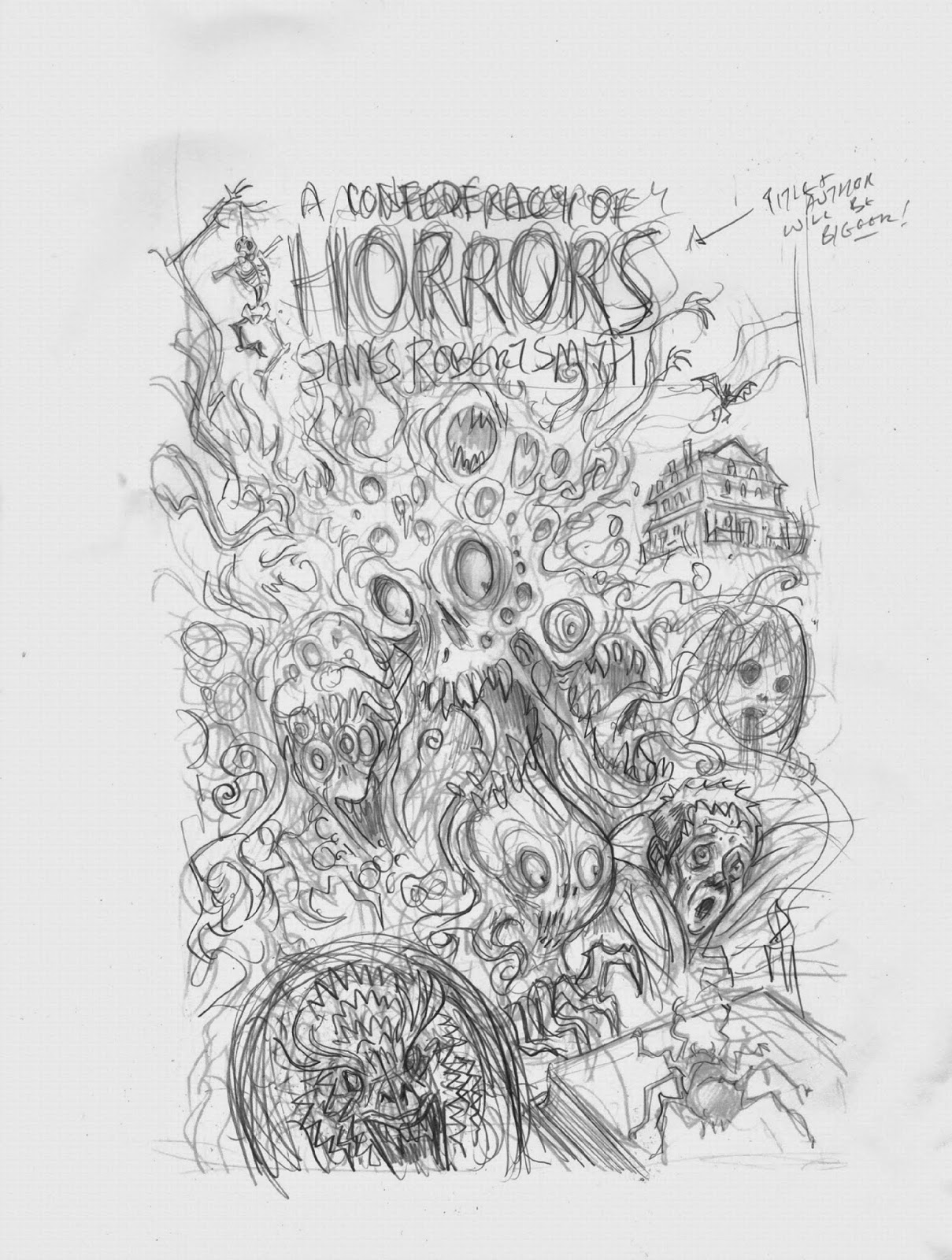
Many years ago I was offered a contract for my first short story collection which I titled A CONFEDERACY OF HORRORS. Unfortunately, as I've recounted in the past, the publisher went under before the book saw publication. I kept trying, though, and managed to find another publisher...who also promptly went out of business before the book could appear. Then more years went by as other publishers expressed interest but weird stuff kept happening (editors left, were fired, etc.). Finally, years in the making, A CONFEDERACY OF HORRORS found a home at the excellent Hippocampus Press. The book is now up for pre-order and today I was shown the cover rough from the very talented Pete Von Sholly. It feels good to finally see the book approaching the light of print. Wonderful! You can order the book HERE.
Editor S.T. Joshi sent me the galley proofs for my first short story collection, A CONFEDERACY OF HORRORS which will be appearing in 2014 from Hippocampus Press. Hippocampus has the best galley proofs I've ever seen, and this includes the ones I've gotten from the big publishers.
So, what the heck? I'll use today's blog to promote a couple of books: Here are a couple of my latest novels you can buy.
Wenzler was one of the unlucky ones who succumbed during the outbreak that almost became the Zombie Apocalypse. Two years have passed. He wakes up and remembers who he is and what he became. No longer quite human, he is consumed with the will to find his son in a largely recovered world. But to do that he'll have to run a gauntlet of the living who are out to finish putting the undead away for good. But is he undead? Or is he something else? Something more? THE NEW ECOLOGY OF DEATH.
Often the monster is just a misunderstood anti-hero. But sometimes it's a murdering, blood-thirsty asshole. WITHERING.
Years ago a publisher got in touch with me, asking to do a collection of my short fiction. So I assembled such; editing and proofreading was completed. And then...the publisher lost air and went belly up. Thereafter I set about trying to find a new home for it. Various publishers showed interest. Finally, one made an offer of publication. Time passed...and they vanished. Off to the markets yet again. I passed the collection around from place to place, a publisher wanted to do the project, letters were exchanged, an agreement was reached and...yeah, they croaked. Todt. Kaput. A couple of years ago a new publisher asked to see the manuscript. The editor in chief liked what he saw and sent me a contract (I actually still have that contract here, with me). And then...yep...outfit croaked. Dead eyes starin' at th' moon. Then, last year, I heard from ST Joshi who is editing short story collections and such for several outfits. He asked to see the book. Stories were plucked out. Some stories were added. We arrived at a collection that contains about 85,000 words, some of it ancient reprints, some of it of more recent origin, and some of it wholly new. This book has killt four publishers so far. Unless the jinx is permanent, A CONFEDERACY OF HORRORS will see the light of print in 2014 from Hippocampus Press. Not some self-published ebook. But actual, hold-the-paper-book-in-yer-hands print. A real book. The only kind of book for me.
The original cover art here was done by the late Harry Fassl. This artwork is unavailable, so new art will have to be commissioned by the publisher, Hippocampus Press.
Many years ago there was going to be a collection of my short stories. The publisher who initiated the project turned out to be a flake and never went to press. So I pulled the book from his outfit and shopped it elsewhere.
Over the years it was picked up by one small press or another, every one of whom went out of business before the book could see the light of day.
This is a low-grade file of what was to have been the cover for A CONFEDERACY OF HORRORS. It was done by the late Harry Fassl. He had also done a number of interior illustrations for the book. I still miss Harry.
This year has been a busy one for possible publication. In the past twelve months three different outfits have expressed interest, but remain silent on final word. I'd really like to see the book come out. Perhaps 2012 will see an actual contract for the collection arrive in the mail.
I'm currently working on two short stories. Both are for anthology invitations. For years, while I pursued the writing of strictly novel-length manuscripts, I ignored the short story form. Then, a couple of years ago after being invited to submit short stories to some anthologies, I took brief breaks from novels to work again on short fiction.
I enjoy writing stories, but they're an awful lot of toil, and I think it's true what many writers say about the form. It really is harder to write a short story than it is to complete a decent novel. I was exceptionally pleased with my effort for the anthology DEAD BAIT 2, and that got me working at the short story form again.
Now I'm signing contracts for my short story collection A CONFEDERACY OF HORRORS and I'm hoping that will soon appear as an ebook. I'll post here when it's ready for purchase.
Some of the illustrations that were originally to grace A CONFEDERACY OF HORRORS (by the late Harry Fassl). Click to embiggen.
Here's another story I sold quite a long time ago. The tale behind this sale is somewhat sad. I sold it to a UK slick magazine called FEAR. FEAR was a high-distribution magazine of fiction and media reviews. It had a very large circulation and I wanted to make a sale there. So I sent them a dark fantasy story I'd just (at the time) written. They bought it.
Well, not really "bought". They accepted it. Payment was on publication. I'd have to wait a few months. But the pay rates were pretty good. One hundred pounds Sterling for every 1,000 words. You do the math.
After a while I got a note from the editor. They were having money problems. The pay had been reduced to one hundred-fifty pounds Sterling straight up. Alas. I could deal with it. I waited for publication.
Eventually, the issue with my story, "Deadly", appeared. With my copies I got a note informing me that the payment would be forthcoming. But, it never arrived. FEAR, and its publisher, declared bankruptcy. A couple of years later I received a cheque (it was spellt that way!) in the mail for a tad over five pounds. I never cashed it. I don't even know what happened to it.
But they published my cool fantasy tale. It, like "A Child of the War God", is set near my fantasy city of Mangrove (albeit in better times for that sad, haunted burg). Once again, this was slated for publication in my stillborn short story collection, A CONFEDERACY OF HORRORS.
Enjoy:
"Deadly"
Copyright 2009 by James Robert Smith
Redmon had planned his moves as well as he could under the circumstances. He was in this outland only because his reputation (if not his face) had become so notorious in Mangrove, the city. He'd become too bold for his own good, stealing things that should have remained in their owner's possession. No merchant would touch the things he had stolen. No fence would handle them. The consequences for being caught with the il-khan's little treasures were too terrible to risk for the fat, sweating middlemen. So Redmon had merely ditched them and had fled the city before anyone could point the finger at him. He was too good, too brash. Too foolish. He was making enemies in the guild, and he knew it.
A month's riding into the western frontiers had brought him to a province he did not know, even by name. The land was thick with stones that did not inhibit the growth of gnarly forests broken here and there by poor farms. Redmon could barely understand the dialect the natives spoke, and he did not like the place, especially when the hills loomed about him and the mist hung low on their shoulders like dewy cotton. He longed for Mangrove's busy streets, crowded taverns; he wished to dance along dung-scattered ways thick with the press of people.
But he could not go back just now. It was still too soon, and some higher Guildsman might not think he had yet done enough penance. Redmon could imagine the crackdown that must surely have occurred after he had fled. Perhaps the palace walls were adorned with the headless corpses of many of his fellows. He shuddered, not wanting to think of his own foolishness.
The more he traveled the outland trails, the less he saw anything he liked. Those rock strewn hills seemed to go on and on, interspersed with splashing streams and little freshets that sprayed him when he drew too near. His pony handled the terrain at a steady, even pace, and it had not split a hoof or broken a bone. Yet.
He did not know what he would do when he needed a new mount. Redmon had brought very little of value with him, and the folk that he met seemed very poor, the kind who would guard a horse as they might guard their own lives. Soon, he knew, he must find something worth stealing, something worth his effort. His food was nearly gone, and his coins were dwindled to less than silver.
Then he came upon the temple.
Like the rest of the land in which he rode, the temple seemed very poor. Outwardly, it was constructed of plain, stone walls, pierced here and there by tiny windows that showed as squares of uninviting black in the gray stone. There was a bell tower at the back of the structure, the old type that rose like a low blister, holding a huge cast bell that had to be struck with a great hammer. The sound of that bell was what attracted him; but its depressing tolling almost chased him away.
Despite the deep, disheartening tone of the bell, Redmon rode his pony down the rutted trail that led to the temple. There had been people—peasants, mainly—filing into the squat building. At first he thought it was a temple of the goddess, Morn. But he could see where her icons had been torn down; their faint outlines were yet visible on the walls, and there was nothing new in their places. He could not tell what god was worshipped here, and none of the folk entering the place seemed to wear any kind of symbol upon their garments or about their necks. He was ignorant.
Still, no one said a cross word to him as he rode near. Few even seemed to more than notice him; only a handful nodded acknowledgment of the horseman. They all filed into the building, one by one, silent but for an occasional murmur: a chant. From inside, he could hear the clink of coins. Silver mostly, but he heard some gold.
He climbed down from his pony and tied it to a post beyond the yard. The animal sipped at a great stone hollowed out and full of rainwater. Leaving it to drink, he went in.
The temple was as dreary as the people of this province. There were few candles to light the place, and the pews had mostly been removed, leaving little space for the worshippers to sit. Perhaps, he mused, these people believed in the austere aspects of life. He knew religions that taught abstinence and want as virtues—he laughed at them. In Mangrove, he would laugh. But here...
The lack of seats did not seem to matter just now:it seemed to be a collection service. He watched as the drably clad folk moved past a deep wooden bowl. As each passed, they tossed in their offerings. Redmon quickly felt about in his pocket, reaching for the single halfpence he knew was there. He was happy to sacrifice that bit of coin for a look at a possible target. Perhaps he could take a share of it for himself before he left this depressing land.
He found himself a place in the line and edged forward, slowly, looking about, sighting unbarred windows, great beams even an oaf could negotiate as if a wide street. It seemed an easy enough target, on the whole.
Before he saw the man, he heard his deep voice and looked forward. Overseeing the collection was a huge brute. Hardly what one would expect of the priestly type. He wore his raiment like a great, loose bag, the hood standing open about his bull neck, showing his coarse, bearded face. Old scars lined his thick jaw, and his shoulders were as wide as a warrior's. Beneath his hard, icy stare, the people tossed in what they could. Redmon began to wonder if he could not slip out of line without attracting too much attention. He didn't think so, and moved ahead, inching along with the others, inevitably.
Yes, as Redmon drew near, he could see the priest was the unlikeliest of fellows. But then, they usually were. This did indeed appear to be more a figure of a guard or soldier than a man of the cloth. His eyes, though! His eyes seemed cut of blue ice, and his gaze speared all who passed before him. No one smiled. No one spoke. They merely gave.
The thief fingered the small coin in his pocket —the only sign of nervousness he would allow himself. Redmon was a cool one; in his profession, one had to be. Still, he was a bit afraid the surly priest might become angry at his meager offering. It was a chance he'd have to take. There were three ahead of him. Two. One.
He tossed his copper into the gaping bowl.
The priest did nothing, uttered no word of ire. Inwardly, Redmon breathed a sigh of relief, and another for a glance at the rewards of his next theft.
***
When darkness came, thick with unseen mist and no moon, Redmon scrambled back down from the rugged hill upon which he'd climbed. He left his horse on the far side of it, a good two miles from the temple. It had taken him three days before he'd satisfied himself that he was familiar with the trailless slope he would flee upon once he had his booty in hand. He hadn't wanted to spend too many days lurking about the gray, gnarly woods for fear one of the empty folk who dwelled in this land might notice him and spread the word. So he'd built no fire and remained deep in brush and forest. Now he was ready.
At night the temple was unguarded. No one hung about its walls or seemed to spy from any of those meager windows. It looked to be an easy mark, but he knew better than to assume that. He'd seen too many Guildsmen gutted in the acts of ‘easy’ jobs.
Using the cover of the arthritic oaks that seemed to grow everywhere, he crept onto the templeyard itself. He stopped, not breathing, listening. There was no one. His wide eyes saw nothing; his straining ears heard nothing but the wind, the rustle of some bird taking flight. He smelled only the earth. Soundlessly, on light feet, he scampered to the walls of the temple.
He stopped again, straining to sense the presence of another. No one. No one. No one. He was sure of it and ready to enter the place.
From a distance, and in the light of day, he had chosen a window in a wall that seemed unsuitable to climb. He slid along the pebbly soil around the structure and found the chosen spot on the chosen wall, just below the window. With fingers callused from constant practice, he climbed the wall, finding purchase in tiny cracks and nubs of granite that stood out from the surface of the hard stone. Soundlessly, he went up, pulling his lean weight with whipcord muscles.
He drew himself to the window and halted. Still he sensed no one, heard nothing.
To his right, a wide beam hewn from that same oak that grew everywhere offered a way across the huge central room he had been in days before. Carefully, he stepped from the window to the beam and slithered along its length till he was above the temple coffer. With an iron hook, he fastened one end of hemp cord to the stout beam, readied to lower himself to the floor. Gazing about, his pupils fat and black, he saw he was truly alone.
He had calculated correctly, and the other end of the tether did not touch the stone floor. In silence, he lowered himself. Catsteps took him to the offering bowl, itself now empty. But he knew that it would be. He had to discover the treasury; and he suspected it was somewhere close—a room near the bell tower. Only a search could confirm his suspicion, and he knew he would not have long to find it and be away.
With great skill he slithered across the floor to a hallway, down its length. In a little room at the end, he found what he was hunting. Gold only. That was all he filled his leather pouch with. The only sound he made was when allowed was a single clink of a pair of coins that tapped as he drew the bag tight.
Later, he doubted that tiny noise had alerted the priest. Surely it had been only a coincidence that had brought the man to the room wherein the treasures of the temple were stored. Perhaps the dour man had merely been paranoid over the safety of the collection of the community's wealth. That had probably been all that had brought him, his mass blocking the room's single doorway.
"Drop what you've taken." His deep voice filled the space, freezing Redmon, surprising the proud thief, chilling him to the core.
Redmon looked up, and for a horrible instant seemed to see the priest's icicle eyes glowering back at him from the tar of the night. He took hold of his panic, replaced it with calm, and saw merely the bulk of robed figure that blocked his exit. His only reply was the hiss of his blade coming free of its leather scabbard, slicing air with its edge. He didn't want to fight. If he could, he would dodge the big man and.
Smash!
The heavy bludgeon missed Redmon, barely, and crashed into the chest he had lockpicked moments before. Splinters flew. Sparks glared in the black, and he saw the priest wielded a flint-headed ax that must weigh as much as a big guard dog. Redmon stepped, weaving aside.
"Thief!" The bludgeon fell again; the priest grunted, holding it back, keeping the weight from pulling him down. "Bastard!" The ax came around, barely missing again. Redmon lunged for the door. Luckily, it was not the axhead that met Redmon's scalp. It was merely the other man's great left fist that popped along his skull and sent him reeling. Powerful though it was, the blow was not enough to knock him senseless. But the thief knew he would not get through this man by stealth and agility.
Redmon dropped to the floor to avoid the ax once more. Using his spare weight, his superior speed, he quickly leaped up, blade forward, his knife hand, his arm, his body a spear. The point pierced heavy wool, passed bothersome ribs; the edge sheared flesh, met a lung.
In the dark Redmon heard the priest. "Hhkkk! A-hukh!" There was a slurp as the man drew breath through two mouths. The ax fell heavily to the stony floor. Redmon fled.
Behind, he could hear the priest muttering, chanting a prayer. The holy man must know his wound was mortal. Quickly, quickly, he was up his rope, out the window, down the wall. The forest hid him as he scrambled up rock-strewn slopes.
***
He was not halfway to his horse when he heard it: the bell tolled, loud even this far from its great metal bulk. Through the darkness he fled. Hurrying no faster than he had before, he again reached deep for that cool reserve upon which he so relied. He must not panic. When he reached his pony, he mustn't be so tired he would have to rest. He had to ride fast, and far. Quickly.
***
At the temple, a peasant who lived on his small farm nearby found the priest lying in a steaming pool of blood at the base of the great bell. The padded hammer used to strike the bell lay just beyond the man's outstretched fingers. Steadily, the priest chanted. When the peasant knelt to listen, the priest gripped him with iron fingers, drew him close.
The peasant heard.
***
Dawn was just beginning to streak the sky when Redmon reached his mount. He stopped by the pony barely long enough to catch his breath. But he was not winded, merely tired after his steady jog across the long ridgetop in the night. For a short time, he had been frightened that dogs might have been put on his trail before he could make it to the pony, but that seemed not to have happened. He quickly lashed the thick pouch to the pack strung upon the pony's rump and climbed atop its warm back.
He had been breathing loudly, sure of himself, and he didn't hear the baying hound as soon as he should have. He could feel the pounding of a single set of hooves not so far behind it; what must be a large horse, one able to traverse the stony way he had fled.
Redmon urged the pony to a gallop and out of the brushy hollow in which he had stashed it. Someone had found his trail much quicker than he had imagined. It must be a superior tracker sent after him so soon. He knew the risks.
Weighing the chance the pony wouldn't catch a leg in the thick brush, he made his way out of the close stuff, finding the trail he had chosen for escape. It was wide, moderately traveled, and he was fairly certain it did not wind toward the temple or any village near the temple. But the one who chased him had followed over the steep hills, disdaining trails, if they existed. His pursuer was mad, probably, with religious fervor and righteous indignation. The worst possible predator. Redmon had his pony up to a run. The hound bayed again, much nearer.
The sun climbed into the sky. Redmon's pony began to tire. Behind him, the hound still bayed, the hoofbeats still thundered heavily. They were gaining. His pony was too poor to do the trick, had been on the trails too long. Redmon was in trouble, but there was nothing he could do except run as long as the pony could go.
They loped around a bend, and the hound was suddenly there, slashing at his mount's hooves, lunging again and again at Redmon's legs. The thief lashed at the dog with a length of cord. The rope looped about the dog's thick neck, and the weight of the stumbling hound caught Redmon by surprise. He fell from his pony, which galloped a hundred feet before pulling up.
As the hound tried to disentangle itself from the loop of hemp, Redmon was on it, stabbing with his long knife. But for a bruise or two, he was unhurt. From around the bend, he could hear the pursuer approaching, almost within sight. He dove into the brush that closed in about the trail, the dog's corpse lying where Redmon had left it.
At least there was only one chasing him, thus far. Or only one who had caught up with him. He could still trust to his proficiency with the longknife, his speed and agility. In his day, he had bested excellent fighters, and he could do so again. From cover, he looked back.
A peasant! He couldn’t believe it. The man climbing from the great plowhorse was merely a farmer! Spying the dog, the other turned to the forest, slashing with a dull sword at the growth that blocked his way. Redmon watched.
The thief lay, waiting, as the farmer hacked at the green brush, tearing at it with the little-used, notched sword. He seemed clumsy with it, unused to the art of swordplay. The thief did not think he would have too difficult a time with him and would even try only to subdue if he had the time. But he didn't have the time. He had to escape, quickly. So...
As soon as the farmer drew near enough, Redmon leaped from hiding. The peasant had drawn up parallel to him, and it was a child's game to thrust forward with his blade. Once only, and he turned and raced back to the trail.
A woman and a small child, a boy, stood there in the trail and saw him. Redmon glared back at them: a tired peasant woman of husky build, dark features and a tow headed boy both gazed at him with blue eyes. He did not need to harm them and dashed past the pair.
He paused for a second to examine the farmer's horse. It was an old animal; Redmon was surprised it had followed as it had. It was less than his pony, even now, so he left it remounted the pony, and galloped away.
***
From the trail, the woman heard the moan, the chanting. She was a wife, a mother, a tender to life. She went down the embankment to the source of the painful sounds, leaving her small son on the trail. It was quite easy to find the man lying in broken vegetation on the forest floor. All about him the twigs and saplings were bent, the loam soaking in his blood. Still he moaned, calling out. She knelt beside him, knelt to listen, and drew close. And she heard.
***
Into the day, Redmon pushed the pony to the limits of its endurance, to the limits of his own. He did not stop for more than a handful of minutes to let the pony sip at some stream or to force some grass into its mouth. It was only in late afternoon that he felt safe enough to halt by the side of a river that splashed over huge boulders, misting spray into the air. He had to stop, or his pony would surely die.
He led the animal to the edge of the water, let it drink its fill. He, too, knelt by the pool's shore, dipping his cupped hand into the cool stuff. Behind, the clatter of hoof against pebble alerted him not an instant too soon.
Redmon spun, his bloodied knife hissing free of its scabbard. He stared with weary eyes.
At the peasant woman.
Yes, he saw, it was the peasant woman he had left by the side of the trail. He relaxed, somewhat, as she climbed down from the massive plowhorse she rode. It was similar to, but not the same as the horse the farmer had ridden to his death. Obviously, it was her own. But why was she here? Had she followed Redmon? Alone? She knelt to the stony ground as he watched.
It was always the ‘easy marks’, he thought as the rock she threw glanced off his skull.
He reeled in genuine pain. He stumbled and fell into the water, and the shock of the cold liquid brought him to his senses. He kicked backwards, pushing himself into deeper water, where he could dive. The woman had followed him in, was struggling with the weight of her dress as it soaked up the moisture and clung to her legs. Despite himself, he lunged toward her, slashing with his knife, which had never left his grip.
On his first try, of course, he stabbed her deeply, a killing wound. The clear water about them ran suddenly red. The thief moaned in horror at what he had done and staggered out of the small river. Passing his pony, he went to the woman's horse, ready to take it in place of his own overworked mount.
A bearded face looked down on him from a steep bank on the far side of the river. Redmon did not think he would have time to lash his booty to the other horse before the man crossed over. With a cry of anguish, he was once again upon his pony, urging it on as best he could, as quickly as he could force it to move.
***
The trapper had been in the hills for months, disdaining contact with his fellow men. If he needed to be reminded why, he had only to look upon the dying woman and know. He thought he recalled seeing her on his last journey to the post where he sold his furs. He wasn't sure, though. Tenderly, he cupped her lolling head in his hard hands, drew her lips close to his ear so that he could hear what she was mumbling to him. He dipped his head,and he heard.
***
Before night fell, the trapper caught up with Redmon on the edge of a small village. They fought; the trapper was cut. Redmon fled on foot—his pony dead of exhaustion just before—with the bag of gold weighing him down. Several folk witnessed the fight, but it was a youth, a red-haired teen, who went to the trapper to see if he were wounded as grievously as it appeared. The boy knelt beside the man to hear what it was he was chanting, and he heard.
***
Redmon could run no further. He had dropped the great pouch of gold a mile back, hoping the boy would take it and be satisfied. But he came on, following even as the sun began to dip below the high ridges about them. Redmon left the trail he had found, stumbling over decaying logs that tripped him, over stones that found his toes and shins and toppled him time and again. He could not run, and the boy would not heed his threats.
Redmon turned, drunkenly, swaying on legs turned to water. The boy smashed him in the face with a staff, crushing Redmon's nose. He dropped, his fingers loose, the blade falling into the leaves. The boy kicked the knife aside and pulled Redmon to him, speaking.
Redmon heard, he listened to the words hissing, slicing into his ear, tunneling; telling him, telling him, telling him.
The thief brought his head forward, looked into the boy's face, saw those eyes of ice, and he heard.
***
On the day of tithing, the farmer was happy to come to the temple to give. He was prepared and obliged to make his weekly offering. He waited in line as the folk moved slowly, filing past the bowl where the money accumulated like grains of wheat. Smiling, he thought of how little grain he and his fellows had harvested before the new temple came into the province. Now, the fields yielded much more than stones. Now, he and all the other peasants had more than enough to feed their families. Now, they could bag their grain and sell it to fat merchants from the cities, and they could give some of their excess to the temple.
True, there were rumors of certain practices the new priests engaged in on some nights when the moon glowed full and bright. But he didn't dwell too much upon that. He didn't care, so long as his fields continued to bear fruit in plenty.
It was his turn now, his time to toss coins into the bowl. The priest should be pleased with the silver he would put there. He looked at the holy man.
Strange, he mused. These priests never were what you would expect of such men. They rarely were what you'd expect. Still, this new one looked even stranger than the last—whipcord lean; more the build of a Guildsman thief than that of a priest.