Showing posts with label Harvey Kurtzman. Show all posts

Monday, July 08, 2019

And the World is Ending.

There's a term that the ancients used often. Hubris. I love that word. Somewhere along the way, after Constantine and his boys saddled us with monotheism, they essentially replaced it with the simple-minded word 'sin', which isn't really anything at all like hubris and in fact muddies the water so much that hubris sank and pretty much vanished from the popular psyche.

Which, I suppose, was part of the plan.

Mention the term to your average shmoe and you'll get a blank stare. And that's a shame, since your average shmoe is awash in it; is, in fact, drowning in it. Quite actually drowning.

Most people seem to while away their days sitting in a bathtub full of pop culture execrate. I'm not being too judgmental here, because I once did the same. Maybe not to the extremes as most other people, but I must admit that I had my own love affair with vacuous music, literature, art, and what passes as theater in the form of television and movies. (But no midget versions of the Great White Way down here in the small towns of the southern USA.)

However, I stopped watching our pop culture delivering a false message of immortality some time back. Now, I look for what the more religious among us call signs and portents. In their cases they're searching for indications that the anti-Christ is coming, that Armageddon is looming, that the Bible-defined end is nigh. Frankly, I can dig their attitude, even if my own curiosity for the end times comes from more technical locations and emanating out of sociological sources and not prophetic texts featuring Moses and his progeny.

I see humanity's termination coming in other ways. There is the inexorable march of extinction as our fellow travelers on this spinning globe vanish into the black hole we have dug for them, thinking that by filling it with all of those sacred creatures we are somehow hiding the fact that we have, in all actuality, carved out our own final resting place. We're just tossing our animal buddies in the tomb preceding us so that we won't go alone, as if we're some kind of multi-headed pharaoh. Every few days the news is there. Some other wonderful animal that has tread the planet for millions of years is no more. Maybe it's a precious species of rhinoceros. Or a type of gazelle. Or maybe some long-skulled gavial, or a blind dolphin that used to ply the muddy depths of a silt-laden river eating a shrinking population of fish.

Those who walk about with their cloak of hubris don't see it. Feh. Some stupid critters went out of style. Who cares? Humans will go on without that fucking rhino as if it had never existed. Or so they think. They're so wrong. They don't know how wrong they are, but that doesn't prevent them from being so very, very wrong.

I don't mention the web of life to these people. There it goes, another strand missing, the weight of Homo sapiens hanging onto the weakening filaments that bind what remains cohesively. I can see the anchors straining away, trying to hold up our collected mass of almost eight billion naked asses extruding shit as we eat every goddamned thing we can grab.

Hell, we even consume the crust of the planet, gouging it out, pouring it into the seas, despoiling the aquifers that we need for fresh freaking water.

Hubris. Frack that bitch. Get that oil. Draw out those metric gigatons of natural gas.

Sociologically, we are a horrid mess. I have watched as even the edges of our popular culture have withered and curled and become desiccated waste that is about to go up in flames. And no one cares because that very culture is throwaway and was intended as such and has already been tossed aside for the next big thing. The beauties of older days are forgotten and been rejected for the latest and greatest pussy du jour.

I recall times when bookstores were a given. If you lived in a town of even modest size there was a bookstore where you could go and shop. Yes, it was likely to be packed with insipid romance novels and silly potboilers and goofy fantasies. But there were always good books mixed in with the escapist fare where one could find them. And in the smaller towns you had libraries. Even in the tiny burgs where I sometimes lived I could go to a library and while away the day searching through books of geology and history, fiction and fact.

But now bookstores are fading. Even the vast factory chains that were supported by investors pouring billions of dollars into those brick and mortar walls are going away, company by company, chain by chain, location by location. Poof. Mr. Hubris grins stupidly. The stellar constant stares into the knowing void while we yammer away, thinking ourselves as persistent as being. Alas, nope.

If you'd told me when I was a kid wandering around the shelves of my parents' bookstores that there would be a time when finding even a used bookstore would be difficult, I'd have laughed at you. Are you loony? You should be bouncing around a cartoon cel with Daffy Duck!

A few days ago I saw that Mad Magazine is effectively ceasing publication. Once the most successful magazine on the planet, it was closing up shop. Yes, it always was a crass, crude, working class kind of silly pop culture. Why should I mourn its passing? I suppose I could spend tens of thousands of words educating you as to why it bothers me, but then I'd be as guilty of hubris as those who never saw that coming. So I'll boil it down for you:

It was, to a couple or three generations of US citizens a constant. It was always there, on the newsstands. Alfred E. Neuman staring out at you with that misshapen ginger face. Mad Magazine for all of its crude sensibilities had spawned an occasional blip of brilliance. Harvey Kurtzman created it. Wally Wood gloried in it. Don Martin swam through the pages. William Gaines profited from that glorious thing like crazy.

It was everywhere and permeated US society without really advertising itself. It was self-evident and mildly subversive. It may not have spawned revolution, but it presaged its coming. In a nutshell, it taught kids and overgrown adolescents that grownups and society lie to us constantly. And in that simple lesson it thrived and was--as I said--everywhere.

Well, until now. Now, it is gone.

Bill Gaines probably saw it coming when he emptied all of those mint condition back issue EC comics from his storage bins. When he sold off every page of original art that he'd ever published. (Yeah, he kept all of that art, that forward thinking capitalist bastard!) I think he saw it coming when he foisted off the magazine upon a corporate behemoth and shuffled his own fat ass into retirement, chuckling gloriously all the way to the bank, maybe not thinking too much of Harvey Kurtzman as he fled this mortal coil.

What does Mad Magazine have to do with mass extinction and the coming end of Homo sapiens? Frankly, I'm not sure myself, except that one got me to thinking about the other. And of that musty, ancient idea that those instigators of western thought came to term as hubris.

A world without Mad Magazine? A society that doesn't even know who Alfred E. Neuman is? You must be daft!

Our own existence is pop culture. Homo sapiens is just Earth's latest fad. We're the trilobite frozen in shale, the dinosaur locked in stone, the rotting mammoth carcass being vomited out of the melting permafrost.

Someday--and it will be soon--we'll follow Mad Magazine and that rare type of rhino down into the sucking black hole where existence ends. We won't terraform Mars and flee to that dead, toxic ball of frozen rock. We're not going to build starships and travel the galaxy. To paraphrase a certain pop-culture villain, the Universe expects us to die, Mr. Bond; and that's an expectation that will be fulfilled.

Hubris, or not, we're goin' down.

Don't say we weren't warned.


Tuesday, December 29, 2015

MINESHAFT #32

I've written about the magazine Mineshaft before. There's not much left of the old underground comic book scene, but the editors/publishers are doing their best to keep the ancient tradition alive with their digest appearing all too infrequently.

The new issue arrived in my mailbox this week. It didn't take long for me to consume the contents and I've gone back and read it all a second time, trying to pick out little details I may have missed the first time around. Alas, I do not know when the next issue will appear. Not soon enough, though.

Old faces are present along with some new artists who are unknown to me. There's Crumb and Fleener and Griffith and Stack and Moriarity and Lynch for the hard core nostalgists among us. And there are some folk displaying inventive material who are new to the scene for me. It could be that these "new" folk are not that at all, but I have been out of the comix loop for so long that I would not know. What I can say is that there's not a misfire in the issue.

As always, highly recommended.

The front cover to MINESHAFT #32. (Tip of the hat to Harvey Kurtzman?)

Back cover complete with a Mr. Natural yarn.

This interior page from R. Crumb struck me for one big reason: it reminded me of  the philosophical musings of Steve Ditko. Not in content, but in form. The illustration, the hand-lettered rambling.
Want to order your own subscription? GO HERE!


Thursday, December 04, 2014

EC Additions

After the comic book red-scare frenzy of the middle 1950s, the Comics Code Authority was put in place and this pulled the teeth from a large portion of creativity in the comics industry. The Code was promoted most loudly and most diligently by John L. Goldwater, the owner of Archie Comics. It was a personal mission of this right wing bastard, and his way of doing his best to put EC Comics out of business. He never forgave them for the "Starchie" parody that Harvey Kurtzman and Will Elder produced for an early issue of MAD.

The limitations of the Code seemed obviously worded to shut down EC, which was easily the finest producer of comics the industry has ever seen. No more horror. No more ground-breaking science-fiction stories. No more violence. No more sex. No more bad guys getting away with their crimes. These were the things that had made EC popular with the readers, and without the ability to speak freely and illustrate freely, the company was likely doomed.

William Gaines, the owner, had two choices. Adapt, or perish. He chose initially to try to steer the company in a tamer lane with his "New Direction" line of comics. The artists were largely the same. Gaines paid the highest rates in the industry for story and art, and he only employed the greatest comics artists who were available. The New Direction titles continued this tradition of excellence.

But...the edge was gone. There was no danger to the stories. No bite. The things that the fan base had come to expect from EC were missing, and they failed to support the company's new titles.

The best selling title Gaines had was MAD. He chose to transform that one into a magazine to escape the Comics Code (a brilliant move). That saved that one title and eventually made Gaines the highest paid publisher on Earth. But he was forced to kill off all of the New Direction books, and thus died the finest comics company that ever saw the light of print.

I picked up a couple of New Direction books this week (PIRACY). Gorgeous artwork. The stories are good, but nothing like the yarns from the days before the hated Comics Code. Alas.

A work of brilliance from Bernie Krigstein. Krigstein was one of the best artists ever to turn his hand to comic books and sequential art. He is  also arguably the closest the industry ever got to fine art. At one point he tried to unionize comic book artists and writers, but failed. Eventually, he was forced from the comics industry.

The last issue of PIRACY. Cover by George Evans.

Friday, December 06, 2013

Sincerest

Flattery be damned. In 1954-55, the hottest comic on the newsstands was MAD, from EC Comics. Almost everyone publishing comics books wanted to imitate it. And the ones who didn't want to imitate it, wanted to kill it off.

But I'm not here to talk about any of the villains who wanted to destroy MAD. I want to mention what EC Comics did to protect their extremely profitable spot on those newsstands. Since almost every publisher was trying like mad to imitate MAD, Bill Gaines and company just decided that the best thing to do was...imitate MAD!

If someone was going to steal some of their sales numbers, it might as well be themselves.

So what they did was create a companion book called PANIC. It had the same writers, the same artists, the same publisher, the same Jewish sense of humor. How could it miss? And the thing was, of course, to kill off the weakest of the imitators by causing the fans to buy PANIC instead of CRAZY or GET LOST! or FLIP or CRACKED or MADHOUSE or WHACK or EH! or...you get the picture. The imitators were out there in droves. Some of them were pretty good, too.

I haven't been concentrating on completing a set of PANIC, but I pick up copies when I see them at a good price. Despite the fact that they are, in essence, exactly the same thing as MAD from exactly the same creators at exactly the same publishing house, you can get these books for a LOT less than you can issues of MAD from the same period.

The last copy I picked up was #7. Sometimes the covers of both MAD and PANIC were kind of bland or uninspiring to me. Such is the case with this issue. But there was something about these special joke covers that seem bland to look upon that inspired the kids of the day to buy the darned things. I reckon they knew what they were doing.

Some day I need to write an essay of how Harvey Kurtzman was fucked out of his position at MAD. It was his baby all the way, and it ended up making the publisher, Bill Gaines, one of the richest men in comics. But for now I'll leave that where it is and save it for another time.

PANIC #7


An ad for MAD from Kurtzman and Elder.

Just as with MAD, much of the humor in PANIC was topical. Most people today have absolutely no idea who Joe Palooka was. Palooka is just a word they heard in PULP FICTION. But it was prime material for parody in 1955.

Jack Davis, one of the most popular comedy artists at EC.

THEM was a hot commodity and still new to the screens. Wally Wood has a go at it.

Wally Wood was a great caricaturist and nobody did women like Woody.


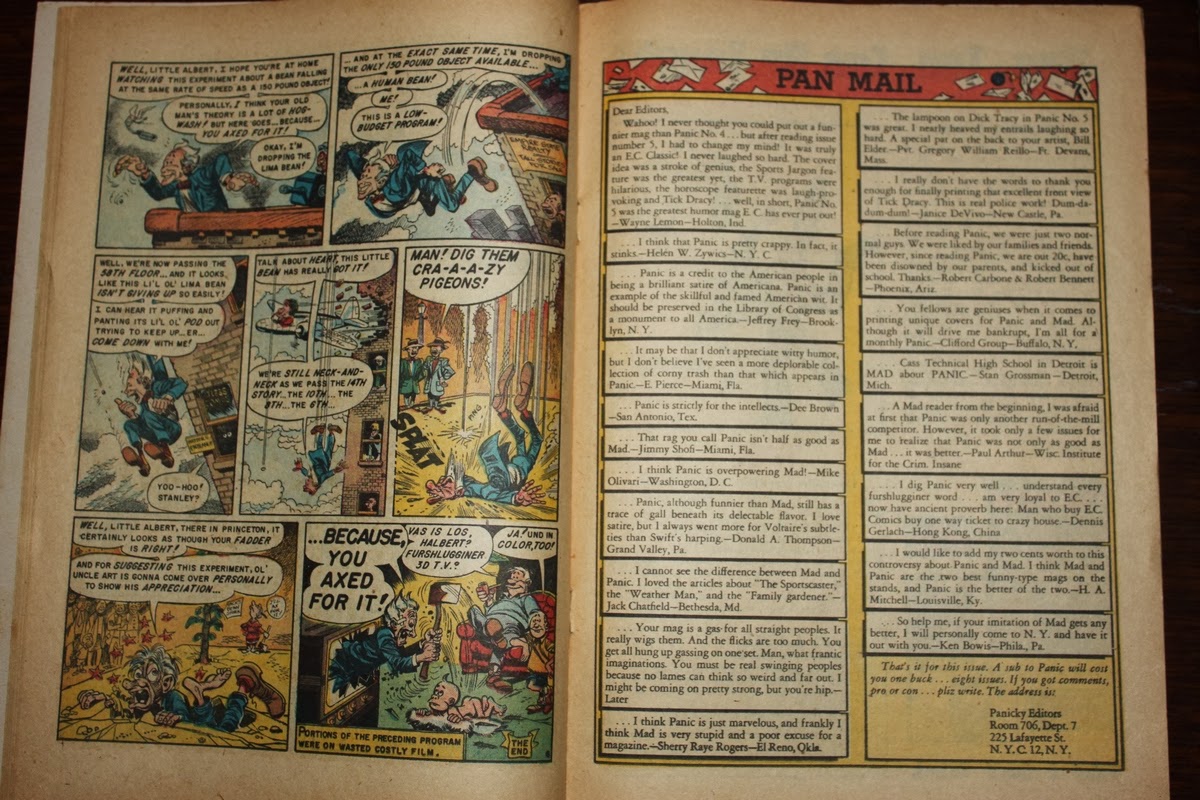
Everyone thinks Marvel was the first publisher to connect with the fans. How wrong those people are! EC was adept at making (and keeping) a connection with its fans. The editors printed fan mail, and they bragged about the men who were writing and illustrating the stories that the fans kept coming back to read.

The average American is introduced to Jewish and Yiddish humor. Nobody did that better than the guys writing MAD and PANIC.

Saturday, November 19, 2011

Adventures on Ebay

I landed a copy of Panic #10 via Ebay. This was the first comic I purchased since a crooked dealer tried to rip me off there. I had bought three copies of Panic from a fellow I will leave unnamed for now. The books had been graded at "VG", which means very good. When the books arrived they were flaking, coming apart, two of them had detached covers, and the one that still had its cover attached was because the spine was heavily taped. I, of course, immediately demanded a refund which he did not want to grant. Hilarity ensued.


I have to say that Ebay was really good during this minor tussle. They demanded that the dealer in question refund my money and they even took a portion of it from him and added it back to my Paypal account, the remainder to be refunded as soon as I returned the worthless books, which I did.


This latest issue I got (from a more reputable dealer) is classic Harvey Kurtzman material. I will assume that he did the layouts. Much of the material seems to have his hand in evidence. But the bulk of the book was illustrated by Will Elder and Jack Davis, both of whom did their usual exceptional work. Davis, in particular shows his talent, but I have to think that Elder was filing off the edges of his art here--I think that while Kurtzman and Gaines intended Panic to be pretty much a carbon-copy of Mad, they were making some minor moves to tone down the harsher aspects of the humor of Mad in favor of appealing to a wider audience...or at least a slightly different audience. Unlike Mad, the last few issues of Panic received the Comics Code Authority approval. But obviously the sales were not up to Mad's level and the title was snuffed out.

PANIC #10.

Sunday, October 23, 2011

PANIC #8

You know the old saying about how imitation is the sincerest form of flattery.

In comic books, however, that flattery was picking the pockets of someone else. In some cases it led to lawsuits and the destruction of the flattering entity. National Periodicals (DC) sued Fawcett over their Capt. Marvel (which had outstripped Superman in popularity and sales) and thus Fawcett was undone and it can be argued that superhero comics almost went away with the destruction of Billy Batson and his alter-ego.

Whenever one comic book publisher came up with a popular idea, there were always at least a few other publishers around ready, willing, and able to try to rip off that idea. When Harvey Kurtzman's MAD hit the stands it was an enormous sales success. In fact, Mad Magazine outlived its parent company and went on to spawn one of the highest selling publications in the world, and a couple of TV series.

And so it was that in this case other publishers fell all over themselves trying to ape Kurtzman's vision of the humor comic book. Most of those imitations fell flat, of course, but the threat was very much there and Bill Gaines and company figured that if someone was going to imitate MAD, then it might as well be the guys who were already publishing the original! Thus, was PANIC born.

PANIC lasted for twelve issues and was, in almost all ways, MAD with just a different title. It sported the same writers, same artists, same feel. If you pick up and read an issue of PANIC you wouldn't know you weren't reading MAD unless you looked at the cover title. And that's what they wanted. When you pick your own pocket the money ends up in the same place.

I've never read or heard what sales of PANIC were like, but they must have been decent for the title to have lasted as long as it did. The only thing that killed it off was the demise of EC as a comic book publisher. When William Gaines decided to leave comics and move strictly to the magazine format (thus escaping the Comics Code Authority), he allowed PANIC to be almost totally forgotten and vanish with his small raft of other Comic Code approved titles such as INCREDIBLE SCIENCE FICTION, PIRACY, VALOR, ACES HIGH, etc.

One of the main reasons for the existence of the Comics Code Authority in those days was to put EC Comics out of business. In this, they succeeded. Of course they ended up creating the single most profitable independently owned publication on Earth, but that's beside the point. the Code put EC down for the count, and that has to be one of the greatest crimes ever committed in the sad history of comic book publishing.

PANIC #8. Yeah, I'm buying old comics again. Newest addition to the collection. Here was Kurtzman and his team putting Jewish humor into the hands of every good little boy and girl. (Who are we kidding? It was almost all boys.)

Modern readers have pretty much no idea at all what the popularity of newspaper comic strips was once like. The American people once adored the funny papers. A popular strip could become a cultural phenomenon. The influence of a popular newspaper comic could not be underestimated. And once upon a time one of the most popular strips was ALLEY OOP. Here, Kurtzman and his band of humorists parody the caveman, Alley Oop. (Strangely--to me, a least--although Alley Oop had been around since 1939, the strip enjoyed its greatest popularity in the 1950s and early 1960s.)

Joe Orlando's humor. Quite different from his more dramatic work at EC, but still effective.

And the great Wally Wood lends his talent to skewering GONE WITH THE WIND.

Saturday, September 24, 2011

Maddening Comic Books

As I mentioned in an earlier post, I'll be taking a short break from collecting comics to concentrate on my writing. I've found that the hobby has been getting in the way just a bit with my fiction work. This particular book will be the last back issue that I'll purchase until probably some time in November when I should be done with a couple of writing projects.

I do like to purchase a Golden Age comic book now and again. They're sometimes far too expensive for me to afford, so I buy them rarely, and only when I can get them at a bargain price. Years ago I had an impressive collection of early issues of MAD, the comic book precursor for what we now know as MAD MAGAZINE. The first 23 issues of the book were in comic format. It was part of the EC Comics stable, and by far the most popular and profitable book that William Gaines published. In fact, when Gaines was basically run out of the comic book business by the right wing insanity infecting the USA during the 1950s, he chose to circumvent the destructive Comics Code Authority by turning Mad into a magazine, thus exempting it from that restrictive body. He experimented briefly with the magazine format for a couple of other genres, but it was MAD that continued to sell in huge numbers and make him, eventually, the highest paid independent publisher in the country. In his way, he had the last laugh on his enemies in comics and in government, if by revenge one defines it as achieving the good life in spite of your enemies' best efforts.

When I was a dealer in old comics, I owned quite literally every single issue of the MAD comic book, including the iconic Mad #1. But currently this is the only issue of the original book that I have in my collection.

The tragedy of MAD is that it was created by Harvey Kurtzman. To my way of thinking, Kurtzman was perhaps the most talented comics artist ever to put pen to paper. He was the very rarest of talents in the world of comics, and I've struggled for years to note anyone who was his better. I've yet to find that artist.

MAD arose out of a pay dispute with Gaines. Kurtzman apparently chafed at the fact that his colleague at EC, Al Feldstein, made more than he did. When he voiced this to Gaines, his employer told him that if Kurtzman could produce a good humor comic then he'd raise Kurtzman's pay to match Feldstein's. (At the time, Feldstein was editing the horror and science-fiction titles while Kurtzman ran the war and adventure books.)

Well, then, that was a project for which Harvey Kurtzman was uniquely placed to create. Thus, MAD came into being. Packed with dangerous humor, the comic was an instant success. It sang. The comic hit at just the right time and impressed just the right audience to ensure that its sales were off the charts and its influence would be felt for decades. It was, from the beginning, a child of Harvey Kurtzman who did the heavy work for each of the comic's early issues.

From the very beginning, MAD was not only a success, but also cutting edge culture. It insinuated itself into the undercurrents of society that would soon make themselves felt in the looming counterculture that was about to raise its head in America.

And, of course, MAD eventually led to yet another in a very sad line of thefts of intellectual property. When Kurtzman demanded a 51% controlling interest in the comic, Gaines of course refused. And Kurtzman either left or was forced out, with the last remaining title of the once formidable EC Comics company being handed off from Kurtzman to Feldstein, the man whose salary had initially instigated the creation and production of the publication.

Kurtzman went on to attempt to duplicate the success of MAD with a number of other, similar concoction. But as so many have sadly learned, lightning generally strikes but once. In what had to be a truly painful turn of events, the comic genius who had created the happy monster of MAD MAGAZINE found himself, hat in hand, at the editorial door of his own creation, selling work to that publication as a freelancer in the twilight of his creative years.

This is the kind of classic parody that later got Kurtzman and Gaines into so much trouble. I mean, who would screw around with the Disney corporation? Why, a canny Jewish humorist named Harvey Kurtzman, that's who! And of course this one didn't get them into nearly as much trouble as "Starchie", the Kurtzman/Elder parody of Archie that apparently sent Archie's publisher, John L. Goldwater, into a frenzy that apparently began a warfare against EC.

Wednesday, September 07, 2011

Big If

As I've said before, I don't target many Golden Age comics for my collection. One of the main reasons is that it's becoming far too expensive to land books from that era of comic publishing. In a mad dash to find investments, the rich are heading into collectible comic books and some of the rare or even moderately difficult-to-find books are soaring in value.

However, now and again I'll find the right book in the right (generally lower) grade and price. So it was when I bid on this book. Actually, I was outbid but the fellow who beat me out never followed through, and so my lower bid ended up getting this book. This is the grade that I really like. Not too low that it's risky to handle it, and not too high so that I worry about lowering its value by actually reading it.

Ah, the smell of old pulp.

This title, FRONTLINE COMBAT was one of Harvey Kurtzman's babies. His stories are always impressive in every way. The panels are neat, compact, and each of them seems bursting with emotion. And this issue features one of his most famous stories, "Big If". The Korean War was raging as this book was being published, and this stuff was working its way under the political radar, because it's one of the best, and most effective anti-war stories ever. If I'd been a kid when this comic book appeared, it would have made me think long and hard about ever wanting to become a soldier. To think that this tale was published in the early 50s and not in the thick of some anti-war movement is impressive.

FRONTLINE COMBAT #5. A Classic Harvey Kurtzman cover!

I'm glad I got to meet Harvey Kurtzman. As with a lot of famous people I admire, I was more than a little afraid of meeting him. What the heck was I going to say? How would he react? After all, even as a young man I recognized that he was one of the best comic artist/writers ever to turn his hand to the art form. But I didn't have to worry. He turned out to be the nicest and friendliest guy I ever encountered at a comic show. It's funny that the most talented artist would turn out to be the nicest one of the bunch.

The opening page of "Big If". The most effective anti-war comic story I've ever read.

Friday, August 05, 2011

TWO-FISTED TALES!

I'm always hunting for bargains on cool, Golden Age comics. When I was a young man I had a really impressive EC comic book collection. For those of you who don't know about EC, it was the company owned by Bill Gaines who published Mad Magazine. Before he had Harvey Kurtzman create Mad for him (it started out as a comic book), he published comics. But he didn't just publish comic books. He published arguably the finest comic books ever created.

Gaines had a canny eye for talent and he intentionally went after the best comic artists in the business to work for him. You had to be something special to lay down the lines for EC. The artists who passed through its doors as employees is simply amazing. Jack Davis. Frank Frazetta. Al Williamson. Roy Krenkel. Bill Elder. Al Feldstein. Harvey Kurtzman. John Severin. Reed Crandall. George Evan. Wally Wood. Bernie Krigstein. Joe Orlando. Jack Kamen. Graham Ingels...
If you weren't among the finest, you didn't work at EC.

Years ago I sold off my EC books. The most I ever owned at any one time was 160 individual EC comics. But, like everything else that was collectible in those days, I sold. I was, after all, a retail merchant and that's what that stuff was to me. Product to be moved out, generally as quickly as possible. The ECs I managed to hold onto for some years, but they went out the door. It didn't take very long to sell them all.

These days I pick them up from time to time when the right deal comes my way. This past week I managed to grab a couple of issues of TWO-FISTED TALES. TWO-FISTED was an adventure comic, often with true stories featuring interpretations of actual events. John Severin did the lion's share of the cover art and seemed to have a story in almost every issue. It was his kind of book. That was something else about Gaines and his editors--they knew what kind of story fit a particular artist.

Alas, EC was killed off by the right wing madness that swept the USA during the 1950s. It was deemed that comic books were dangerous stuff for kids, leading them to become delinquents, drug addicts, and communists. So the kind of story that EC published--stories that pushed envelopes and crashed through barriers--couldn't be done there anymore, so Gaines sadly pulled the plug on his comic book empire, banking his publishing future entirely on one title--MAD MAGAZINE, which went to magazine format to circumvent the Comics Code Authority that had emasculated his other books.

So. Here are two old EC comics that I was able to grab for my personal collection. Nice books!

TWO-FISTED TALES #36.

TWO-FISTED TALES #37.

Wednesday, June 15, 2011

New Old Comics

Here are a few new additions to the growing comic collection:

I managed to get a really nice condition copy of TUROK #18, which has a nifty and effective T-rex cover, and Turok wrestling a primitive caveman who is after his technologically superior weaponry.

I don't buy many Golden Age comics. When I do, I tend to stick to things like Disney books and work by Walt Kelly. But every once in a while I'll purchase an EC comic, if the price is right. This copy of FRONTLINE COMBAT #9 was in lower grade and I got it really cheap. It's in nice enough condition for me to read and it's packed with what you expect from EC--great artwork by some of the best artists ever to work in the industry, along with stellar writing from the likes of Harvey Kurtzman and company. This cover was by Mr. Kurtzman, who was probably the nicest comic book professional I ever met. Marvel had its house of ideas inside Jack Kirby's head. EC had its greatest achievements from the mind of Harvey Kurtzman.

Finally, I completed my collection of the Ditko run of BLUE BEETLE from Charlton Comics. This pair of books are in about very good condition, much lower than the other ones I landed. But good enough for me, since I read my books. It's nice to see what Ditko was doing once he'd left Marvel and was working for Charlton, for DC, and for Warren Publications (and others). His artwork was as good (in some cases better) as his Marvel efforts, but the lack of a keen editorial hand weakened his plotting and Lee's hip dialog is almost always missed.

BLUE BEETLE #2. Ditko pencils, but it doesn't look as if he inked his own work here.