Showing posts with label Mad. Show all posts

Friday, December 06, 2013

Sincerest

Flattery be damned. In 1954-55, the hottest comic on the newsstands was MAD, from EC Comics. Almost everyone publishing comics books wanted to imitate it. And the ones who didn't want to imitate it, wanted to kill it off.

But I'm not here to talk about any of the villains who wanted to destroy MAD. I want to mention what EC Comics did to protect their extremely profitable spot on those newsstands. Since almost every publisher was trying like mad to imitate MAD, Bill Gaines and company just decided that the best thing to do was...imitate MAD!

If someone was going to steal some of their sales numbers, it might as well be themselves.

So what they did was create a companion book called PANIC. It had the same writers, the same artists, the same publisher, the same Jewish sense of humor. How could it miss? And the thing was, of course, to kill off the weakest of the imitators by causing the fans to buy PANIC instead of CRAZY or GET LOST! or FLIP or CRACKED or MADHOUSE or WHACK or EH! or...you get the picture. The imitators were out there in droves. Some of them were pretty good, too.

I haven't been concentrating on completing a set of PANIC, but I pick up copies when I see them at a good price. Despite the fact that they are, in essence, exactly the same thing as MAD from exactly the same creators at exactly the same publishing house, you can get these books for a LOT less than you can issues of MAD from the same period.

The last copy I picked up was #7. Sometimes the covers of both MAD and PANIC were kind of bland or uninspiring to me. Such is the case with this issue. But there was something about these special joke covers that seem bland to look upon that inspired the kids of the day to buy the darned things. I reckon they knew what they were doing.

Some day I need to write an essay of how Harvey Kurtzman was fucked out of his position at MAD. It was his baby all the way, and it ended up making the publisher, Bill Gaines, one of the richest men in comics. But for now I'll leave that where it is and save it for another time.

PANIC #7


An ad for MAD from Kurtzman and Elder.

Just as with MAD, much of the humor in PANIC was topical. Most people today have absolutely no idea who Joe Palooka was. Palooka is just a word they heard in PULP FICTION. But it was prime material for parody in 1955.

Jack Davis, one of the most popular comedy artists at EC.

THEM was a hot commodity and still new to the screens. Wally Wood has a go at it.

Wally Wood was a great caricaturist and nobody did women like Woody.


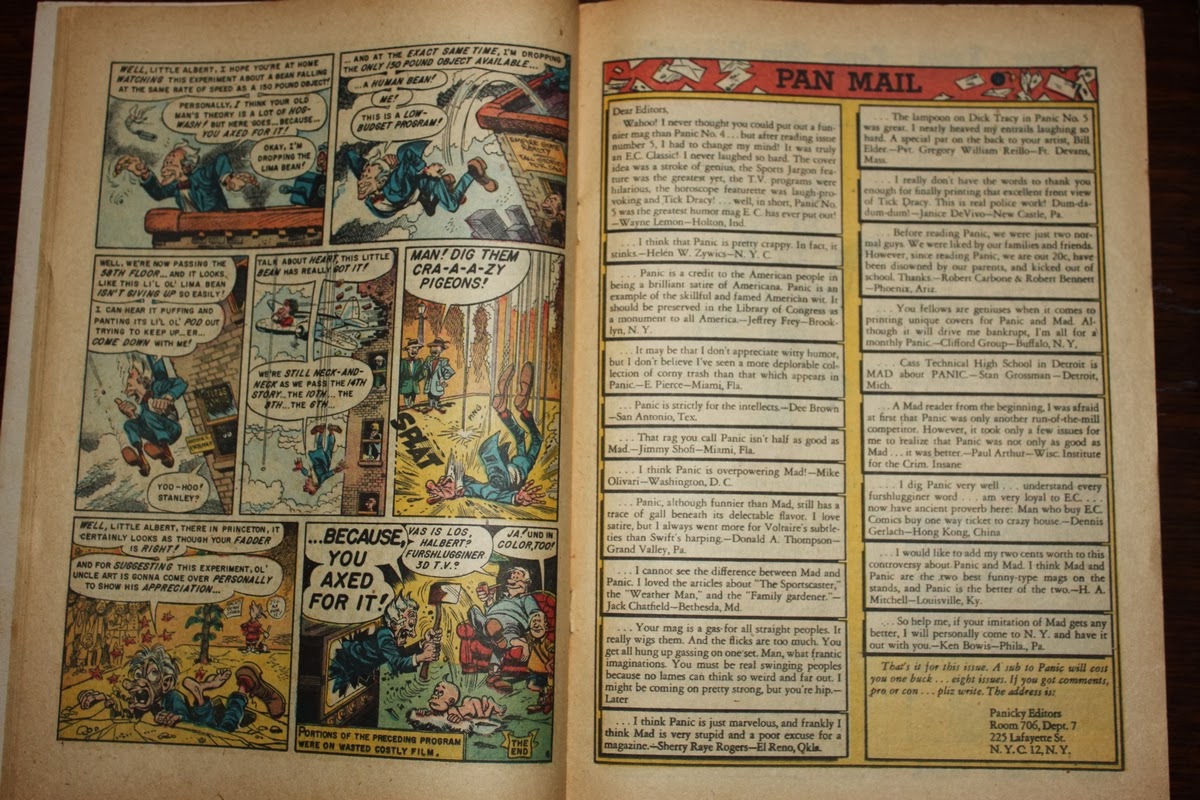
Everyone thinks Marvel was the first publisher to connect with the fans. How wrong those people are! EC was adept at making (and keeping) a connection with its fans. The editors printed fan mail, and they bragged about the men who were writing and illustrating the stories that the fans kept coming back to read.

The average American is introduced to Jewish and Yiddish humor. Nobody did that better than the guys writing MAD and PANIC.

Saturday, November 19, 2011

Adventures on Ebay

I landed a copy of Panic #10 via Ebay. This was the first comic I purchased since a crooked dealer tried to rip me off there. I had bought three copies of Panic from a fellow I will leave unnamed for now. The books had been graded at "VG", which means very good. When the books arrived they were flaking, coming apart, two of them had detached covers, and the one that still had its cover attached was because the spine was heavily taped. I, of course, immediately demanded a refund which he did not want to grant. Hilarity ensued.


I have to say that Ebay was really good during this minor tussle. They demanded that the dealer in question refund my money and they even took a portion of it from him and added it back to my Paypal account, the remainder to be refunded as soon as I returned the worthless books, which I did.


This latest issue I got (from a more reputable dealer) is classic Harvey Kurtzman material. I will assume that he did the layouts. Much of the material seems to have his hand in evidence. But the bulk of the book was illustrated by Will Elder and Jack Davis, both of whom did their usual exceptional work. Davis, in particular shows his talent, but I have to think that Elder was filing off the edges of his art here--I think that while Kurtzman and Gaines intended Panic to be pretty much a carbon-copy of Mad, they were making some minor moves to tone down the harsher aspects of the humor of Mad in favor of appealing to a wider audience...or at least a slightly different audience. Unlike Mad, the last few issues of Panic received the Comics Code Authority approval. But obviously the sales were not up to Mad's level and the title was snuffed out.

PANIC #10.

Saturday, September 24, 2011

Maddening Comic Books

As I mentioned in an earlier post, I'll be taking a short break from collecting comics to concentrate on my writing. I've found that the hobby has been getting in the way just a bit with my fiction work. This particular book will be the last back issue that I'll purchase until probably some time in November when I should be done with a couple of writing projects.

I do like to purchase a Golden Age comic book now and again. They're sometimes far too expensive for me to afford, so I buy them rarely, and only when I can get them at a bargain price. Years ago I had an impressive collection of early issues of MAD, the comic book precursor for what we now know as MAD MAGAZINE. The first 23 issues of the book were in comic format. It was part of the EC Comics stable, and by far the most popular and profitable book that William Gaines published. In fact, when Gaines was basically run out of the comic book business by the right wing insanity infecting the USA during the 1950s, he chose to circumvent the destructive Comics Code Authority by turning Mad into a magazine, thus exempting it from that restrictive body. He experimented briefly with the magazine format for a couple of other genres, but it was MAD that continued to sell in huge numbers and make him, eventually, the highest paid independent publisher in the country. In his way, he had the last laugh on his enemies in comics and in government, if by revenge one defines it as achieving the good life in spite of your enemies' best efforts.

When I was a dealer in old comics, I owned quite literally every single issue of the MAD comic book, including the iconic Mad #1. But currently this is the only issue of the original book that I have in my collection.

The tragedy of MAD is that it was created by Harvey Kurtzman. To my way of thinking, Kurtzman was perhaps the most talented comics artist ever to put pen to paper. He was the very rarest of talents in the world of comics, and I've struggled for years to note anyone who was his better. I've yet to find that artist.

MAD arose out of a pay dispute with Gaines. Kurtzman apparently chafed at the fact that his colleague at EC, Al Feldstein, made more than he did. When he voiced this to Gaines, his employer told him that if Kurtzman could produce a good humor comic then he'd raise Kurtzman's pay to match Feldstein's. (At the time, Feldstein was editing the horror and science-fiction titles while Kurtzman ran the war and adventure books.)

Well, then, that was a project for which Harvey Kurtzman was uniquely placed to create. Thus, MAD came into being. Packed with dangerous humor, the comic was an instant success. It sang. The comic hit at just the right time and impressed just the right audience to ensure that its sales were off the charts and its influence would be felt for decades. It was, from the beginning, a child of Harvey Kurtzman who did the heavy work for each of the comic's early issues.

From the very beginning, MAD was not only a success, but also cutting edge culture. It insinuated itself into the undercurrents of society that would soon make themselves felt in the looming counterculture that was about to raise its head in America.

And, of course, MAD eventually led to yet another in a very sad line of thefts of intellectual property. When Kurtzman demanded a 51% controlling interest in the comic, Gaines of course refused. And Kurtzman either left or was forced out, with the last remaining title of the once formidable EC Comics company being handed off from Kurtzman to Feldstein, the man whose salary had initially instigated the creation and production of the publication.

Kurtzman went on to attempt to duplicate the success of MAD with a number of other, similar concoction. But as so many have sadly learned, lightning generally strikes but once. In what had to be a truly painful turn of events, the comic genius who had created the happy monster of MAD MAGAZINE found himself, hat in hand, at the editorial door of his own creation, selling work to that publication as a freelancer in the twilight of his creative years.

This is the kind of classic parody that later got Kurtzman and Gaines into so much trouble. I mean, who would screw around with the Disney corporation? Why, a canny Jewish humorist named Harvey Kurtzman, that's who! And of course this one didn't get them into nearly as much trouble as "Starchie", the Kurtzman/Elder parody of Archie that apparently sent Archie's publisher, John L. Goldwater, into a frenzy that apparently began a warfare against EC.