Showing posts with label EC Comics. Show all posts

Friday, March 22, 2019

Krigstein

Today I happened upon the only photograph I have ever seen of Bernard (Bernie) Krigstein. He was one of the most talented artists who ever worked in the US comics field. To my way of thinking, he was easily the most skilled pure artist who published in the format of four-color, periodical American comic books.

In many ways, Krigstein was too good for the industry. I say that not to make light of the art form we call comic books, but to separate the vision of comics books that Krigstein seemed to have from that of the other artists who toiled in creating sequential art.

The first time I ever saw his work was in a coverless EC comic book I happened upon while digging through the giant stacks of old comics in one of my dad's used bookstores. I recall Jim Steranko was really popular at the time, so it must have been around 1966 or 1967. Maybe as late as 1968. The story dealt with an indigenous South American Indian who took revenge on his white employer who had unknowingly killed the Indian's parents. The afflicted man took his revenge by placing a school of ravenous piranha in his master's bath--the fish eating the evil man from the waist down.

This was powerful stuff for a kid of nine or ten years old to see--from a comic that was then only fourteen or fifteen years old. If I'd known such stuff had been banned by the Comics Code Authority, I'd have cursed them. The story was brilliantly illustrated and the moral of it must have appealed in some way to Krigstein who had--I later discovered--tried to form a union for comic book artists in the very early 50s.

He ended up working mainly for EC Comics--specifically for William Gaines, because Gaines paid the very highest rates among the then many comic book publishers. And those page rates showed in the stunning quality of the work his stable of artists turned in for the various suspense, crime, horror, and science fiction titles that Gaines published.

The next time I stumbled upon a Krigstein story was his work "The Master Race", in a copy of IMPACT #1, also in my dad's vast inventory of old comics. That one impressed me even more than the piranha yarn. Here I was as a kid, seeing what is probably still likely the most brilliant visually conceived comics story I have encountered. If anyone has done anything close to it for sheer power and brilliance I have not seen it.

Krigstein's comic book career didn't seem to last very far beyond the demise of EC Comics (shut down by the Comics Code limitations). He drifted off into more traditional artistic venues and rarely seemed to look back.

At any rate, here is the photo of Mr. Krigstein who so impressed me when I was still a very little kid. It's fitting that he had such striking features. He was almost like one of the distinctive Asian characters that he lovingly illustrated from time to time.


Bernard Krigstein.

Wednesday, December 31, 2014

PIRACY #3, #4.

I picked up two more EC books for my collection: PIRACY #3 and PIRACY #4. They are part of Bill Gaines' failed effort to keep EC afloat as a comic book company after the comic book scare of the 1950s that all but killed the industry. And looking at these books I'm reminded once again how the Comics Code and its insane backers robbed us of the finest comic book publisher of the day.

Both of these covers are by artist Reed Crandall. Crandall was noted for amazing line work and attention to fine detail. He was considered one of the best artists around in the Golden Age and it was likely only the high page rates that Gaines offered his employees that enabled Crandall to be able to lavish the attention he needed to create his lush pages.

Gaines was keeping his stable of great artists busy for the year or so that he tried to change direction on his radical imprint. But it just was not to be. Not when he had MAD under his wing and which he was able to switch to magazine format to merely escape the pernicious Comics Code Authority.

Alas.

PIRACY #3 with a gorgeous Reed Crandall cover.

PIRACY #4 with another spectacular Crandall cover.

Thursday, December 04, 2014

EC Additions

After the comic book red-scare frenzy of the middle 1950s, the Comics Code Authority was put in place and this pulled the teeth from a large portion of creativity in the comics industry. The Code was promoted most loudly and most diligently by John L. Goldwater, the owner of Archie Comics. It was a personal mission of this right wing bastard, and his way of doing his best to put EC Comics out of business. He never forgave them for the "Starchie" parody that Harvey Kurtzman and Will Elder produced for an early issue of MAD.

The limitations of the Code seemed obviously worded to shut down EC, which was easily the finest producer of comics the industry has ever seen. No more horror. No more ground-breaking science-fiction stories. No more violence. No more sex. No more bad guys getting away with their crimes. These were the things that had made EC popular with the readers, and without the ability to speak freely and illustrate freely, the company was likely doomed.

William Gaines, the owner, had two choices. Adapt, or perish. He chose initially to try to steer the company in a tamer lane with his "New Direction" line of comics. The artists were largely the same. Gaines paid the highest rates in the industry for story and art, and he only employed the greatest comics artists who were available. The New Direction titles continued this tradition of excellence.

But...the edge was gone. There was no danger to the stories. No bite. The things that the fan base had come to expect from EC were missing, and they failed to support the company's new titles.

The best selling title Gaines had was MAD. He chose to transform that one into a magazine to escape the Comics Code (a brilliant move). That saved that one title and eventually made Gaines the highest paid publisher on Earth. But he was forced to kill off all of the New Direction books, and thus died the finest comics company that ever saw the light of print.

I picked up a couple of New Direction books this week (PIRACY). Gorgeous artwork. The stories are good, but nothing like the yarns from the days before the hated Comics Code. Alas.

A work of brilliance from Bernie Krigstein. Krigstein was one of the best artists ever to turn his hand to comic books and sequential art. He is  also arguably the closest the industry ever got to fine art. At one point he tried to unionize comic book artists and writers, but failed. Eventually, he was forced from the comics industry.

The last issue of PIRACY. Cover by George Evans.

Monday, October 20, 2014

Comic Collection Additions.

I haven't had much time to devote to my comic collecting hobby lately. In fact, I've had quite a dry period for that because of my workload. I've been way too busy to work on the collection very much.

But I have picked up a couple of comics recently.

Adding to my early Marvel collection I grabbed a copy of STRANGE TALES #112. Jack Kirby cover. One of my pals has made the pitch that if the cover for these early superhero stories was by Kirby, then he likely did the plot also. He'd hand in the art for the cover along with the plot. Of course the plot would later be credited to a certain asshole editor who wrote nothing and created nothing and who slapped his name on everything to pad his paycheck and to ensure that the company retained copyright.

This issue has a story illustrated by Dick Ayers. When I was a kid I never liked any of the Human Torch stories that Ayers illustrated. There was something in those days that I found crude about his art style and I always found it an effort to read any story that he illustrated. Of course now I have a greater appreciation for him, but there's always that nagging memory of my childhood feelings coloring my opinion of his work.

The story dialog is credited to someone named "Joe Carter". I didn't know who this was, so I asked around on the Internet about him, and was informed that Mr. Carter was, in fact, Jerry Siegel, one half of the creative team who gave us Superman. In the early 60s he was still writing for the industry and he did the dialog on a number of these Human Torch yarns.

There's also a good Steve Ditko science-fiction story in the mix. All through the first few years of the superhero renaissance at Marvel there was a backlog of science-fiction and monster stories written and illustrated by the likes of Jack Kirby, Steve Ditko, Don Heck, Paul Reinman, and the rest of the Marvel bullpen in those days. So Marvel would pad the issues out with these unpublished stories that had already been commissioned and paid for. It's actually for these monster stories mainly by Kirby and Ditko that I started collecting comics again.

STRANGE TALES #112.

Another book that I picked up was an EC. I don't focus on collecting Golden Age comics, but I do enjoy buying EC books now and again. I've bought a number of them this year, and this one was a real find. It's in decent shape and is currently the oldest EC comic that I own, published in 1950. It's #16, but is in reality #2 of the title. It used the numbering from a previous title and after #17 the numbering started with #4. So there are actually two "#15 through #17", which can be confusing.

Owning this book, I'm reminded why EC is considered as having the highest quality stories and artwork of any mainstream comic book publisher in the history of the format. I hope to keep buying ECs over the next few years.

HAUNT OF FEAR #16 (actually #2) with a great Johnny Craig cover.

Friday, August 22, 2014

Some New Golden Age Comics

As I've talked about in the past, my main passion as far as collecting comics are Silver Age titles. Specifically those containing art and stories by Steve Ditko and Jack Kirby. But sometimes I'll land some Golden Age titles for my collection. Especially if the contents are of especially high quality of art and fiction.

And the quality doesn't get any higher than titles from the late EC Comics. At its head was William C. Gaines, whose mission it obviously must have been to publish the finest art in comics at that time. The names of the men and women he employed to work for him have become legend. So I look for EC books to add to my collection when I can find them at the right price.

So it was this week. The latest old comics to arrive as Casa Smith.

CRIME SUSPENSTORIES #2. Back in my youth, I had an extensive EC collection. But most of those were horror and science-fiction titles. I never had many copies of this title, and most of those were later issues.

CRIME SUSPENSTORIES #5. A great, dramatic cover from Johnny Craig.

Another image of high drama from Craig. When the Silver Age rolled around, he worked for a time at Marvel Comics, mainly as an inker.

Friday, December 06, 2013

Sincerest

Flattery be damned. In 1954-55, the hottest comic on the newsstands was MAD, from EC Comics. Almost everyone publishing comics books wanted to imitate it. And the ones who didn't want to imitate it, wanted to kill it off.

But I'm not here to talk about any of the villains who wanted to destroy MAD. I want to mention what EC Comics did to protect their extremely profitable spot on those newsstands. Since almost every publisher was trying like mad to imitate MAD, Bill Gaines and company just decided that the best thing to do was...imitate MAD!

If someone was going to steal some of their sales numbers, it might as well be themselves.

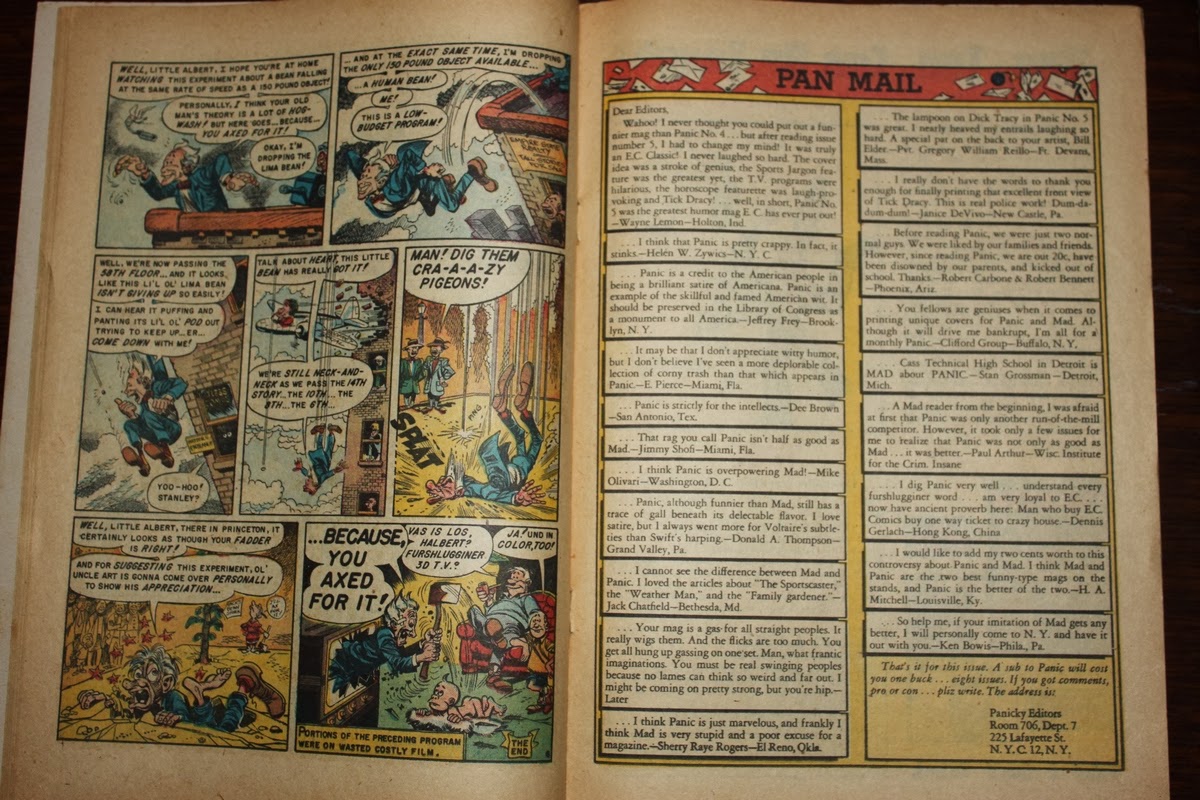
So what they did was create a companion book called PANIC. It had the same writers, the same artists, the same publisher, the same Jewish sense of humor. How could it miss? And the thing was, of course, to kill off the weakest of the imitators by causing the fans to buy PANIC instead of CRAZY or GET LOST! or FLIP or CRACKED or MADHOUSE or WHACK or EH! or...you get the picture. The imitators were out there in droves. Some of them were pretty good, too.

I haven't been concentrating on completing a set of PANIC, but I pick up copies when I see them at a good price. Despite the fact that they are, in essence, exactly the same thing as MAD from exactly the same creators at exactly the same publishing house, you can get these books for a LOT less than you can issues of MAD from the same period.

The last copy I picked up was #7. Sometimes the covers of both MAD and PANIC were kind of bland or uninspiring to me. Such is the case with this issue. But there was something about these special joke covers that seem bland to look upon that inspired the kids of the day to buy the darned things. I reckon they knew what they were doing.

Some day I need to write an essay of how Harvey Kurtzman was fucked out of his position at MAD. It was his baby all the way, and it ended up making the publisher, Bill Gaines, one of the richest men in comics. But for now I'll leave that where it is and save it for another time.

PANIC #7


An ad for MAD from Kurtzman and Elder.

Just as with MAD, much of the humor in PANIC was topical. Most people today have absolutely no idea who Joe Palooka was. Palooka is just a word they heard in PULP FICTION. But it was prime material for parody in 1955.

Jack Davis, one of the most popular comedy artists at EC.

THEM was a hot commodity and still new to the screens. Wally Wood has a go at it.

Wally Wood was a great caricaturist and nobody did women like Woody.


Everyone thinks Marvel was the first publisher to connect with the fans. How wrong those people are! EC was adept at making (and keeping) a connection with its fans. The editors printed fan mail, and they bragged about the men who were writing and illustrating the stories that the fans kept coming back to read.

The average American is introduced to Jewish and Yiddish humor. Nobody did that better than the guys writing MAD and PANIC.

Monday, December 24, 2012

EXTRA! EC Tries to Survive!

There needs to be several volumes of a good and comprehensive history of EC Comics. It probably produced the finest quality comic stories of any commercial publisher the business ever had. Fronted by William Gaines, he led a small number of fine editors who assembled the best artists and writers who were then floating around the industry. The reputation of the company is today legendary. Indeed, the reputation of the company in its finest days was also legendary...but not in a good way.

For EC was infamous in the eyes of the mundane public. It was singled out for a number of reasons and by a number of sources as one of the worst influences on then-modern American youth. Attacks from all sides eventually succeeded in taking the company to its knees, and it only survived by reducing itself to a single title and by fleeing the comic book format and going to magazine format as Mad Magazine. The move eventually made Gaines the single most wealthy publisher in the US. But the rest of the company faded away and became the legend.

For a brief time after the forces of evil had beaten down the comics industry, EC tried several methods to cooperate with the newly-formed Comics Code Authority and to circumvent the Authority. Gaines and his editors produced a line of more family-friendly comics, while at the same time moving a few titles to magazine size and avoiding the Code entirely. However, despite a few heroic efforts, the new lines failed. The fans who had so adored the gritty, cutting stories EC had provided just did not appreciate the pablum the company was reduced to offering, and those fans abandoned EC.

Today I got one of these later efforts by the publisher to try to spark the same electrical charge they'd generated with titles like TALES FROM THE CRYPT, and HAUNT OF FEAR, and WEIRD SCIENCE-FANTASY, etc. These new ones, though, were pedestrian books with no shock endings and almost no violence and not really much in the way of tension. The titles, while a noble effort, failed.

EXTRA was just such a comic book. It featured stories about investigative reporters digging to find the answers to crooked deals and violent crimes (which are never shown, or referred to in the mildest of terminology). Gone was the gore of the old EC. Vanished was the sarcasm and the tone of fatal irony. EC's bosses tried, but they failed. And their enemies laughed. Having cut off their own noses, they laughed.

My copy of EXTRA #3, cover art by the great Johnny Craig.

Tuesday, August 14, 2012

VALOR #3

I picked up this low-grade copy of VALOR #3. This was during the abbreviated attempt by EC to conform to the Comics Code Authority, which effectively killed off the company. Without being able to create the visually and intellectually dangerous comics that had defined the company their sales suffered. They escaped the Comics Code by transforming MAD into a magazine and that kept the company afloat for decades, although they published nothing else but MAD.

Great cover by Joe Orlando.

Sunday, August 12, 2012

TWO-FISTED TALES #37

I added another couple of EC comics to my collection this week. This is the better of the pair, TWO-FISTED TALES #37. This book is John Severin from start to finish. The cover art is by Severin and all three stories in the book are his, too. This was John Severin territory, after all, adventure and gun-play.

My copy of Two-Fisted Tales #37. My EC collection is growing.

Thursday, July 26, 2012

FRONTLINE COMBAT #14

I just got another old EC for my collection. This one is FRONTLINE COMBAT #14 with a cover and first interior story illustrated by Wally Wood. Also in this issue is a great Civil War yarn drawn by Jack Davis. I was surprised to see a story by Joe Kubert in here. He certainly was someone who would have fit right in at EC, but I don't recall seeing his work in any of the EC books I've owned in the past. And there's a beautifully drawn WWI story by George Evans who excelled at illustrating tales of the flying aces.

Nice Wally Wood cover. A bit of a departure from his regular style.

Saturday, July 21, 2012

BATTLE-GROUND

Battle-Ground was an Atlas war title (obviously). I bought this copy for the Russ Heath cover. Heath is one of the best comic artists who worked the industry, in my opinion, and is well known for his work on various war stories. He was a long-time artist on the Sgt. Rock series at DC.

This issue came out in 1954. Occasionally Goodman and Lee would land art from the EC artists. I'm not sure, but I think this issue came out around the time EC was having trouble from HUAC. During the time just before and just after EC's titles ceased publication (save for MAD which became a magazine to avoid the Comics Code Authority), many of the EC artists showed up doing work for Atlas. Of course some could not remain there because Atlas just didn't pay the rates they were accustomed to making at EC, which were among the highest in the industry.

But from time to time you'd see Jack Davis, John Severin, and even Bernard Krigstein showing up to produce stories for Goodman and Lee.

I was surprised at the quality of work in this issue of BATTLE-GROUND. I may end up having to purchase some more of these Atlas war comics.


Saturday, November 19, 2011

Adventures on Ebay

I landed a copy of Panic #10 via Ebay. This was the first comic I purchased since a crooked dealer tried to rip me off there. I had bought three copies of Panic from a fellow I will leave unnamed for now. The books had been graded at "VG", which means very good. When the books arrived they were flaking, coming apart, two of them had detached covers, and the one that still had its cover attached was because the spine was heavily taped. I, of course, immediately demanded a refund which he did not want to grant. Hilarity ensued.


I have to say that Ebay was really good during this minor tussle. They demanded that the dealer in question refund my money and they even took a portion of it from him and added it back to my Paypal account, the remainder to be refunded as soon as I returned the worthless books, which I did.


This latest issue I got (from a more reputable dealer) is classic Harvey Kurtzman material. I will assume that he did the layouts. Much of the material seems to have his hand in evidence. But the bulk of the book was illustrated by Will Elder and Jack Davis, both of whom did their usual exceptional work. Davis, in particular shows his talent, but I have to think that Elder was filing off the edges of his art here--I think that while Kurtzman and Gaines intended Panic to be pretty much a carbon-copy of Mad, they were making some minor moves to tone down the harsher aspects of the humor of Mad in favor of appealing to a wider audience...or at least a slightly different audience. Unlike Mad, the last few issues of Panic received the Comics Code Authority approval. But obviously the sales were not up to Mad's level and the title was snuffed out.

PANIC #10.

Wednesday, September 07, 2011

Big If

As I've said before, I don't target many Golden Age comics for my collection. One of the main reasons is that it's becoming far too expensive to land books from that era of comic publishing. In a mad dash to find investments, the rich are heading into collectible comic books and some of the rare or even moderately difficult-to-find books are soaring in value.

However, now and again I'll find the right book in the right (generally lower) grade and price. So it was when I bid on this book. Actually, I was outbid but the fellow who beat me out never followed through, and so my lower bid ended up getting this book. This is the grade that I really like. Not too low that it's risky to handle it, and not too high so that I worry about lowering its value by actually reading it.

Ah, the smell of old pulp.

This title, FRONTLINE COMBAT was one of Harvey Kurtzman's babies. His stories are always impressive in every way. The panels are neat, compact, and each of them seems bursting with emotion. And this issue features one of his most famous stories, "Big If". The Korean War was raging as this book was being published, and this stuff was working its way under the political radar, because it's one of the best, and most effective anti-war stories ever. If I'd been a kid when this comic book appeared, it would have made me think long and hard about ever wanting to become a soldier. To think that this tale was published in the early 50s and not in the thick of some anti-war movement is impressive.

FRONTLINE COMBAT #5. A Classic Harvey Kurtzman cover!

I'm glad I got to meet Harvey Kurtzman. As with a lot of famous people I admire, I was more than a little afraid of meeting him. What the heck was I going to say? How would he react? After all, even as a young man I recognized that he was one of the best comic artist/writers ever to turn his hand to the art form. But I didn't have to worry. He turned out to be the nicest and friendliest guy I ever encountered at a comic show. It's funny that the most talented artist would turn out to be the nicest one of the bunch.

The opening page of "Big If". The most effective anti-war comic story I've ever read.

Friday, August 05, 2011

TWO-FISTED TALES!

I'm always hunting for bargains on cool, Golden Age comics. When I was a young man I had a really impressive EC comic book collection. For those of you who don't know about EC, it was the company owned by Bill Gaines who published Mad Magazine. Before he had Harvey Kurtzman create Mad for him (it started out as a comic book), he published comics. But he didn't just publish comic books. He published arguably the finest comic books ever created.

Gaines had a canny eye for talent and he intentionally went after the best comic artists in the business to work for him. You had to be something special to lay down the lines for EC. The artists who passed through its doors as employees is simply amazing. Jack Davis. Frank Frazetta. Al Williamson. Roy Krenkel. Bill Elder. Al Feldstein. Harvey Kurtzman. John Severin. Reed Crandall. George Evan. Wally Wood. Bernie Krigstein. Joe Orlando. Jack Kamen. Graham Ingels...
If you weren't among the finest, you didn't work at EC.

Years ago I sold off my EC books. The most I ever owned at any one time was 160 individual EC comics. But, like everything else that was collectible in those days, I sold. I was, after all, a retail merchant and that's what that stuff was to me. Product to be moved out, generally as quickly as possible. The ECs I managed to hold onto for some years, but they went out the door. It didn't take very long to sell them all.

These days I pick them up from time to time when the right deal comes my way. This past week I managed to grab a couple of issues of TWO-FISTED TALES. TWO-FISTED was an adventure comic, often with true stories featuring interpretations of actual events. John Severin did the lion's share of the cover art and seemed to have a story in almost every issue. It was his kind of book. That was something else about Gaines and his editors--they knew what kind of story fit a particular artist.

Alas, EC was killed off by the right wing madness that swept the USA during the 1950s. It was deemed that comic books were dangerous stuff for kids, leading them to become delinquents, drug addicts, and communists. So the kind of story that EC published--stories that pushed envelopes and crashed through barriers--couldn't be done there anymore, so Gaines sadly pulled the plug on his comic book empire, banking his publishing future entirely on one title--MAD MAGAZINE, which went to magazine format to circumvent the Comics Code Authority that had emasculated his other books.

So. Here are two old EC comics that I was able to grab for my personal collection. Nice books!

TWO-FISTED TALES #36.

TWO-FISTED TALES #37.

Monday, April 11, 2011

RACKET SQUAD!

The latest addition to my burgeoning comic book collection is this formerly obscure book: RACKET SQUAD #12. It's these days high on the list of some collectors because it's an early example of Steve Ditko's work. At this time, EC was dominating the comic book marketplace with cutting edge graphics depicting things that skirted the very thin edge of public acceptance. And so many publishers requested that their artists do their best to go toe to toe with the best of the EC artists. Ditko seemed eager to do this by producing some particularly strange and unsettling images during these days.

Once again I had to settle for a lower grade copy of this book, as higher grade examples are going for far more than I would want to pay right now. Still, the cover is in nice enough shape, and since Ditko didn't illustrate any of the interior work, this one's good enough for me.


RACKET SQUAD #12, cover art by Steve Ditko.


Buy THE LIVING END!

And now in Kindle!

Wednesday, March 09, 2011

It's a Mad House!

I'm not sure why I bought this comic. I think it was because I read a ton of these when I was a kid and this issue was just so cheap I couldn't resist picking it up. I got it for $1.99. You can't a buy a new comic that cheap! And this one's 48 years old! And in excellent condition. I couldn't resist the purchase.

Mad House was an attempt by Archie Comics to capitalize off of the popularity of Mad Magazine. As it happened, the publisher/owner of Archie absolutely loathed William Gaines, the publisher of Mad. Mainly because of the early parody "Starchie" that appeared in isssue #12 of Mad when it was still in comic book format. I'm sure the owner, Mr. John L. Goldwater was apparently totally enraged over this Kurtzman/Elder take on his wholesome characters and just did not get the joke. So he must have taken great satisfaction when one of Goldwater's own creations, The Comics Code Authority, put most of Gaines' publishing empire out of business. Of course the revenge was short-lived as Mad switched from a comic book to a magazine that quickly became one of the most profitable publishing concerns in the history of American periodicals, making Gaines insanely wealthy.

The comic book publishing business was (and still is) notoriously incestuous. Ideas are stolen and what one company finds success with another publisher will do its best to steal and/or copy. Mad was such an enormous boon for EC that just about everyone did their best to copy it. Even Archie Comics threw its hat into the ring with a watered-down and innocuous version of the parody comic by creating ARCHIE'S MAD HOUSE. This was basically just a series of short-shorts and one page jokes and even one-panel jokes, some featuring the Archie characters, but many starring monsters or aliens or cartoon versions of historical figures placed into funny settings.

It must have worked for the series ran for eighty issues in various incarnations and counting annuals, (of which this was the first).

At any rate, I'd best be careful. Or else I'll find myself collecting Archie Comics! There are just way too many of those!

Annual #1.

To see the entire parody of "Starchie" that so enraged Goldwater to the point of wanting to actually destroy Gaines and EC Comics, go to this link HERE.

The horny Principal Weathernot chases the big breasted Biddy & Salonica around his office while Starchie and Bottleneck watch. Later he exclaims "I can't help it! They're just drawn so gosh darned cute!"

Monday, December 27, 2010

Mr. Ditko and Mr. Kirby

December has been a good month for my burgeoning comic collection. One of the items I picked up was an EC science fiction comic. Way back when, I had a really good EC collection. Several hundred books strong. But, as with everything else I owned in my youth, I sold them off to survive or to pay medical bills. Since I'd had so many EC comics in my day I really had no terrible hunger to replace them. However, never say never.

When I was buying some old DC comics for a friend, I wanted to buy some more stuff from the dealer who was helping me out and write him a check with a nice round number on it. So I kept searching through his stock, looking for some more books to add to the stack. Finally, I noticed that he had a Weird Fantasy #11 which has a classic atomic bomb cover and was in really nice shape, so we came to an agreement on the price and I nabbed it. Will I buy more EC comics to go with this one? Yes.


Outside of doing my best to finish assembling all of the Steve Ditko created/written/illustrated issues of The Amazing Spider-Man (this being Amazing Fantasy 15 and Amazing Spider-Man 1-38), one of my collecting projects has been to buy up a set of all of Mr. Ditko's 1950s work for various titles. I've been really lucky this year in grabbing many of his early books, including a lot of the per-hero titles he did for Marvel Comics shortly before Mr. Ditko and Jack Kirby created and illustrated (and wrote) the various superheroes that would cement Marvel Comics as the preeminent publisher of comic books in the USA.
So here are just a few of those books that I was able to purchase in the closing month of 2010:

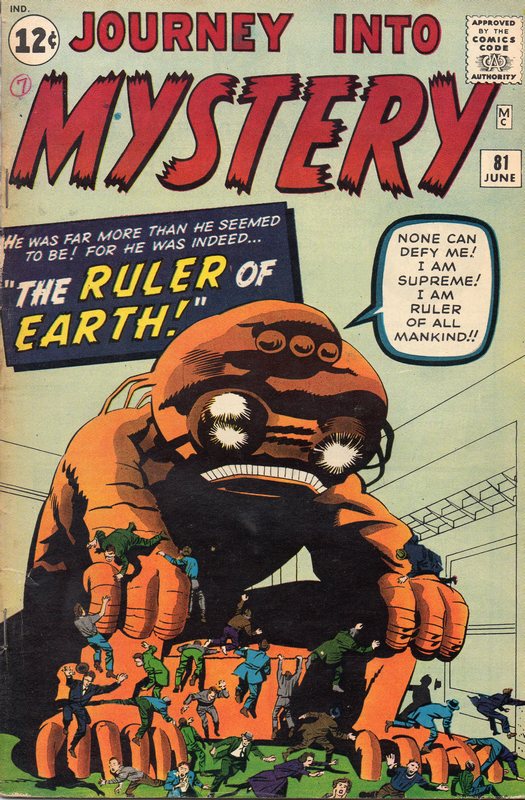
Journey Into Mystery #81. This was two issues from when Jack Kirby would create and introduce his superhero version of the character Thor, who is about to become the star of a major motion picture. Created wholly by Jack Kirby, no matter what else you may hear or read.

Journey Into Mystery #80. Lots of Jack Kirby and Steve Ditko art.

One of the amazing things about Ditko is that he was often given the task of creating an entire book that was, essentially, an illustrated anthology. This book was a prime example of what he would do in his struggle to support himself in an industry not known for paying a living wage. This comic book is almost entirely illustrated by Ditko, with only a single one-page story on the last page possibly not being by him. His signature isn't on it, but it's possible that he did the layouts. But the other five stories in the comic are all by Mr. Ditko. And even though Charlton Comics (the publisher of this title) was not known for paying a fair page rate, Steve Ditko did not spare any effort to breathe life into each of the tales here.