Latest pickup on the comic book front is a copy of TALES TO ASTONISH #25. It has a great Jack Kirby cover and was mainly picked up as part of my quest to collect the Silver Age work of Steve Ditko.

 Mill Creek Falls--in West Virginia. Remains one of the prettiest waterfalls I've ever seen.
 Potato Knob in West Virginia. I don't get into technical climbing, so this is about as close to that as I'll go. This wall of rock is what's known as "Class III" climbing. It looks like it's straight up, but there are plenty of handholds. You can get hurt if you slip, of course, but you'd have to be careless or a terrible klutz. I went up this section in quick order.
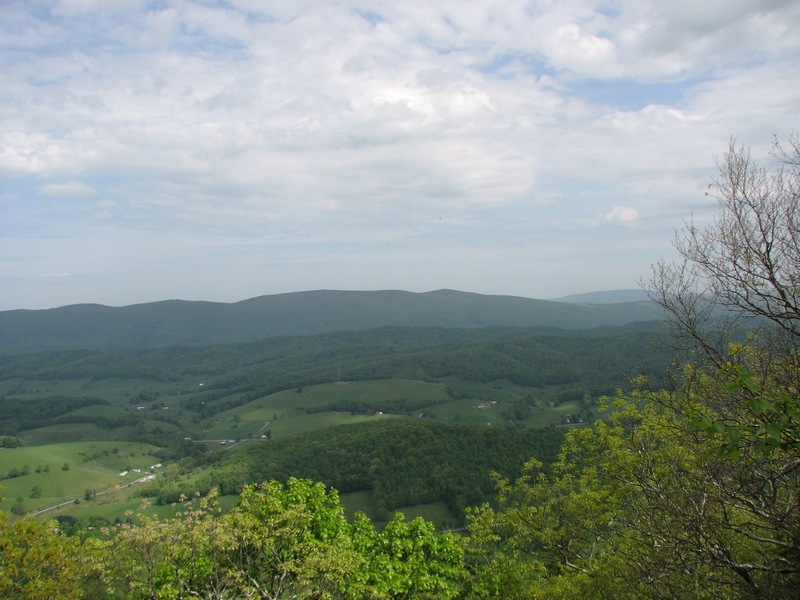
 This was taken along a cliffside trail in Hanging Rock State Park in North Carolina.



 The food court. We stopped here and had a tad to eat.
 This was some kind of Santa bubble. People were lined up here and they'd go inside and have photos taken of their kids sitting on Santa's lap. I think the crazy thing was sponsored by the movie studio that makes those damnable Narnia movies.
 I called this one "The Orca Dress". Carole was not amused.
 We found a store in there that sells absolutely nothing but Hello Kitty shit. For real.
 This is the Borders Books where we spent some money buying Christmas gifts for ourselves and for others. It was really busy in there. I was impressed.
 I could wipe away the towers, that crowd out all the flowers and crush trees of every sort.


 The tree we picked out last year in Sparta, NC at the Crazy Fox Christmas Tree Patch.
 The new secretary at the bottom of the stairs.
 Carole, at our favorite Christmas tree farm, last year.
  Ernest Hemingway had an editor. Big deal.
 took me to the used bookstore where she'd bought that one and I found another issue in the stacks. This one was Fantastic Four #12. Of course I loved the issue and never forgot the story and those amazing images.
 My own copy of Fantastic Four #28, featuring Jack Kirby's Fantastic Four and some of his other creations, the X-Men.
 James R. Smith as zombie, image courtesy Stuart Gardner.
 Scale illustration of Indricotherium with a modern African elephant and a human. These guys were getting up toward the general size of a respectable sauropod dinosaur. All that mammals needed was room to spread their wings, so to speak.
 Deinotherium was a far larger animal than I had known before I read the recent articles about the early explosion of size in terrestrial mammals.
 Hanging out with a tame hadrosaur a couple of weeks ago. Being careful not to step in the dinosaur poop lying around.
 My zombies and dogs as delineated by Mark Masztal.
 Carole took this one of me and Andy at Mammoth Hot Springs. Not too many years ago energy companies wanted to tap the thermal aquifer beneath Yellowstone National Park to run steam turbines to create electricity. This would effectively have destroyed most, if not all, of the thermal features in the park.
 Mother Nature does fine art with super-heated water and mineral deposition.
 If these hot springs were ever tapped, they would be destroyed.
  The ever-changing pools at the top of Mammoth Hot Springs.
  Hot springs and mountain vistas.
  One of the amazing roaring features we witnessed on our Yellowstone trip.
  This huge buffalo was using a dust wallow on a steep slope above the valley.
 It was the beginning of the rut and this bull was staking out this cow and warning everyone away. Later that same day, I watched a group of motor bikers pull up beside an enormous bull bison sitting in a wallow beside the road, walk up to him, surround the animal, as one of the idiots reached out to touch the almost one-ton buffalo. Humans can, and will, destroy everything that they can get their mitts on.
 Telephoto shot of part of one of the enormous herds we watched in Hayden Valley.
 A bit of the hundreds-strong herd in Hayden Valley. Once upon a time, the west was all like this for thousands and thousands of miles. We've destroyed 98% of it, but that apparently is not enough. That remaining 2% must, apparently, also go away.
 View of 10,300-foot Mount Washburn, which I had climbed a day earlier. It has one building on it, and would, some would argue, be better off if it could be covered in subdivisions and gas stations. I am reminded of Highlands NC and the hideous sprawl of houses wrecking the slopes every time I look at an unspoiled mountain.
The birds in my novel THE FLOCK are Terror birds, also known as Phorusrhacids were an extinct form of the modern type we know as ratites. These are almost all large birds that are flightless. Most of them today are much smaller than the Terror birds and are herbivorous rather than carnivorous. Why the herbivores thrived while the flesh-eaters died out is a matter for paleontologists to puzzle. About the closest we have to the Terror birds these days would be the Cassowary which is considered the most dangerous living bird, having killed a total of two human beings in the past few hundred years. I've read that they do occasionally chase down and consume insects and small reptiles, thus making them omnivorous rather than strict herbivores. Like most of today's amazing creatures, they're near extinction.
Recently, I read that the eggshell of the extinct Aepyornis, the heaviest bird known to have ever lived, gave up its DNA. This is, I suppose, something of a genetic coup, but I don't know if it means that the species can be resurrected. From what I've read on the subject, I rather doubt it. Still, it's interesting to know that the DNA of these critters can be recovered and studied, if not actually used to recreate the lost animals. Which is a shame, of course, because unlike the Terror birds who exist only in my novel, ratites such as Aepyornis and the moas of New Zealand were killed off by humans and not by the normal means of Natural Selection.
 Worst.


