Monday, May 23, 2016

Favorite Camping Experience.

Carole and I have been on so many camping trips that sometimes they all seem to blur and we try to recall where and when we saw this or that view, or how we happened upon a certain swimming hole or kayaking run, or how we found a certain waterfall. And so on.

We have our memories and our photos and have considered what we think of as our favorites.

Recently we thought about the single best campground we've ever used, and without too much debate about it, we settled on Rock Creek Recreation Area. It's located in, and operated by, the Cherokee National Forest near Erwin, Tennessee. There is so much to see and do in and around the area that you could spend months there and still never exhaust the possibilities for outdoor adventures.

One thing that I have to say about the campground is that is is extremely popular. The locals are endeared to it and--since you cannot reserve a campsite--it can be exceedingly difficult to land a campsite. Even in the middle of the week you can find the place full. All sites are first-come, first-serve. So you just have to take a chance and ride in to see if a spot is available. If you do find one open, nab it and begin one of the finest camping experiences you will ever have.

Easily our all-time favorite campground. Fantastic amenities.

This little sheltered kiosk is unique in our camping experience. Most of the campsites had one.We used it to set up our propane stove for outdoor cooking.

The slope above our campsite.

It doesn't get any better.


Upper Rock Creek Falls. Just a short hike from the campground.

Campground entrance.

Sunday, May 22, 2016

Reptile Love!

We spent the second leg of our Florida/Georgia trip at Three Rivers State Park right on the Florida/Georgia border. The park is located on the shore of the man-made Lake Seminole which is a nice impoundment that has created a lot of deep water habitat for all manner of freshwater flora and fauna.

While you can boat and kayak and fish in the lake, it is actually unsafe for swimming. This is because of the hefty populations of large alligators who live there, and for the danger of infection from a particular nasty amoebic infection that has been reported (rarely, thank goodness) from exposure to the those who have gone swimming there.

The one thing about this trip to Florida is that we did not encounter much in the way of wildlife. I'm not sure why this was, but I suspect the spring flooding of the Suwannee River drainage system likely contributed to this. Normally we see plenty of wildlife down there, but reliable animals such as raccoons, armadillos, white-tailed deer, hawks, owls, ibises, woodpeckers, and other creatures were in very short supply.

However, I did see a number of large alligators in Lake Seminole just off the boat ramp not far from our campsite. In the late afternoon I spotted one alligator that seemed to be very gradually creeping up on the near shore from a point on the opposite side of the channel. It was hard to get photos because she was so far out, and I have never been happy with the quality of photos that I get with my telephoto lens.

After a while I noticed that she seemed to be switching position. And then I realized that I was seeing two alligators. Then, in a while, I recalled that it is getting close to mating season for alligators when the males will take to roaring and vibrating their bodies to create enough of a bass-line to attract the opposite sex. What I was seeing was a female alligator taking the measure of the tolerance level she night expect from a large male who was hovering around the near side of the lake. Better safe than sorry, I expect.

At any rate, here are a few that I managed to take (not good ones, I'm afraid) of the near encounter of a female gator and her bashful target.

This was our campsite at Three Rivers State Park. Nice and quiet even when the campground filled up on the weekend.

Lake Seminole. Kayakers and Canoers make the turn around an island.

A medium sized gator was sliding carefully across the lake.

And then I noticed that there were two!

When your prospective mate is an armored, territorial grouch, you approach with care.

Sunday, May 15, 2016

When Springs Go Dark.

Too busy to post much on the blog today. But I did want to post a video I created of the situation we encountered when Carole and I kayaked down the Suwannee River. We originally wanted to see some of the springs that line the banks of the Suwannee, but the Spring floods had inundated all of them. This has happened to us before when we went to see springs that are within the Suwannee floodplain. We'll try again.

The river was going down, but not enough to reveal the springs.

This boardwalk is normally not only high and dry, but a fair distance above the river.

Anderson Springs was bubbling away, but had gone dark.
Better luck next trip....


Saturday, May 14, 2016

Spring Floods!

One of the main things we wanted to do on this trip was kayak the Suwannee River to see the many springs that lie along its banks and in the areas around that river. We have tried this a number of times and every time we have been stymied by the spring floods. The Suwannee drains the Okefenokee Swamp and every spring that area gets a tremendous amount of rain which swells the river. When this happens the river overtops its banks and inundates the springs and fills them with the dark, tea-colored water of the swamp and river system. This is called "a blackout" of the springs.

And so, alas, the time we wanted to spend exploring and snorkeling in the big freshwater springs and the clear blue waters they generate was not to be. We got there just after the flooding of the Suwannee River basin and so encountered nothing but dark water and no sparkling springs.

Still, we went ahead with the main kayaking trip we had opted to take. We picked a canoe service just outside the entrance to the Suwannee River State Park where we were staying. They had a great deal of charging only $10 per kayak to shuttle you to a point seven miles upstream from the park. After that all we had to do was paddle down the river and back to the park where we would use the boat launch to disembark just yards from our campsite!

And, while we did not get to see the springs we wanted to explore, we still had a great time kayaking the river. We saw one small alligator along the way, a few turtles, and heard a tremendous number and variety of birdsong.

Carole heads off!

High water.

Live oaks and Spanish moss.

Limestone rock, the reason for the wealth of springs in Florida.


Thursday, May 12, 2016

Radium Springs, Georgia.

As I had mentioned earlier, Carole and I decided to take a swing through middle Georgia on the way home. This was done so that we could hit a number of locations and parks that I recalled from my childhood and which Carole had never seen.

The first place we had decided to see was Radium Springs in Albany Georgia. My dad had taken me there when I was very young and I remember swimming in the spring vent. I think I was about six years old at the time. So it had been more than five decades since I had been there, but I vividly recall swimming in those cold, blue waters.

Until the late '90s, Radium Springs had a large, abandoned hotel sitting above it. This was referred to as "the Casino" and it was a very impressive building. In its day it had been a major vacation destination for wealthy white folk who came from far and wide to spend time in the lush interior, to swim in the phenomenal spring, to go horseback riding, and to play golf on the (I'm told) fine course that was then present. Apparently no less than Bobby Jones had played the course.

The Depression put an end to most of that and by World War II the military had taken over the building so that it could serve as a place for officers to vacation, relax, and recuperate from deployment overseas. After that the building was pretty much completely abandoned. Subsequently a series of mighty floods following the course of the Flint River inundated the casino doing major damage to the building. The last flood did so much damage that any idea of restoring the structure was out of the question. Thus, the Casino was slated for destruction and soon met the fate that every man-made building must face sooner or later.

These days, all that is left of the old hotel and resort are the walls of the bottom floor of the main building, and the facades of a few more out-buildings that serve as decoration. The fine rock walls that line the springs and which were used in the construction of small shelters and gazebos are also there, alog with a bridge leading to a small island in the center of the main spring.

In addition, the city of Albany has created a fine garden and park around Radium Springs. There is ample parking, some short trails to walk, and plenty of opportunity to sit and take in the beauty of what is called one of Georgia's Seven Natural Wonders. The spring was as beautiful and awe-inspiring as my child's memory recalled. However, these days no swimming is allowed in the spring. So walking down the stairways to take a dip in those cool, clear waters is something that is with us now only in memory.

Well maintained gardens.

The remains of the old hotel.

Turn of the century rock work.

Southern beauty.

Cobalt water.

An extremely deep spring vent.
Video of Radium Springs, Georgia.

Tuesday, May 10, 2016

The Bird's Nest.

Recall the bird's nest with babies in it from just before we left for Florida? The ones for whom I had to create a new, safe nesting area? As you recall, we took off for the Sunshine State not really knowing if my efforts would succeed.

Well, as soon as we arrived at the parking spot for our little trailer, I got out of the truck to examine the nest. The birds had fledged, the parents were gone. The nest was still sitting unmolested in my makeshift shelter. Carole wants to save it and use it in some kind of decoration. (Not sure what.) So it will be preserved in some manner.

Mission accomplished.

I removed the roof I had rigged...

Woo HOO! The family was gone. (The metal part you can see inside is the valve handle for the tank.)

North Florida Indian Mounds

Carole and I love to visit sites that relate to American history. We always have a blast learning about America's past. We especially enjoy archaeological sites and parks.

Northern Florida has a number of Native American mound complexes. Many of these were obliterated over the years by European farmers and developers who used the mounds as fill material to use in construction or drainage projects. There is quite actually no telling what kind of history and artifacts we lost when mounds were removed to make room for fields or foundations.


Two mound complexes that are still at least partially present are the ones in the Letchworth-Love Mounds Archaeological State Park and the Lake Jackson Mounds Archaeological State Park. We decided to see both of those in the same day because they're in the same general region.

First we headed over to the Letchworth complex. It contains the highest temple mound in Florida, topping out at almost fifty feet tall. When you consider that these structures were built using only hoes and the earth transported in baskets, it must have taken a great deal of time to bring them up. We arrived to find that we had this isolated rural park all to ourselves. The entire time we were there we saw no one else. There are some information kiosks there explaining the history of the people who made the mounds and filling in details about what we know of their culture.

You can't actually climb to the top of the Letchworth temple mound, but there is a fine boardwalk and viewing platform at the base that offers a good look.

From there, we headed over to Tallahassee to find the Lake Jackson Mound Complex. Thank goodness for GPS. In no time we located the park. Again, we arrived to find it empty of visitors. There was one guy working who we assumed was the groundskeeper. And that he was, working busily to clear brush. But he was also obviously the park ranger who filled me in on the history of the Lake Jackson site. At one time there were many more mounds there, but most of them were destroyed by farmers and builders who wanted the earth to use in fields and foundations. You have to wonder what they destroyed in uprooting the work of the people who were there before them.

A few days later we would be visiting the Ocmulgee Mound Complex in Georgia which dwarfs both of these sites, but I still recommend that you see these two complexes if you are at all interested in American history and specifically Native American history and culture.

Me for scale. The tallest Native American temple mound in Florida.

Representation of the mound under construction.

The walkways leading to the temple mound at Letchworth.

The lesser temple mound at the Lake Jackson complex.

It looks like you could just walk across the field to the larger mound. However, flooding had caused a creek in the middle of the field to overflow. I had to find a narrow place to pick my way across.

Once I found a way across, I climbed the stairs to the top.
Video tour of the mounds. Carole and I do enjoy our vacations together.

Monday, May 09, 2016

Mr. Jones

I just read a crazy article about a woman on a passenger plane who noticed that the man beside her was scribbling in and peering intently at a notebook. He was apparently so focused on the the material in that book that he refused to engage in conversation...as if obsessed. So she apparently looked at the visible pages of the notebook and could not decipher the insane glyphs and icons written upon them.

So, she concluded, he had to be a terrorist and she reported him to the employees of the airline and insanity ensued.

In fact, he was a mathematics professor and was working on a very complicated equation. His fellow passenger could not fathom the meaning of the visible contents of the pages and concluded that he was a force for evil.

Now, when I was taking Polygons and Trigonometry in high school, I would have agreed with her. But it is all indicative of the level of ignorance that is prevalent in the USA and which seems to be actively encouraged by our present society. Learning is apparently something that is beneath contempt for the average American.

And it all made me think of how I came to even be found in a Polygons and Trigonometry class in my senior year of high school.

I have a slightly above average IQ (127). I always tell people that I'm just smart enough to know that I'm not all that smart. In my senior year of high school in the small mountain town of Ellijay, Georgia I found myself every semester in at least one class taught by a mathematics teacher named Mr. Jones. To my shame, I have forgotten his first name. But for some reason he liked me and we would sometimes have pleasant conversations. In addition to teaching, he had been an elected member of Georgia's House of Representatives as a Republican. (The county where I lived then elected no Democrats to office.) During the previous election cycle he had angered one of his strongest supporters, the Georgia Power Company, by voting in favor of creating the Cohutta Wilderness Area (which Georgia Power did not wish to see). So they stopped contributing to his campaigns and supported a rival and he did not win the subsequent primary.

At any rate, he was kind to me. At the time I was heavily involved in sports which means that if you are at all dedicated to your team and coach, you are present each and every day for practice and team meetings. Thus, my attendance that year was spotless and my grades were accordingly excellent. During the first semester I took a business math class under Mr. Jones and emerged with the highest average in that class. I recall because if I failed to score 100 on any test I was pretty angry with myself. That only happened twice, when I got back a 98 and a 99.

So, at the end of that semester he encouraged me to take Polygons and Trigonometry. I explained to him that I always had trouble with anything that remotely resembled advanced math and math theory. I told him that I was good at just doing the basic number thing, and could even do okay in some of the easier algebra and geometry subjects. But anything more advanced than that and I seemed to fall by the wayside. I explained that I was doing my best to produce perfect "A" status in my senior year and that if I failed at Polygons and Trig then I would not meet my goal and thus have a harder time entering college.

He then told me that he was positive that I would do well in the class and I continued to refuse. Finally, he told me that he would guarantee me at least a "B", no matter what. Yes, I know the ethics of that are not good--either for him or for me, but I agreed, since he seemed so confident that I would do well in the class (based on my superlative grades in Business Math). I signed up for the class.

Now...here let me say that I did try. I did not take the promise of "at least a B" and go all lazy. I applied myself tremendously, but the concepts were beyond my ability to comprehend, even when I had help from Mr. Jones and various class tutors. As I had explained to him, it was just not my bag. At tests I would always score less than a 50. Consistent "F"s. I recall scoring a 28 on one test. It was a disaster.

In that semester football season was alreadyover and I was then on the wrestling team. I was at school every day and cracked the books as consistently as I struggled to become a decent wrestler. But while I made "A"s in all of my other classes, I emerged officially with about a 35 average from that freaking Trigonometry class. I was upset with myself and feared what it would do to my GPA. However, true to his promise, Mr. Jones gave me a "B" in the class. I can't recall if he penned in an 80 or an 81, but there it was on the report cards they issued us. It was the only time that final year that I failed to get an A in any class.

Sometime during that period Richard Nixon had had to resign as President. Subsequently Nixon developed some serious health issues due to a condition called phlebitis. One day Mr. Jones came into class upset. It was just after the news of Nixon's health crisis had hit the papers and TV shows. He was a faithful Republican despite his pro-environment stance as a Georgia State congressman and he was genuinely upset over Nixon's situation. I remember that he stepped through the classroom door looking red-eyed. I asked him what was wrong (he was actually wringing his hands).

And he said, "Nixon. They've killed him. They're killing him."

To my shame, my reply was, "I hope so."

And this was before he kept his promise and gave me a "B" for taking the challenge to prove myself.

I never went to college for reasons having nothing to do with my excellent GPA and everything to do with money. I was good enough to get into most schools I wanted to attend, but not to grab anything approaching a scholarship. As I said...I am smart enough to understand that I just ain't all that smart. I think about that every time I remember my curt response to Mr. Jones' genuine despair over the welfare of the man who had led his political party.

Part of the stadium where I played football and ran track. Gilmer High had a stadium in those days that was excessive for such a small school (grades 8-12, graduating senior class of barely over 100). They love their football in Georgia.

Sunday, May 08, 2016

A Day on the Wacissa River.

I have yet to see anyone agree on the spelling of the Wacissa River. Add to this the fact that there were confusing maps and information that claimed that there are two such named rivers in Florida and it compounds the problem. From speaking to people, the pronunciation of the river is WOCK-suh. A name from one of the Native American tribes, of course, but I'm not sure which nation.

We finally settled on one information source and headed to what we were told was the put-in point to paddle the river.Our destination was a tributary that appears whole from the earth from a series of powerful freshwater springs that emerge from the limestone karst geography in that part of Florida. What we found was a classic spring-fed river with clear, blue water. We were near there last year and didn't kayak the river, opting to do something else. Later, after we'd heard what a great place it is for springs, we regretted our initial choice and had penned this one in to visit on this trip.

We arrived at the boat launch location which is a very, very pretty county park. There is a really substantial parking area and two boat launches: one for kayaks and canoes, and the other for motorboats. In addition there is a beautiful grassy area and a small beach for swimming in the clear, blue water. We did see some alligators around, but small ones, and it didn't seem to worry the locals.

After we unloaded the kayaks and talked to a Florida Wildlife officer we put our kayaks in the river and headed downstream to where we were told we'd find the biggest of the area springs. Along the way we spotted a couple of more alligators, including one that looked to be seven feet or so in length. So I know that there are some large ones in the river. I'm always careful when it comes time to swim or snorkel where gators could be present and watch to see how the locals handle it.

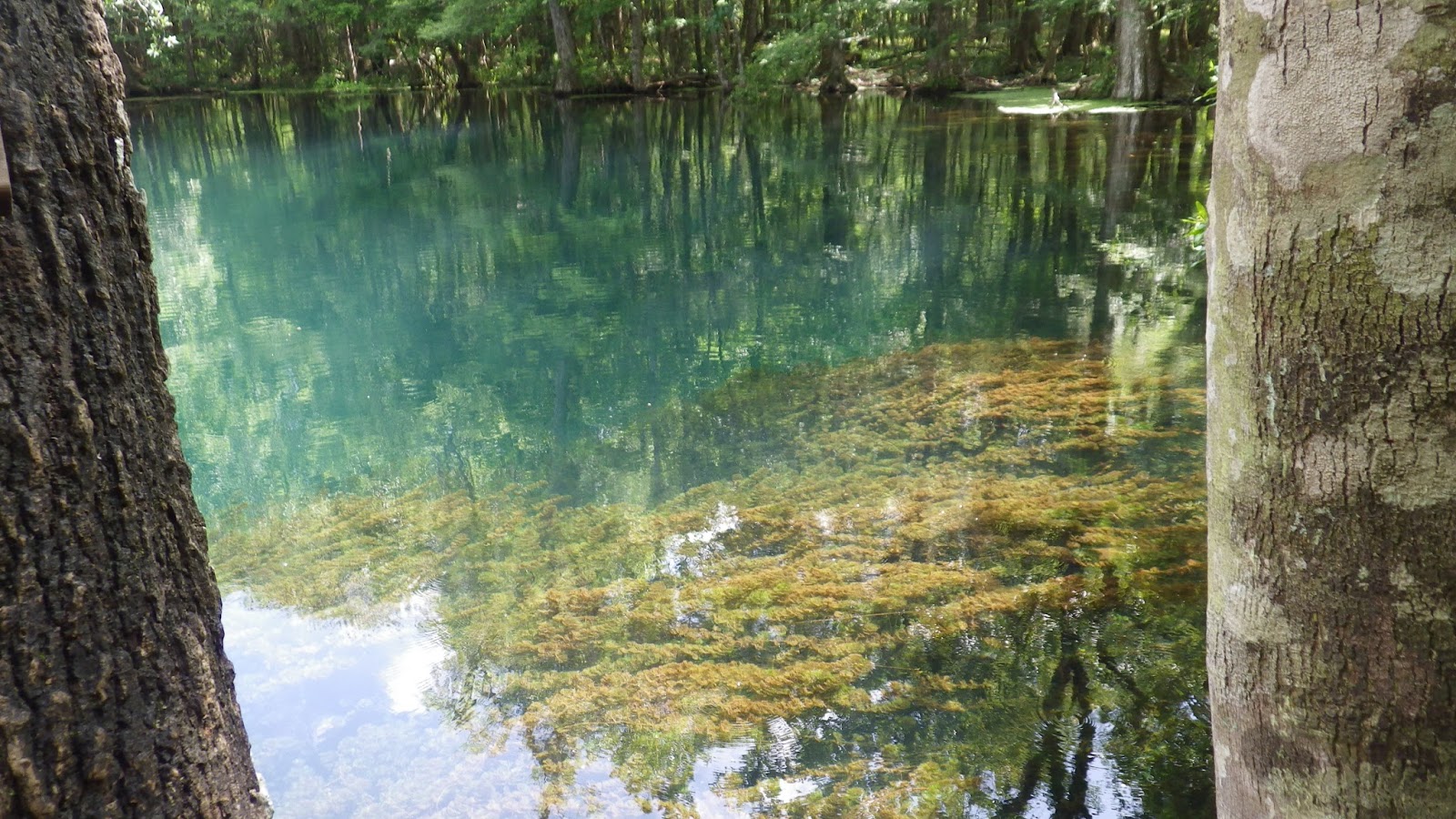
When we got to the spring we were impressed. It was discharging an amazing amount of water. This one (Big Blue Spring) has a fair amount of limestone dissolved in solution and the water is a deep blue rather than the clear blue one encounters in springs such as the ones at Ichetucknee.

We beached our kayaks near some trees overhanging the spring, had lunch, and decided to go swimming. There were other people swimming and using the ropes to swing out over the very deep waters of the spring to drop in from a height of ten feet or so.

After spending about an hour there we boarded our kayaks and explored the spring run that curled into the deep forest and back again to the main channel of the Wacissa. We could hear a truly symphonic amount of bird songs as we paddled along.

Soon we headed leisurely back up the Wacissa against the current, stopping to  visit some of the smaller springs along the route, including Curtis Spring which I'd like to visit again to swim in. It has some cool limestone tunnels that you can traverse that are short in length and no danger to snorkel. We are planning to go back to this park again as soon as we can to hit some of the springs we missed.

Some hours after departing, we returned to the county park where I took the kayaks out of the water and tossed them back onto the carriers on the truck. Securing them,  we hit the road to return to our base at the Suwannee River State Park.

The park. A really big parking area, some picnic tables. a small sandy beach, a rope swing hanging from a truly huge cypress tree and some portable toilets and two boat launches (one for motorboats and one for kayaks/canoes).

Selfie in front of one of the big cypress trees.

I sit in the weeds to get this photo of Carole.

Typical view along the Wacissa River.

One of the locals.

This young woman was using the rope swing to fall into the deep waters of the spring.
The water here was very clear and very, very deep.

Along the spring run.

We head leisurely back upstream, visiting some of the smaller springs along the way.

An overview of our float and swim on the Wacissa River.

Saturday, May 07, 2016

Ocmulgee National Monument

We had decided to cruise up through Georgia on the way home to see a few places from my youth where I had not been for decades. These were places that I just wanted to view once more, and which Carole wanted to see for the first time.

When I was a kid I lived in Macon, Georgia for--I think--three years. One of the few nice things that I recalled about Macon was the Ocmulgee National Monument located just across the Ocmulgee River from downtown Macon. I was both pleased and surprised that the skyline of my one-time town had not changed one iota since I was a kid. It's rare to see a town the size of Macon not raise a single large building over the course of four decades.

I think I visited the Ocmulgee mound complex about five times or so during the three years we lived there. As I recalled from my childhood, it is indeed an impressive display of Native American culture and engineering. The large temple mound there is impressive by any standards of earthen mound construction by the people who lived here first. That mound, and several others in the monument, are vast. The society that built it was obviously complex and cohesive to have been able to undertake a public works project such as the one that left us with these amazing structures.

We had the good fortune to arrive at Ocmulgee during an outdoor class session for one of the local public schools. It was being taught by a Native American couple. I didn't get there in time to hear from which tribe they hailed, but their teaching process and personalities were sharp. They explained the long history of the native peoples of the Americas and showed the steady development of stone-age technology among the nations that were here before the Europeans.

Like the Wright Brothers Memorial at the Outer Banks, this is one of the National Monuments that Americans should visit. It impressed me at the same level as that one at Kill Devil Hill and is both inspirational and educational.

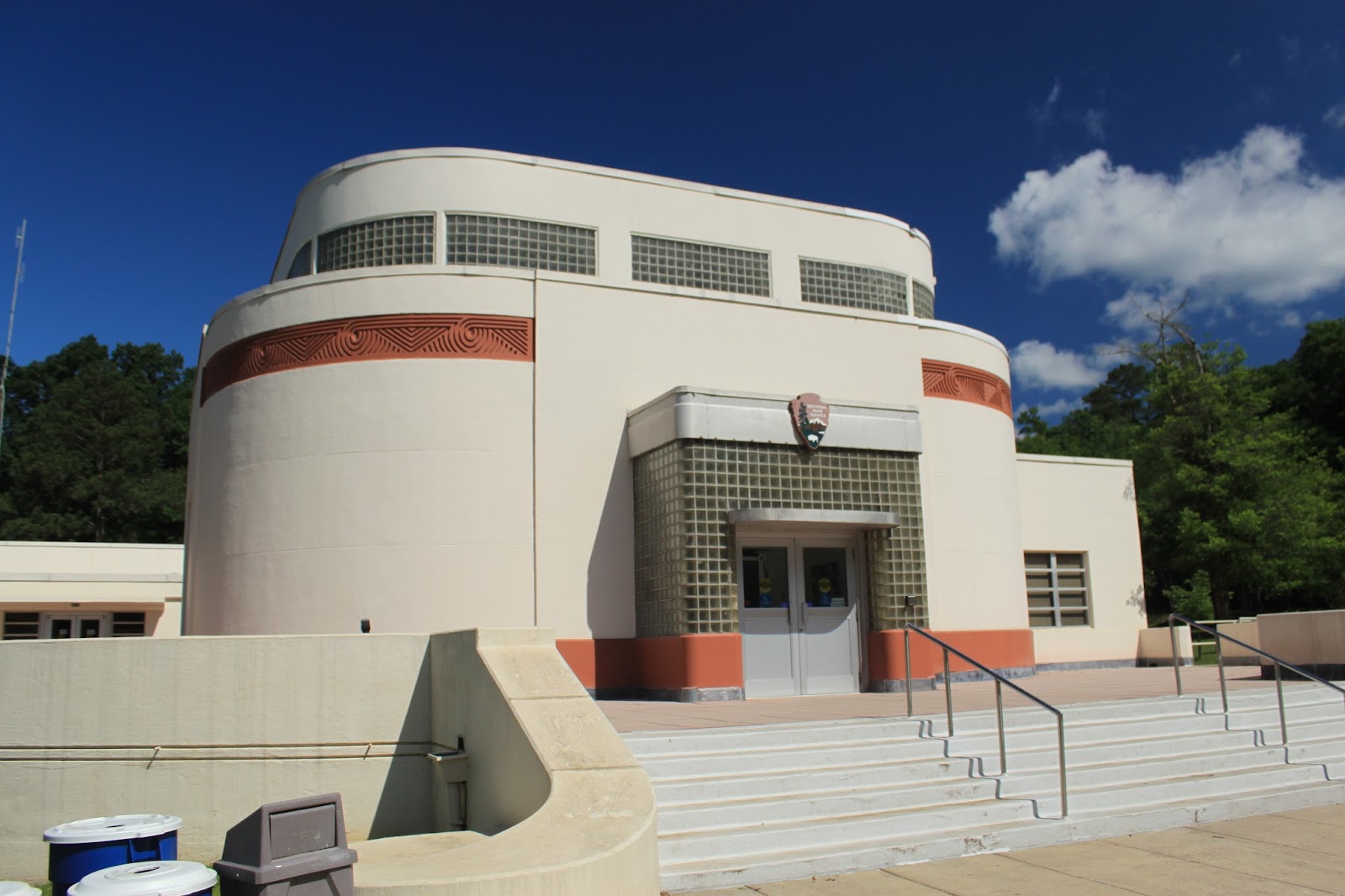
The museum and visitor's center building. I really dig this style of architecture.

The Earth Lodge. One has to duckwalk to enter it. The doorway is (maybe) three feet high. This lodge is over 1,000 years old.

Hallway to the meeting room in the Earth Lodge.

Interior shot. The raised platform is where three speakers/moderators/chiefs would have sat. Other seats radiated out from the central platform which seemed to me something like the bema.

The interior of the Earth Lodge.

After a half-mile hike, Carole and I approach the main temple mound.

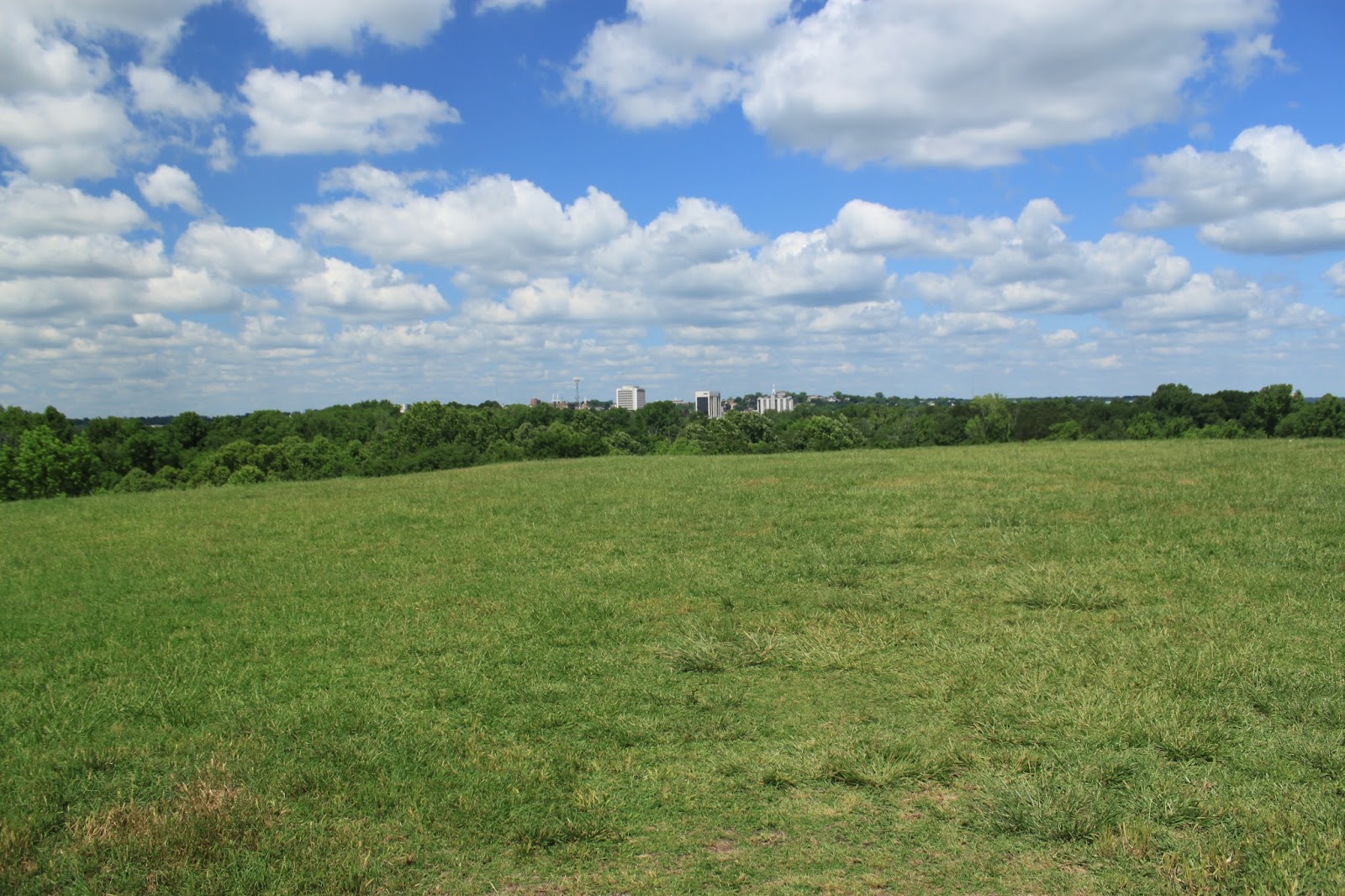
The view from atop the main temple mound. You could play a football game up there. That's the skyline of downtown Macon across the river in the distance. There were likely various lodges constructed on the flat plateau of the mound.

To give you a good scale of the main temple mound, this is part of the staircase leading to the top. Carole is about halfway down, descending.

Friday, May 06, 2016

Springs

The thing Carole and I enjoy the most when we go to Florida is seeking out and exploring the enormous freshwater springs that emerge from the karst topography of the state. We had hit many of them, but there are so many that we know that there are always new ones to discover. This year we were hoping to see and experience many of the big springs that line the shores of the Suwannee River in the north of the state.

However, seeing those springs is a hit-or-miss option since they Suwannee often overruns its banks and subsequently the tea-colored water of that river "blacks out" the freshwater springs. This happened to us once before when we journeyed there to kayak and snorkel. And,  alas, it happened again. The river was up many feet above flood stage and this killed off our chance to see the dozens of first, second, and third degree springs along its banks.

However, there are always some springs that emerge from higher areas of the state and we fell back on seeing some of those. The first one we decided to hit was Ichetucknee Springs. That one is an old favorite of ours, and a very popular destination of most of the residents of northern Florida and southern Georgia. You can almost always count on huge, noisy crowds on the Ichetucknee.

The one great thing about this trip to those springs was that they were almost deserted. For about an hour, we had the Ichetucknee Head Spring all to ourselves. It was pure bliss.

(Tomorrow,  the springs of the Wacissa River.)

The view of the Head Springs that greeted us.
Jump in!

Underwater beauty.

Swimming the day away in Ichetucknee Springs.


Thursday, May 05, 2016

Return

This is my first chance to post since we got back. We had a great time and explored some new areas and revisited a couple of old favorites. I'll post details as I can find the time.

For the first time in many vacations I actually got a fair amount of writing done. I was able to work steadily on one of my novels which is a rarity when I'm on vacation. During such times I'm either too busy outdoors or too tired after returning to our Casita travel trailer. This trip was different and I was able to get some real work done on a project.

Look for more video and photos in a day or so.

A Rough-scaled green snake we saw at Deer Lake State Park. It looks menacing but is actually a harmless (to humans) constrictor that is non-venomous. This one was about a foot and a half long. Very thin.
The circa 1849 plantation house at Torryea State Park. Just behind this mansion is a 100-foot-tall bluff overlooking the Apalachicola River and the plains beyond. One does not typically see vertical relief of that nature in Florida. It was a surprise. The house contains the second largest collection of Louis XIV furniture in North America (or so we were told).