Showing posts with label Grizzly Bear. Show all posts

Sunday, December 31, 2017

Extirpation and Extinction.

I used to know a lot of people who hunted. When I was a kid I would go small game hunting from time to time with my dad. Rabbits, quail, that type of thing. I stopped when I was 13 years old, no longer able to kill birds and mammals. My choice, no wish here to dictate that to others.

Up until a few years ago I would still hang out and talk to hunters sometimes. Some people hunt for what they call sport. Others hunt because they enjoy eating wild game and consuming what they kill. Truth to tell, one of my favorite things to eat is venison. So I am making no judgment call here. I have friends who hunt deer and other game to put protein in their freezers which helps them to cut down on the expense of feeding themselves and their families; it also stops them from consuming meat produced on factory farms. This is a good thing.

However, in my conversations with my friends who are hunters, and with strangers I meet who hunt, the talk almost always ends up with a mention of predators. Hunters hate predators. They hate any animal that also eats the deer, elk, moose, grouse, quail, etc. that people like to hunt and kill. At first I just assumed that this rabid hatred of predators was due to a sense of competition that they felt. But I never heard any of these hunters verbally savage or complain about other human hunters. Their rage and hatred was only for Grizzly bears, mountain lions, bobcats, coyotes, lynxes, and other such animals.

But they reserved a very special species of hatred for one particular animal: the Timber wolf.

If the conversation ever turned to wolves, I would watch my hunter friends start to slobber at the mouth like rabid dogs. Their eyes would go crazy. They would begin to rant and rave, talking about how the entire species should be exterminated and how any liberal college-educated moron who advocates for the defense of wolves should be jailed or killed. And, no, I am not exaggerating. I have seen otherwise calm, normal men start yelling for the extinction of an entire species and the deaths of educated biologists over this topic. They almost always referred to those with college educations as scum of the Earth.

I mainly would just squint at these people and wonder what the fuck was wrong with them and look at them as if they were a kind of specimen wriggling on a microscope slide or some cocktail of infection culturing in a petri dish.

Later, I would sit and try to figure it out, putting together what I knew about the activity of hunting and the people I knew who engaged in it.

Almost every hunter I knew (or know) is a white adult male. Nearly all of them are not just avid gun owners, but also are right wing types who--in addition to hating wolves--also don't care for people of other cultures, nor for people who have different skin pigmentation. Most of them are members of the National Rifle Association. Most of them are registered Republicans. Most of them hate the environmental movement.

Also, most of the hunters I have known subscribe to one or more sportsman's magazines. I am quite familiar with these publications because when I was a kid and thirsting for information about wildlife I was drawn to them since they had garish covers with photos and paintings of wild animals on them. And I had an endless supply of back issues of such magazines because my parents owned used bookstores and had stacks and stacks of them in the shops. I was allowed to take home as many as I wanted to read.

One thing that I learned very early on from reading these magazines is that there was an editorial thirst to promote the hatred of all predatory mammals that are not humans. It doesn't matter what kind of carnivorous animal they chose to target, these creatures were presented in a light that was as negative as could possibly be conveyed in words and pictures. Grizzly bears were monsters that should be avoided at all cost except to shoot or poison. Mountain lions were killers of deer and elk that should all be tracked down with dogs and shot on sight. Coyotes and bobcats are worthless vermin that need to be completely obliterated for reducing the rabbit population.

But paramount in their hatred and propaganda was, and is, the Timber wolf. When you read these magazine articles there is nothing whatsoever good about wolves. They are a toxin on the forest landscape that must be expunged. No mercy for any wolf. No quarter to be given. Just kill them all down to the smallest pup.

As I grew older I also noticed that most of these magazines look toward the environmental movement in a similarly negative light. They didn't call for the murder of activists who are out to create wilderness and National Parks, but they did blanket them with disdain and advocate for legislation against them, and to fight any rule such people support or pass.

And there it was. These magazines are distributed to people who, ironically, depend on open, relatively wild spaces where they can engage in their pastime of hunting. But these articles attack mainly two bits of legislation--the Endangered Species Act, and the Wilderness Act. To this end these magazines lobby endlessly, rabidly, and ceaselessly to overturn these protections for wild places and the animals who inhabit them. Who would profit from this? Hunters? Not really. But the folk who do profit from the reversal of these laws need hunters to act as triggers to remove these Acts. Therefore, have those hunters advocate obliquely for the call to remove such protections.

The folk who would ultimately have the most to gain from destroying the laws that preserve the last bits of wild spaces that we have are mining outfits, timber companies, energy corporations, and real estate concerns. If only there were no wilderness protections they could lay waste to the forests and gouge out the minerals. If only there was no Endangered Species Act they could wade into our National Parks to do as they please.

And there I realized that all of these hideous little magazines were nothing but propaganda material for the worst of what my country has created: fossil fuel companies, timber barons, real estate moguls. These are the scumbags directing their poison through hunters, targeting our wild forests to scour out the things that keep those greedy bastards from taking possession of what little wilderness that remains.

I don't read those magazines anymore. I used to pick one up now and again in shops or libraries just to see if things had changed. They have not. The scumbags who write for them still sell their souls for a few dollars to malign wolves and mountain lions. My hope is that these pernicious bastards who work for the worst of the worst will all die choking on their own guts.

To look for evil, follow the trail of profit.

The eastern Timber wolf.
What hunting magazines tell you Grizzly bears do.

What grizzly bears really do 99.999999999% of the time.

Tuesday, September 01, 2015

No Griz!

Well, we have returned home. Very long trip. Longest ever vacation. So much of it spent driving!

I now no longer have to imagine what it's like to witness a cloud of smoke that covers a huge portion of the North American continent. Between the historically enormous fires in Washington state (over 400 square miles) and the ones in Idaho, and the local fires in Montana we saw smoke clouds that spread over thousands and thousands of miles. Upon leaving, we actually drove for two days over three (enormous) western states trying to escape from the smoke. Only on the very eastern edge of South Dakota did we find ourselves free of most of it.

That said, we did have some days without smoke covering the skies. Three days in South Dakota and Wyoming, and roughly two and a half days in Glacier National Park (Montana). Then the fire smoke rolled in and obliterated the views. Most of the wildlife, also, seemed to fade from the landscape. Hiding? It sure seemed so.

We ended up never seeing a single grizzly bear, not one moose, and only two black bears (one of them a cub).

Details as I download the files and collect my thoughts.

Wyoming's Devil's Tower.

Monday, August 10, 2015

B'ars, Part II

Not too long ago I wrote a post about bears and posted some photos of various individual bears I have encountered in my treks. So I thought I'd refresh the subject--briefly--since I am going to be camping and walking about in grizzly bear country in less than a week.

I can't count the total number of bears whose paths I have crossed in my years of wandering about in the forests. Many. Since I've done almost all of my adventuring here in the east coast where only black bears live, that is the species I have most encountered. And even though black bears attack (and sometimes kill) more people than do grizzly bears, it's the griz who get all of the bad publicity.

Yesterday there was a story of a man who was killed and partially devoured by a grizzly bear in  Yellowstone National Park. One part of the story struck me because he was killed in an area that I had very seriously considered hiking when I was in Yellowstone, but ended up not doing because I chose to go elsewhere. It was on a medium-sized mountain called Elephant Back. The trail was relatively easy, I had read, and had the payoff of some good views and some solitude.

There are many more dangerous things that can happen to you in the wilds than running into a Grizzly bear. Lightning strikes are a much more likely threat than meeting up with an irate griz. A bison or a moose will gore or trample you before a grizzly bear would consider doing the same thing to you. Basically, being hurt by any kind of animal while hiking or backpacking is pretty darned rare. I'm far more frightened of being hit by a car or being shot by a nut with a gun than I am of being attacked by a bruin.

Still, I will be hiking in what is likely the densest grizzly bear population in the lower 48 states. So I will carry my bear-strength canister of pepper spray. And I'll be sure to make a lot of noise while I'm in the bush so that I have less of a chance of surprising the big ol' beasties. However, I do not want to get mauled and eaten by a grizzly bear, so I will take all due precautions.

Griz the way I like 'em. Far away from me and not interested in anything but where I'm not. I encountered this one just as I was getting ready to start my hike to the summit of Avalanche Peak in Yellowstone. He saw me and immediately went in the opposite direction. I took this photo from a very great distance.

This confused fellow I surprised while hiking alone in Douthat State Park in the mountains of Virginia. He saw me and bolted. I got this shot (from a good distance) with my telephoto lens because he stopped to take a look back at me to make sure I wasn't going to chase him or shoot at him. He, also, didn't want anything to do with me.

Sunday, February 22, 2015

B'ars!

My favorite animal is the bear. I have encountered them relatively often on my hikes and backpacking trips. The species I'm most familiar with is the black bear (Ursus americanus). This animal ranges all over the North American continent and I can tell you from personal experience that there are a lot more of them these days than there were when I was a kid.

Back in the days when I first started traveling in wilderness and park locales, I would rarely see them. About the only place I could be assured of spotting a black bear in those days (mid 1970s) was in the Great Smoky Mountains National Park. And even there you were not always assured of seeing one, even though they were habituated to human food sources back then.

In modern times, because of improved habitat protection and the enforcement of hunting laws, the black bear has made an impressive comeback. I now see them in places where they were just rumors, or where they were present but genuinely rare.

The other species that I've seen while hiking is the Grizzly bear (Ursus arctos horribilus). The griz has a reputation for belligerence and aggression. Although the truth of the matter is that most bear attacks are by black bears due to the sheer numbers of black bears as compared with grizzly bears. Still, you stand a much higher chance of being struck my lightning than you do of being menaced by any kind of bear.

In all of my years of tramping about in wild places, the only spot where I've been that had grizzly bears in any number is Yellowstone National Park. And I saw exactly two griz in that Park, both being at some distance, which is the way I think we would both prefer it. If a grizzly is far away then there is not likely to be any misunderstanding about my presence in his world.

In just a few short months I'll be heading to griz country again: Glacier National Park. That spot has just about the highest density of grizzly bears in the lower 48 states. I am hoping to see them there, although I do know one guy who visited Glacier and never saw a single grizzly. Hopefully I will see them while we're visiting, and hopefully it will be at a respectful distance.

A young black bear Carole and I encountered in Beartown State Park in West Virginia.


A black bear I saw this year in Douthat State Park.
The only grizzly I have ever encountered while hiking. Just before I started my trek to the summit of Avalanche Peak in Yellowstone National Park. As you can see, it had no interest in me and seemed keen only on moving far away from me.
I spotted this grizzly sleeping in a bed it had scooped out for itself on the banks of the Lamar River in Yellowstone National Park. He was very, very far away. This is a cropped photo that I took with my most powerful telephoto lens.
This is the only brown phase black bear I have seen. I spotted it in Grand Teton National Park. It was so interested in feeding that it never raised its face from the brush. I have no idea what it was eating, but it was moving along the forest grazing on something. Here in the east, one almost never sees any other coloration of the black bear but the darkest of black.

A bear in Beartown!

Wednesday, December 17, 2014

Why I Love Yellowstone

There are plenty of reasons to love Yellowstone National Park. Too many to list, actually. But right at the top is that there is so much wilderness there between the Park roads that there is a ridiculous amount of wildlife. Specifically, there is tons of unspoiled habitat for megafauna. You know...the big stuff. Big herbivores and big predators.

Someday I'll go back. Not in 2015. We're going to Glacier in 2015. But maybe in 2016. We'll see.

You have to love this place. Carole and Andy and I were walking back to our room and what's in the parking lot eating greens? A giant bison. We gave him a wide berth.

Part of the giant elk herd that got between me and my family as we were hiking back to Mammoth Hot Springs. We had to wait for it to pass before we could link up.

I took this photo of this griz from a VERY great distance. This is a digitally enlarged image taken with my most powerful telephoto lens. This bear had dug a bed for itself in the bank of the Lamar River and was completely sacked out. Why wouldn't he be comfortable? Who's going to mess with him?

Actually in the area between Grand Teton and Yellowstone. A bull moose.
 
Again...this was just outside Yellowstone. This was the only black bear we saw in the Yellowstone/Teton area. It is, as you can see, a brown phase black bear. I wasn't as close as this photo makes it appear. He was feeding heavily on something low to the ground as he walked along. I never saw what it was and he never once lifted his head. He was just vacuuming whatever goodies were growing there.

Bison in a dust wallow. Hayden Valley.

And it's not just the animals. A boiling hot lake, ladies and gentlemen. A. Boiling. Hot. Lake. Give me a break.

Sunday, November 16, 2014

Megafauna from South to West

I spend a lot more time in the outdoors than most Americans. A lot more.

One reason I go to Parks and wilderness areas is to find solitude. I also go to enjoy various types of scenery. Mountain vistas. Waterfalls. Rivers and streams. Forests.

But another huge reason I head off into the forests and swamps and mountains is to see wildlife. And there are all kinds of animals to define wildlife, but when I talk about that aspect of my journeys I'm speaking about megafauna. These are the larger animals. Things that are not tiny to us.

Most of our National Parks feature habitat that is the very reason that enables us to view such creatures. And in my wide journeys I am always on the lookout for the big critters, and I have varying degrees of luck spotting them.

For big fur-bearing animals I suppose the places like the western National Parks are the best. It's hard to visit one of those spots and not see the large critters we all think of as designating wilderness. In the east...well, the pickings are slim in comparison. When I'm hiking in the Piedmont or along the spine of the Appalachians, I just don't see a lot of wildlife. I feel fortunate to spot the occasional black bear. Elk are only now being reintroduced, but I do spot them from time to time. I've never seen a bobcat or a mountain lion here in the East. About the only big critters I can count on seeing in the East are white-tailed deer, raccoons, wild turkey, and the two vulture species we have.

But there is one place in the east where I often travel where there is at least as much wildlife as in the west. Maybe more. And that is in the wetlands of the deep South. If I go paddling in the Okefenokee Swamp, or trekking the rivers around the Outer Banks, or cruising the low country of Florida then I can pretty much guarantee myself that I will enjoy a vast bounty of wildlife.

West, East, South. I'll take what I can get.

Mullet school. Silver Glen Springs, Florida.

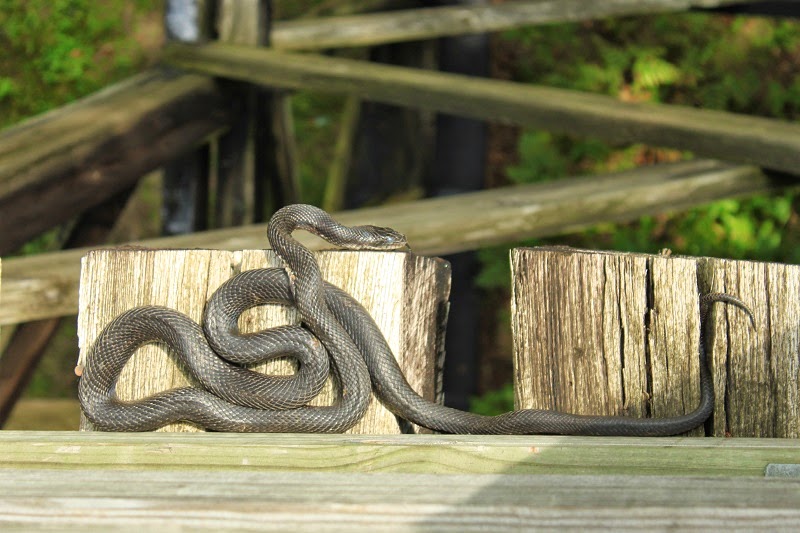
Black snake. Virginia Creeper Trail, southwest Virginia.

Migrating hawks forming a "kettle". Linville Gorge Wilderness, North Carolina.


White-tailed deer. Cades Cove, Great Smoky Mountains National Park.

Coyote/Red wolf hybrid. Great Smoky Mountains National Park.

Alligator Snapping turtle. Outer Banks, North Carolina.

Cottontail rabbit. Blue Ridge Parkway, North Carolina.

A black bear and I surprise one another. Douthat State Park, Virginia.

Bison herd, Hayden Valley, Yellowstone National Park.

Bothersome raccoon. Blue Spring State Park, Florida.

Black buzzard, Manatee Springs State Park, Florida.

Bull elk. Rocky Mountain State Park, Colorado.

Bull elk, Great Smoky Mountains National Park, Cataloochee section, North Carolina.

Grizzly bear, Yellowstone National Park. (Yeah, not a good photo, but I prefer Grizzly bears to be far away.)

Manatees. Manatee Springs, Florida.

Bull moose. Grand Teton National Park.

Key Deer. Big Pine Key, Florida.

Osprey. Fort DeSoto Park, Tampa Florida.

Friday, August 23, 2013

The Last Big Predator

When humans first reached North America, there was a wealth of giant mammals roaming the continent. Our land was home to amazing creatures that we can only imagine today because the Native Americans wiped them all out.

There were all manner of vast mammals wandering the forests, plains, mountains, streams, rivers, and canyons. Among the many things we will never witness are Mammoths, Mastodons, Glyptodonts, Megatherium, Camelops, Smilodon, Homotherium, Miracinonyx, Arctodus, Tapirs, Bison antiqus, Bootherium, Castoroides...I could go on.

But they're all gone. Fled into oblivion. Of the great Pleistocene mammals, few remain in North America today, killed off by the humans who first colonized the New World.

A griz I saw in Lamar Valley in Yellowstone. I was well over a mile away when I photographed him asleep on the banks of the Lamar River. The best way to see a Griz. From a distance.


The last truly great Pleistocene predator still roaming small pockets of North America is the Brown bear. These animals were more than equal to the task of competing with giants like the Short-faced bear and the American lion. Their enormous wild companions all fell before the onslaught of human depredation, but the grizzly bear remains.

I've read accounts of how and why they made it through the great extinction that took their fellows, but I take no sides. Perhaps they were just too damned mean to fade before fire and arrows and superior numbers. Maybe they just toughed it through. One of my guesses is that humans never squeezed them out of the territory they preferred, finding those places too cold, too high, too wet, too inaccessible. The Brown bears that inhabited the deserts and the plains did fall before those early Americans and were too few in number to last out the first wave of gun-toting Europeans who journeyed across the lands killing everything that they perceived as even the slightest of threats.

But the griz held on in some few places. The wildest and most inaccessible lands remained their final redoubt.

I have a healthy respect for Grizzly bears. They are today, as in the past, the biggest and baddest soul in the Valley. They know they're tough. They have to be. I've only hiked and camped in the lands where they live a few times. I saw some of them, at a distance, which is the best and only real way to witness them. I'll go again to roam the same lands of this last of the Pleistocene giant predators, but I will tread lightly in their home, as I always do. I will make noise to let them know I am there, and I will retreat if I find myself too close to them. They are, indeed, awesome creatures.

I'm glad they toughed it out.

My favorite hike in Griz country to date: to the summit of Avalanche Peak. I did see a griz just as I began the hike. He wanted nothing to do with me and quickly moved off into the forest in the other direction.

Here's a good video about hiking around big animals. It doesn't concern Grizzly bears, specifically, but the same general rules apply.


Friday, May 25, 2012

Trends

Having grown up with parents who let me read as I wished, and in a home packed with books of all sorts, I have always been horrified by people who believe in mythical origins of life. Evolution has never--to put it mildly--been a problem for me.

One thing that I have wondered about over the years is the European brown bear. It is, in just about every way, the same bear that we have here in the North American west; the animal we know as the Grizzly bear or North American brown bear. Eurasia and North America share many of the same basic species that roamed the northern hemisphere, crossing and recrossing the Bering Land Bridge when it existed.

However, the brown bears of Europe are not widely known for their ferocity. The Grizzly bear is, though, famed for its demeanor. Its scientific name is, after all, Ursus arctos horribilis (the "horrible bear"). It got the name for its reputation for being a bad-ass. The European brown bear, with the same physical appearance of our Grizzly bear, is not known for tearing people asunder.

So, I have wondered about this. There are always slight differences in bears based on geographic locations and their general habitat. For instance, a Brown bear in Montana would be considered huge if it weighed 800 pounds. The same bear on Kodiak Island in Alaska would be no more than average sized and a wimp when stacked against a really large male bear who might weigh in at 1500 pounds (or more). Similarly, the Brown bears in Kamchatka (in Russia) are on a par in size and demeanor with Alaskan brown bears (both living in similar habitats and eating similar diets).

But the bears in places like Austria, Finland, Yugoslavia, etc. are the same basic animal but are not widely considered to be particularly ornery, nor have the reputation for mauling humans when encountered. Indeed, they're said to be rather shy creatures.

So, is this because humans have selected the survivors? That is, have the brown bears of western Europe been pacified on an evolutionary basis because humans went out of their ways to kill off the more aggressive bears? Leaving only bears of a relatively mild temperament?

I wonder if any scholarly studies on this subject have been done? I'd be surprised if such had not been conducted.

A European brown bear in western Europe. Pretty much indistinguishable physically from a North American grizzly bear.

Monday, March 26, 2012

Read the Fine Print

One relatively easy hike that I took in Yellowstone in 2010 was the climb to the top of Mount Washburn and down the other side to the main loop road. I started on the Dunraven Pass Trail, climbed up to the summit ranger/weather station, and then used the Chittendon Road Trail to descend.

I was hoping to see Bighorn sheep along the way, for I'd been told this was a good place to spot them. And I finally did see a small herd on the way down, but it was all ewes and lambs. None of the big males with the formidable horns.

The big excitement for me was climbing another peak over 10K feet in elevation. This was all new stuff for me. Before this trip, the highest mountain I had ever hiked was Mount Mitchell here in North Carolina, which is a shade under 6,700 feet above sea level. I had wondered if I'd have problems with altitude, but I hiked as easily at 10,000 feet as I do at 3,000. So there were no worries for me there. I have known people who get sick at relatively low altitudes, so it was a relief to know I wasn't among that unfortunate group. Part of it was probably that I had plenty of time to acclimate by sleeping for a few days in the lodges which are all around 7,000 to 8,000 feet high.

I did this hike alone. I did encounter a few people who arrived on the summit from the opposite direction, and I bumped into a group when I was almost at the end of the hike. But most of the time I was alone. And it was only later--after Andy and Carole had arrived to pick me up that I noticed the signs mentioning heavy grizzly bear activity and not to hike alone.

Oh, well.

From the Dunraven Pass side. I was surprised to see so many dead pine trees. In some places in the Park all of the forests were dead as far as you could see. Apparently they've been the victims of some type of insect infestation.

When you're in the big western mountains, the high country of the East almost fade from memory. It's only after you return and begin hiking in the Appalachians again that you recall their own allure and grandeur.

In the sheltered rest area below the ranger/weather station I was visited by a little ground squirrel expecting handouts. I ignored his pleas for food and just took his photo.

On the way down, via the Chittendon Road Trail. The fire tower/ranger station/weather station behind me on the 10,000-foot summit of Mount Washburn.

These mountains are rugged, for damned sure.

I stopped to look down this steep draw.

Looking back up the Chittendon Road Trail as I got close to the end and my ride.

"Heavy grizzly bear activity?!" Now they tell me.

Saturday, March 24, 2012

More Yellowstone Memories.

Yellowstone's wildlife is amazing. It's everywhere. The only place I've visited where there is more wildlife on display acre-for-acre is Florida. Everywhere we drove and everywhere I hiked I encountered all sorts of animals. They call in "America's Serengeti", and I suppose that's true. And with the return of the wolf to the Park, we have our chief top predator back in the mix.

Wolves were about the only thing we never saw when we were in the Park. We did visit Lamar Valley, where sightings of wolves is most common, but we never did see one. The closest we came to seeing a wolf was a coyote--and that was a young, shy one who hid behind a big evergreen tree and wouldn't come out where I could take a good photo.

My main goal was to see a grizzly bear while we were in Yellowstone. And I saw two of them. Both were from a distance, and one was fast asleep. He was taking a nap along the collapsed banks of the Lamar River. I took his photo from a very great distance, which is the way I always want to see a grizzly bear.


If you look in the center of this photo, you can see the griz asleep in the dirt.

Here's the cropped version of the photo with the sleeping bear.

The true emblem of the faded Pleistocene: the American bison.

I expected to see a lot of pronghorn, but we saw very few of them in Yellowstone. This one, like the griz above, was in the Lamar Valley.

When I go back to Yellowstone, I hope to spend most of the time in the Lamar Valley. It was, to me, the prettiest part of the Park. It was also the least crowded with humans.

There was a trail leading to the top of this peak. I plan to hike it when I return.

To illustrate how fragile the thermal features are in the Park, here is a geyser that was active in the early history of the Park, but which is now cold and dormant.


It took this panorama from the high ridges of a 10K-foot peak (Mount Washburn). It's the Grand Canyon of the Yellowstone seen from thousands of feet above the rim of the canyon. The air was hazy in that part of the Park that day because of some forest fires (that quickly faded out by the next day).