I miss out on a lot of wildlife photos because I mainly photograph wildlife from a great distance. You just either cannot, or should not get very close to many types of animal in their natural habitat. For instance, all of the photos that I have taken of grizzly bears have been from a great distance. And since I don't have a really effective telephoto lens, all of my shots of griz have been grainy. Here are a couple of examples of frustrating instances of trying to get photos of, first, an alligator catching and eating a prey animal; and a strange-looking osprey who had just caught a large fish. In both cases I'd have been able to get some decent detail if only I'd had a much better telephoto lens. In each case, the distance from which I was taking the photos was from well over 100 meters. I just couldn't capture exactly what I needed to see. Yes, I am currently shopping for some better telephoto lenses. I have a couple picked out and will probably buy them over the next few months. Even a halfway decent lens costs more than I paid for my new camera. So the expense is somewhat daunting. But if I'm going to take better photos of wild animals, I must have a couple of good lenses.
I noticed this alligator in the Upper Myakka Lake because she had risen to the surface and was struggling to swallow something. From the distance I was at (a lake tour boat) I couldn't see what she was trying to eat. At first I thought it was a cormorant or anhinga. But once I got to shore and expanded the photo I could see that it was a very primitive looking fish (almost something like a lobefin!) that I assume is a catfish of some sort?
It was interesting how the alligator bowed its body by lifting its head and tail out of the water to position the large fish for swallowing. (By then the gator had changed position so that I was seeing the opposite side of its head..)
The next photo is of an unusual looking osprey that I watched as it splashed into the lake to catch a fish (an invasive talapia). As I'd watched the osprey in flight there was nothing strange about the raptor at all. It flew normally and dived into the water and came back up moving naturally. But when I looked at the first image I got there seemed to be something trailing from the left wing. Had it picked up some water weed in the lake? Was it a loose wing feather? It just looked very weird.
It was only in taking a good look at the second photo in the series that I saw that this osprey has a left wing that is much, much longer than the right wing. So that was the culprit of the weirdness of the first image. Whatever the source of the difference in lengths of the bird's wings, it obviously has no influence on its ability to fly or to hunt. But it does make me wonder how this happened. Was it due to an injury as a tiny nestling? Result of a mutation? Is this common in ospreys?
These pair of instances, taken quite actually just minutes apart in the wildlife-rich Myakka River State Park, illustrated to me that I must buy a couple of new telephoto lenses. Until I buy such lenses, my wildlife photography will continue to be limited.
When I go hiking and backpacking it is always a thrill to see classic megafauna. That is, very large animals--the types of which are going extinct or being threatened in the wild. Here in the South, outside of places like Florida, the list of big animals is very small. Florida has manatees, alligators, bobcats, panthers, bears, deer, and a few other big critters. But in the southern Appalachians the list is much shorter. Basically the big animals you can hope to see are the black bear, the whitetail deer, bobcats, and in a very abbreviate area, the elk. Recently I went on a day trip to the Smokies where I was looking forward to seeing black bears and elk. I chose to visit the Cataloochee area of the Park where I have not failed to see large numbers of elk since they were reintroduced a couple of decades back. And I can generally count on seeing at least one bear when I'm in the Great Smoky Mountains. Alas, this was not the case. I saw no elk at all and only one bear that had been darted and trapped by the Park Service and who was being released from its cage (that hardly counts). But one thing that I did see in the Park that day was wild turkey flocks. Lots of them. Scores of them. When I was a kid backpacking the Park I was always told they were present in the ecosystem, but I never saw one. Never. These days the Park--and indeed most of the southeastern US--is packed with huge numbers of wild turkey. All due, I have been told, to reintroduction efforts and strict laws on poaching of wild turkey and heavy enforcement of those laws. So I saw a lot of turkey that day. A couple of days later I went kayaking on Mountain Island Lake which is located about two miles from my house. And I again saw a number of impressive bird species. No turkey, but Great blue herons, Great egrets, and osprey. I'm not sure of the exact definition of megafauna, but maybe birds like turkey, osprey, herons and egrets should be included. More and more they're about the largest animals that I encounter when I go hiking and kayaking.
I have never seen more ospreys in a more compact area than I did at the Gulf Shores National Seashore. There were enormous osprey nests all around, and each nest was inhabited by an osprey couple. Since they were stationary taking care of newly laid eggs (I never saw any hatchlings, but I suppose they could already have emerged), it was easy to photograph mated pairs of the birds. Nothing hit home to me more that I need a better camera and finer lenses than when I got back to my Casita travel trailer to look at the photos I had taken. Only to find that hours exploring around the freshwater marsh and lurking near osprey nests had netted me about 50 ruined photos. The filter I had used for my telephoto lens obviously was not a good match and the photos were all ruined. Slightly blurred. I lost dozens of wonderful action shots. I remedied this by removing and disposing of the faulty filter, but the damage was done. Wasted moments lost to sub-standard camera equipment. Alas. I went back out on subsequent days, but I never did get those kinds of photos again. I got some decent ones, but not the shots of action and interaction between the mated ospreys. As soon as I can afford the budget for a camera/lens upgrade I will do that. For now, I'll have to be extremely careful of what I am doing with the equipment that I do have and to make sure that the images are as clear as possible. Because of the ecosystem where we camped, I got to see ospreys actively hunting. Carole and I actually saw an osprey descend to catch and kill a Hispid rat. To that point I had only seen them bringing in fish. But we sat and watched as a big osprey suddenly altered his flight and hit the ground to grab the small rodent and return to the air. An opportunistic moment and I didn't even have my camera ready.
I only post this as a cautionary lesson. This would have been a kickass photo if only I'd realized the filter I had applied does not work with this lens. I screwed up well over fifty otherwise wonderful photographs because of this. Damn.
There was a specific nest I visited a lot because there was easy access through the sawgrass. The male seemed okay with it, but the mama osprey finally had enough of my shit. This is the photo I took just before she took wing to give me an earful and--I am convinced--looked for an opportunity to dive-bomb or claw my ass. I beat feet and gave her some solitude.
Nice trail and boardwalk through the sawgrass.
Damn it! Not you again?!!
Their nests are often enormous. I've heard they keep adding to them year after year.
The sawgrass ecosystem in which most of the nests are located.
I am pretty sure that at this precise second, she was altering her flightpath and considering diving down and taking a piece of me back up with her. I think she was carefully gauging the distance and my capacity to do more than scream in terror. Sorry for the blurry photo, but...well...there you are.
As I mentioned in an earlier post, I will sometimes review old photos from hiking and backpacking trips and wonder what I was aiming for when I took them. And sometimes I will know what I was trying to capture but was unable due to problems such as lighting or distance or other factors. So it was in Tower Canyon in Yellowstone. I had stopped along a trail and could see a tower of rock standing up from the canyon wall (what are commonly referred to as "hoodoos"). Atop this pillar of soft rock and soil was a vast osprey nest. I tried to take photos of it, but the nest and hoodoo were in deep shadow and the background of the canyon wall was in very bright sunlight. The contrast was just too much for my camera to handle. But I kept taking photos because I could see two large osprey chicks in the nest and a parent arriving from a fishing expedition with a large trout. And I took the photos and tried to see what I had captured after I got back to our lodgings in the Park. And, in one of the shots, I realized that I'd caught a photo of the two big chicks squabbling over the carcass of the lake trout just delivered by the parent bird. Maybe they were cooperating to tear it apart, or maybe they were fighting over ownership. Either way, each chick had a grasp on the fish. I had to modify the photo to make clear what I'd managed to get in digital form, but there it was. A moment of small drama captured as an image.
I spend a lot more time in the outdoors than most Americans. A lot more. One reason I go to Parks and wilderness areas is to find solitude. I also go to enjoy various types of scenery. Mountain vistas. Waterfalls. Rivers and streams. Forests. But another huge reason I head off into the forests and swamps and mountains is to see wildlife. And there are all kinds of animals to define wildlife, but when I talk about that aspect of my journeys I'm speaking about megafauna. These are the larger animals. Things that are not tiny to us. Most of our National Parks feature habitat that is the very reason that enables us to view such creatures. And in my wide journeys I am always on the lookout for the big critters, and I have varying degrees of luck spotting them. For big fur-bearing animals I suppose the places like the western National Parks are the best. It's hard to visit one of those spots and not see the large critters we all think of as designating wilderness. In the east...well, the pickings are slim in comparison. When I'm hiking in the Piedmont or along the spine of the Appalachians, I just don't see a lot of wildlife. I feel fortunate to spot the occasional black bear. Elk are only now being reintroduced, but I do spot them from time to time. I've never seen a bobcat or a mountain lion here in the East. About the only big critters I can count on seeing in the East are white-tailed deer, raccoons, wild turkey, and the two vulture species we have. But there is one place in the east where I often travel where there is at least as much wildlife as in the west. Maybe more. And that is in the wetlands of the deep South. If I go paddling in the Okefenokee Swamp, or trekking the rivers around the Outer Banks, or cruising the low country of Florida then I can pretty much guarantee myself that I will enjoy a vast bounty of wildlife. West, East, South. I'll take what I can get.
Mullet school. Silver Glen Springs, Florida.
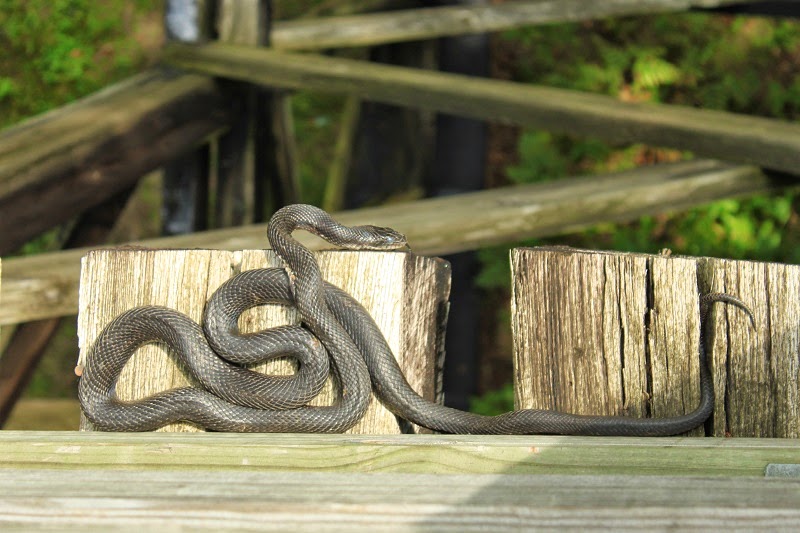
Black snake. Virginia Creeper Trail, southwest Virginia.
Migrating hawks forming a "kettle". Linville Gorge Wilderness, North Carolina.
White-tailed deer. Cades Cove, Great Smoky Mountains National Park.
Coyote/Red wolf hybrid. Great Smoky Mountains National Park.
Alligator Snapping turtle. Outer Banks, North Carolina.
Cottontail rabbit. Blue Ridge Parkway, North Carolina.
A black bear and I surprise one another. Douthat State Park, Virginia.
Bison herd, Hayden Valley, Yellowstone National Park.
Bothersome raccoon. Blue Spring State Park, Florida.
Black buzzard, Manatee Springs State Park, Florida.
Bull elk. Rocky Mountain State Park, Colorado.
Bull elk, Great Smoky Mountains National Park, Cataloochee section, North Carolina.
Grizzly bear, Yellowstone National Park. (Yeah, not a good photo, but I prefer Grizzly bears to be far away.)
Just eight more working days until we hook up the Casita and head to the Outer Banks. I don't really know what to expect, but I'm really looking forward to the trip. Other folk keep telling me that the drive to the Outer Banks is not the nightmare it once was now that several of the two-lane roads have been converted to four-lane freeways. We'll see. Our reservations for campsites are all done so we don't have to worry about that. I suspect that bird life will be similar in variety and number to what I have witnessed in the low country of Georgia, South Carolina, and Florida. So I hope to take plenty of photos of birds while we're there. And alligators, of course. It would be nice to spot some whales. I haven't seen any pilot whales for many years, so I'm hoping to catch sight of a pod of them. We'll see.
These critters were all captured on photo images in Florida, but it's the kind of thing I'm expecting on the Outer Banks.
Gator. Waiting for dinner.
Osprey chick in nest.
Among my favorite and most present of large birds, the Great blue heron.
Next year will be the first year that I get five weeks of vacation. I'm trying to figure out what our big family trip will be. Carole wants to go to visit some first magnitude springs that we haven't seen in Florida. That would be about a week-long trip and would be tons of fun. We always have a blast snorkeling and kayaking the big freshwater springs in Florida. But I was thinking more of hitting a National Park or two that we've never seen. We've long wanted to see Crater Lake National Park, and I dearly want to see the big redwoods and sequoias in California. The deal with a western trip is that they're really expensive, so we have to plan them carefully. At any rate, I'll have a whole 'nother week to play around with in 2014.
I think this was taken at Manatee Springs State Park.
Blue Springs Run at Blue Springs State Park.
Big alligator at Wakulla Springs State Park.
A friendly osprey on the Chassahowitzka River.
Kayaking down the Ichetucknee River in Ichetucknee Springs State Park.
And then there's the allure of those big California peaks. I took this shot near Joshua Tree National Park in 2010.
Most of the wildlife that I notice on my trips are birds. And of the strict birds of prey, the one that I see most often (vultures are not--truly--raptors) are Ospreys. These birds seem to live everywhere I go. Coastal regions. Piedmont. Mountains. Even dry habitats don't seem to keep them away (I reckon they can fly to far-off lakes and rivers before returning home). When I was in Yellowstone in 2010 I saw a lot of them. I noticed a huge osprey nest on a pillar of rock in Tower Canyon not far above the falls. While I was watching, an osprey parent arrived with a large fish for the nestlings. The young were very large and were, I assume, close to being ready to hit the skies. They were so large that I found it hard, once the fish had been dropped off, to figure out who was the parent and who were the babies.
Like every osprey nest I've seen, this one was enormous. What was different about this one was that it was constructed at the tip of a huge spire of rock projecting about 100 feet into the air.
Slightly altered second photo. This one had the nest area in shadow, so I altered lighting and contrast to show at least some detail. If you look closely, you can see the two young osprey tugging at the large fish between them.
Carole and I are relatively adventurous when we go to visit parks. Most people who go to Florida are there for the beaches, perhaps, or the amusement parks. But most folk don't seem to venture out much farther than the edge of the shore.
We tend to go hiking into the forests a lot and to hit the waterways either in a canoe or kayaks or sometimes via water taxis to get out to isolated islands where we can go hiking. That is what we did one day on this trip. We took a boat out to Egmont Key where we spent most of the day walking the trails on the island and seeing what it had to offer.
And, of course, in addition to the historical ruins out there, we also viewed a fair amount of wildlife. Here are some of them:
This dark shape was approaching the boat. The captain took us to see it up close.
Mr. Manatee! This was the first ocean-going manatee we had seen. Most we encounter are in the freshwater springs.
The endangered Gopher tortoise. Egmont Key has a good breeding population of this rare reptile.
Beachside crow.
This baby osprey was way up on an enormous concrete tower that was part of the fort.
The ungainly anhinga in flight.
A bottlenose dolphin on our way back to shore.
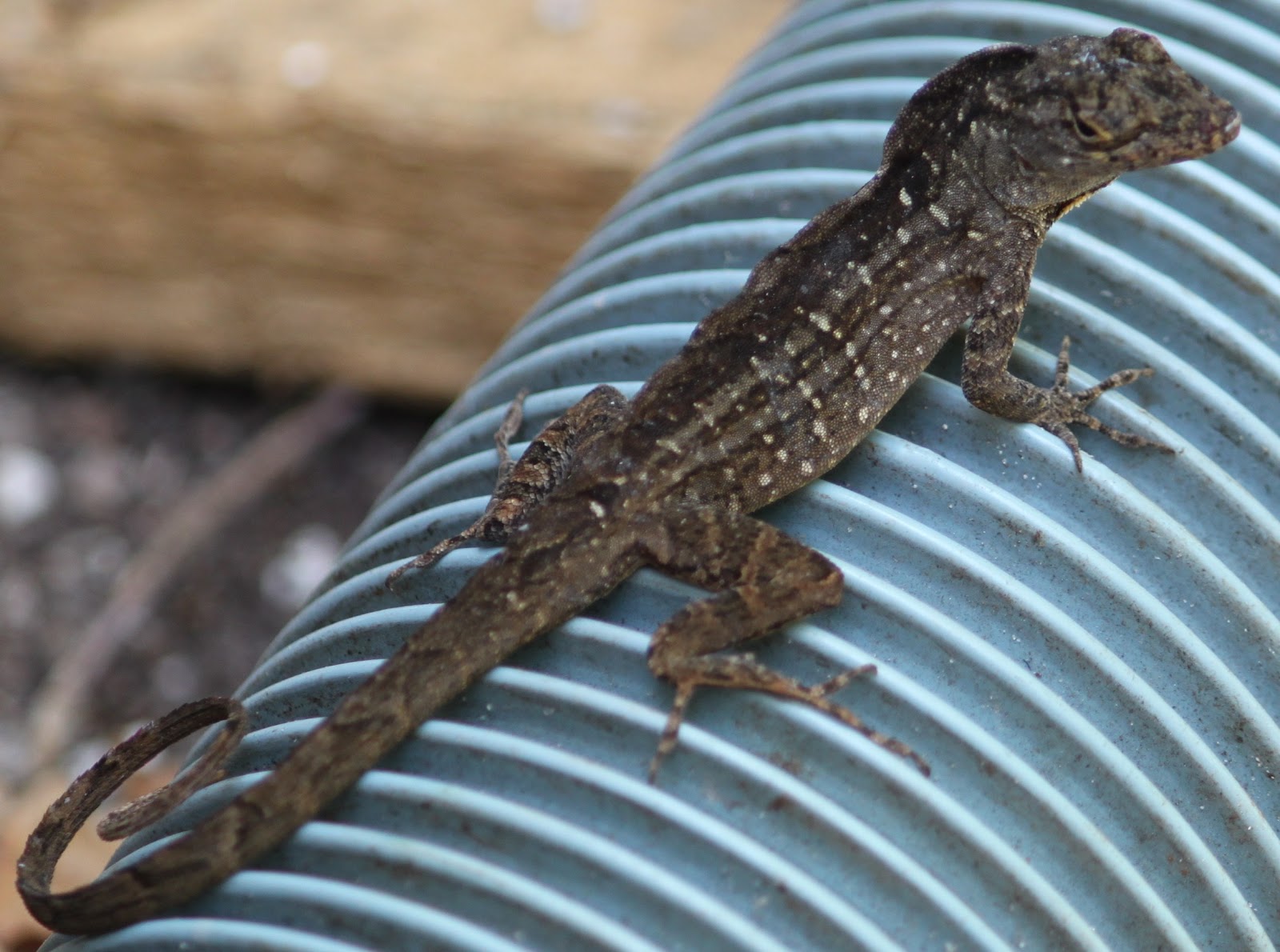
And back at camp, this little lizard was sitting on one of our wastewater hoses.