Wednesday, May 18, 2011

Hopkins Prairie

Whenever Carole and I go camping we always like to take long drives around the areas we are targeting to seek out places not mentioned in most publication or at online sites. As we were driving around the Salt Lake Recreation Area we saw a sign for a spot called "Hopkins Prairie". So we pointed the truck down a long, unpaved sandy road and headed toward it.

What we found was a bare bones National Forest campground overlooking a wildlife sanctuary known as Hopkins Prairie. Now, in Florida, a prairie is not what the rest of us think of as such. It might look like an extensive grassland at first glance, but in actuality the Florida version of a prairie is a shallow lake. Most of the time it's a lake with spans of open water. But in times of low water or no rainfall the water can recede a bit and the grasses take over to make the shallow lake appear as a grassland. But don't try to walk across it, unless you are possessed of supernatural powers. It's still a lake.

We were impressed with the place, including the very secluded campground. It's our kind of camping spot. The day we were there, not a single person was taking advantage of the campground. It was totally empty.

We took a hike around the edges of the prairie to try to see some wildlife, but we didn't have much luck. Apparently the refuge is prime bear habitat and we heard that there are a lot of them about, but we didn't see any, nor any sign of them. We did see a lot of bird life, but it was all pretty skittish and took wing whenever we got close. I missed out on a lot of photo opportunities because the birds would not hang around when they saw me emerge from cover.

Part of the Florida Trail goes through the refuge. As we were hiking on that trail Carole saw this. What is it? she asked. After looking at it for a second I said, "I'm not sure, but if I had to guess I'd say it has something to do with bats."
A few yards farther along we saw this. It was, indeed, a bat shelter.

The Florida Trail.

Click on this stitched panorama I took of the "prairie". It's actually a lake.

When you get close to the edge of the prairie you can see that it is, in fact, a wide body of water with grasses protruding from the shallows.

The bird life there was EXTREMELY skittish around humans. Things that normally put up with us flew away at the first motion from us. I missed some really good potential shots because of their shyness. This egret took wing when it noticed us as it was hunting along the shallows. Normally they're pretty tolerant of people. Not out there on the prairie.

Tuesday, May 17, 2011

Politics and Creative Folk

Sometimes I make a point of trying to avoid the political, religious, and philosophical beliefs of some of my favorite writers and artists. Often I find that creators whose work I had long admired are--politically and philosophically speaking--assholes.

Thus it is with one of my favorite comic book artists Chester Brown. For many years I have admired his work as an independent writer/artist. I supported his comic YUMMY FUR during the months when the book was being attacked and boycotted by an overbearing comic book distributor who is now (happily for me) bankrupt.

Sample art from what is my favorite Chester Brown comic series, Louis Riel, a biography of the Metis revolutionary Louis Riel. (A man who has far more in common with Che Guevara than with any Libertarian scum.)

His work is not only impossible to categorize, but it is almost impossible to describe. It's part fantasy, part autobiography, part biography. It is always thought-provoking and overwhelmingly unique and interesting.

Regular readers of my blog know that I absolutely hate Libertarians. I've never met one that I like and I find their political goals to be completely harmful to society and to almost every individual. I have absolutely no respect on either an intellectual basis or a moral basis for anyone who proclaims to be a Libertarian. (I must make it clear that "Libertarian" does not mean the ACLU which, as a civil liberties proponent protects us all from the shite who compose the various Libertarian parties working to destroy society for corporate power.)

And so it was with shock and disgust that I read that not only is Chester Brown a Libertarian, but that he stands in as a candidate for elective office as a member of the Libertarian Party of Canada. Fortunately he has never finished higher than next-to-last place in any race, and I hope this track record continues.


Will this knowledge that he's part of a wholly evil and destructive political party influence my appreciation of his work? I hope not, but there will always be the subconscious knowledge that he holds as dear thoughts and ideas that I find to be completely and utterly noxious. However, I think that I can still seek out and enjoy his books. As with his like-minded fellow travelers of the extreme right--folk such as Peter Bagge and Steve Ditko--I'll still read and view and enjoy his creations, despite the fact that I find his views to be execrate.


On becoming a whore-hopper.

His latest autobiographic work on deciding to frequent prostitutes.

Monday, May 16, 2011

Do Poplar Trees Attract Lightning?

I love hanging around in the vast yard at Carole's mom's place. Carole's late father did a good job of landscaping the space and of deciding which large trees to leave and he made some good choices in planting trees, also. I almost always concentrate on the two big hemlocks he planted when Carole was just a little girl (over 40 years ago). But there are some other cool trees in the yard.

One of these is a decent sized Yellow poplar tree. Carole's mom hates those trees and if a young one appears on the verges of the yard, she will immediately chop it down if she sees it. I asked her why she did this and she explained to me that "poplars attract lightning".


At first, this seemed like classic bullshit. How could any tree "attract" lightning any more than any other tree. So I did a little research. Apparently some folk contend that the content of starches and such in some trees actually makes those trees far more likely to be struck by lightning. I'm still not convinced and figure it's an old bit of rural bullcrap. But I could be wrong. At any rate, I hate to see almost any tree cut down for no good reason.


I do have a few exceptions. If I see a sweetgum appearing in the yard I will personally destroy it. I hate mucking about with those damned gumballs, even if the tree itself is relatively pretty. And Carole's mom planted a holly tree in her yard. If I ever get the chance I will chop down and kill that son of a bitchin' tree and do my best to eradicate every vestige of its existence.

The big back yard Yellow poplar.

Sunday, May 15, 2011

Down the Amazing Ichetucknee River

Carole and Andy and I had been to Ichetucknee River/Springs before. We took Andy tubing down the river when he was only five years old. In fact, that was the last time we went there, so it has been a very long time since we'd visited.


Ichetucknee was one of my favorite places when I was a young man. I first floated the river when I was nineteen years old and made a number of trips to visit it when I was living in the hideous hell hole called Brunswick, Georgia. In those days the entire length of the river could be tubed, from the head springs all the way to the end of the state owned property. This proved disastrous for the river's fragile ecosystem and there were long runs of the waterway in which almost all of the native grasses and shoreside plants had been killed off.

These days, the park is very protective of the river's ecosystem. You can now only tube about half the river, although the entire length remains open to canoes and kayaks which don't damage the native plants (the occupants are far less likely to get out and walk all over them). So we found that we had the upper reaches of the river all to ourselves for most of that part of the trip. I was pleased to see that the river has completely recovered in the intervening years, now that people are not allowed to slog through the shallows, tearing up the vegetation.

Here, then, is a brief photo essay of our float down the river and our trip to swim in the river's head springs.


This was the put-in point for us. We used the services of Ichetucknee Family Canoe and Cabins which is just a few hundred feet from the park entrance. They were very good, with friendly owners and reasonable rates for the rentals and shuttle services.


The river quickly opens up and reveals its beauty.

I was surprised to see spider lillies in bloom. I didn't know that they grew there.

Room to go under!

Moss-draped cypress trees line the shores.

These common river turtles were literally EVERYWHERE we looked.

In short order the river began to widen and deepen as flow from more and more side springs were added as we floated along.

This is a spot where we stopped to go swimming. There are deep holes all along the length of the river, some of them ten feet or more.

Typical view looking into the cypress groves.

Back in the days of my youth, this limestone bank was a popular jumping and diving area. These were activities which caused destruction of plant life, so it's not allowed anymore. And if you think you can get away with breaking the rules, don't try. This park is HEAVILY patrolled by rangers who don't hesitate to enforce the laws.

More spider lilies.

Tubers began to show up at the halfway point. This is where they are allowed to put in, where the water is deeper and dangling legs and swimming people are far less likely to damage the river vegetation.

You want beauty? We got beauty.

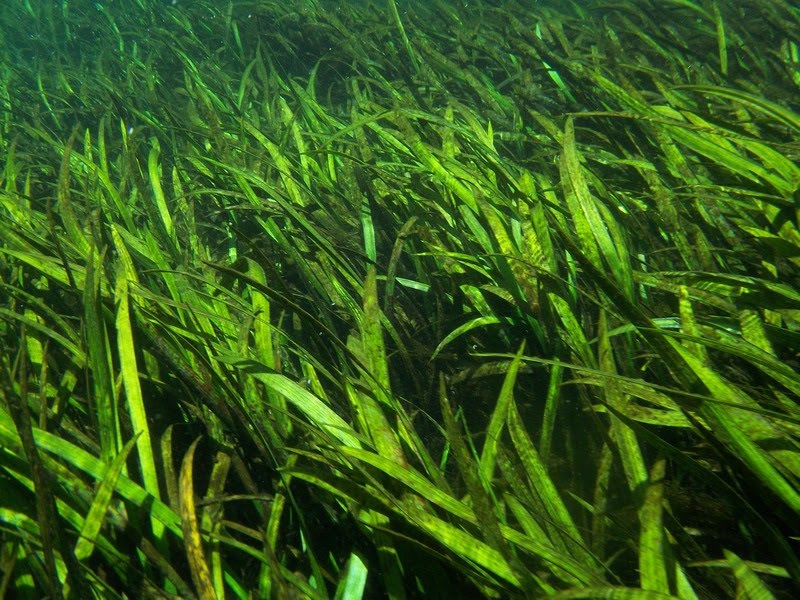
When I was a kid, whole portions of the river had lost the river grasses that are supposed to grow there, supporting an array of life.

The current causes the grass to sway gently in the air-clear water.

There are some spots where the river grasses have not recovered, even after a couple of decades of protection.

Looking down on The Blue Hole, one of the most impressive springs in the park. You can see the fence that prevents passage by people from the spring into the run that flows into the Ichetucknee River. When I was young, you could swim/tube from the spring into the river, and the tributary had been denuded of plant life.

Looking down into one of the big spring fissures at The Blue Hole.

Carole took this of me as I climbed out of The Blue Hole onto the dock and boardwalk.

This is the main headspring with many Homo sapiens present .(In summer it gets so packed with people you can barely find a spot to stand.)

A snorkeler was swimming out of the main fissure at the headspring as I snapped this shot.

Saturday, May 14, 2011

In Flight

Because of the new camera and the telephoto lens capability, I've been lucky enough to catch a few birds in flight and obtain some decent images. Since I won't take this camera out on the open water in a small craft, I've missed some good opportunities, but generally I've been pleased with the results. As I get used to using this camera I'm hoping that I can eventually nail some really top-notch photographs of animals in motion.

This is a cormorant that I saw on the ferry ride back from Egmont Key.

Each afternoon our campsite was in what seemed to be a flight path for many of the species of birds that inhabit the island. I kept taking photos of the brown pelicans but just couldn't get the right composition. Finally, I succeeded in getting a shot close to what I was aiming for.

There are a LOT of ospreys on the island where the campground is located. Every afternoon they would congregate on the shore and scan for fish, hovering just over our campsite. Their calls were not at all what I would have expected from a top predator. The sounds they make are more what you would expect from a songbird.

I wasn't really looking to take photos of the common gulls around the area, but this one came out pretty good.

This shot was not at Fort DeSoto but was taken at Salt Springs. The buzzard was very high up and quite a distance away, so the image is fairly nice, all things considered.

Friday, May 13, 2011

TUROK #596

My latest acquisition for my comic book collection is this issue of Four Color #596, which is the very first TUROK comic. I covered the book in a little detail previously. In my day, I had most of the issues at one time or another, but I'd like to assemble a full set. Getting this one out of the way was a lucky break for me, so I no longer have to worry about getting a copy of the most expensive issue.

Four Color #596, the first issue of TUROK, SON OF STONE. Indians and dinosaurs! What could be cooler?!


On the writing front, DEAD BAIT 2 is now available in Kindle as well as trade paperback. My story in this book, "The Krang", is one of my best short stories. Set in my mythical nation of Mangrove, it got me interested in doing more stories and novels in that fantastic world.

Thursday, May 12, 2011

Lithia Springs

Carole and I love to bag the various springs in Florida. Our favorites are the first-magnitude springs, of course. But we also enjoy the second and third-magnitude springs. Lithia Springs was on our list so since we knew we were going to be in that area, we made a special effort to drive over to go swimming and snorkeling there. Once again, it's not a state park site but a county park. This time it's Hillsborough County that owns the spring and environs. There's beautiful forest and even hills around the spring, but unfortunately some nearby land was not protected and there's some kind of huge construction going on at one side of the park. I couldn't tell what it's going to be--but anything is bad news for the park, considering the proximity of the development. Even if it's a golf course it's going to screw up the wild feel of the forest and streams.


Since we visited on a weekday we didn't have to deal with crowds. Considering one lot of low-class jerks who seemed to be everywhere at once, I can only shudder at what it must be like when the place is packed. So I'm really happy that we were able to sample the spring on such a low-attendance day.


As springs go, it's fairly impressive. The deepest sections are right above the spring head, about nine or ten feet deep. The spring has been covered with an iron grate to keep the local idiots from killing themselves in the cave system from which the water pours. There also seems to be some kind of water extracting going on above the spring--I suspect either the county uses it as a freshwater source or perhaps a bottling company. At any rate, someone appears to be drawing water out of the aquifer there.


Despite the minor quibbles we had with the park, it's well worth a trip if you can arrange it on a day when the spring isn't packed cheek by jowl with humans.


The sight of the springs that greeted us after we paid admission at the park gate and changed into our bathing suits. There were only about a dozen other people there, so it wasn't hard to get a shot with no people in it.

I dove under the surface and began to swim toward the main spring. This was just above one of the rock shelves.


The spring has been covered with a metal grate to keep people out of the extensive cave system that permeates the soluble limestone rock through which the water pours. The mist looking clouds are sand dislodged by others from the rock shelf. The spring pressure sends it back up, making it appear cloudy in places.

I liked the dappling effect of sunlight filtering through the clear spring water.

Lying on the floor of the spring.

The weather was good to us the whole trip. This was typical of what we faced each day.

A stitched panorama of the entire spring area. Deepest section farthest from me. I used the cheap underwater camera for this image, so it's not very good.

Tuesday, May 10, 2011

Three Campsites

Carole and I love Florida parks. Everywhere we stay the facilities are generally excellent and most often superlative. There are few state parks or National Forest campgrounds anywhere we've stayed that even come close to the parks and forest campgrounds in Florida.

On this trip, we used three different campgrounds. Our first two nights were spent at the Salt Spring Recreation Area Campground which is a National Forest site. The US government bought it from private concerns in the 1970s and ever since it has been a Federal area. Because it was originally in private hands and was a commercial campground, it has one thing at every site that few other Forest Service campgrounds can boast: sewer hookups for travel trailers. This was the only public campground where we've stayed that had this option. It was nice to not have to pull up to a dump station and wait in line to dump the gray and black water tanks.

Our campsite at Salt Springs.

After the second night we moved on down to our primary destination, the Fort DeSoto Park in Pinellas County in the Tampa/St. Petersburg area. We'd found this park by accident on a joy-ride while visiting central Florida several years before. Back then we were floored by the park and thought that it was one of the most beautiful beach state parks we'd ever seen. It was (and remains) one of the most beautiful oceanfront public parks we've ever visited, but we were wrong about one thing:

It isn't a state park. It's a county park! Pinellas County has, in Fort DeSoto Park, one of the greatest county parks I've ever heard of. The place is pretty big (over 3K acres) and it's hard to believe that you're so close to such a huge urban area. The beach and forest areas are pristine, packed with wildlife, and there is so much to do that the idea of leaving the island seems to constantly be a bad one. At the risk of making the place more popular than it should be, I have to say that it's one of the finest parks we've ever visited. I can't say enough good things about it.


Campsite at Fort DeSoto Park, front view.

Casita and stuff as we were unpacking. (The accordion contraption is a clothesline for drying clothes.)

Rear view of the campsite at Fort DeSoto. The sites are really big to accommodate the enormous rigs rich folk have.

This was the view we had from our site, looking out into the bay.

One of the many, many, many bird visitors we had at our campsite at Fort DeSoto. They would generally arrive in larger numbers at low tide, as this ibis did.


After our five-night stay at Fort DeSoto we pulled up stakes and headed for O'Leno State Park. We chose this one not because of the park environs, but because it's so near Ichetucknee Springs State Park which was our main destination for the last two days of our vacation. Once more, we were rewarded by fine facilities in Florida State Parks. The site was spacious, shady, and had water/electric hookups. And we had only a nine-mile drive to the Ichetucknee Springs and River complex where we wanted to spend most of our time.

That said, O'Leno is a good destination in and of itself. The park is beautiful, has a lot to offer in the way of swimming, canoeing, fishing, hiking, photography, and history.

Just after our arrival at O'Leno State Park.

After a day of swimming at Ichetucknee Springs.


Brief video of part of our fantastic kayak ride down the deserted Ichetucknee River.