Sunday, September 02, 2007

Boo, Mars!

Like all readers of science fiction, I grew up dreaming about the colonization of Mars. I read all of the Martian sf out there and hoped to someday see Von Braun’s illustrations of a trip to Mars become reality.

Alas.

Now that we’ve had a number of landers on Mars and the rovers and orbital observers hovering over the Red Planet for years, I’ve come to the conclusion that the place is just a hellish ball of rock not worthy of much attention at all.

The atmosphere is just the tiniest fraction of the Earth’s. And what “air” exists there is extremely toxic. The place has been oxidizing for billions of years, and who knows how poisonous even the soil may be. It may be that the very dirt will react negatively with whatever moisture we bring with us.

And dry! Great Jove, the place is drier than the driest spot on Earth. The entire planet is so cold and so dry that microscopic bits of the toxic soil is wafted into the air in global storms of dust so fine that it’s practically on a kind of molecular level. There’d be no way to even filter that shit! And so cold that carbon dioxide freezes out as a solid onto the surface of the planet from pole to pole.

In addition, Mars seems to be geologically inactive, and has been for quite some time. There are no plate tectonics going on, no current volcanism, and only a boring cycle of airborne sedimentation taking place for the past couple billion years.

I hate to say it, but fuck Mars. As a stopping-off point, it may be worthwhile as a base. But as far as colonizing that hideously cold and dry turdball—it’s a pipe dream.

Alas!


Tuesday, August 28, 2007

Made the summit!


We just returned from our trip to New Hampshire/Maine.

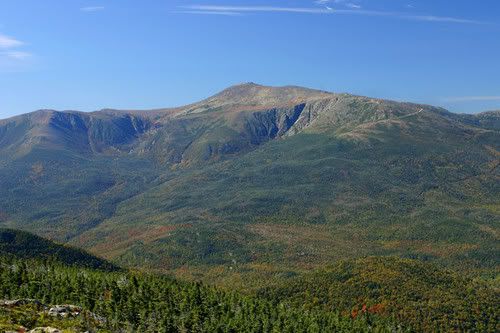
I managed to summit Mount Washington in really pea-soup thick fog, 40mph winds. Conditions sucked above 5200 feet, but were pretty good below a mile high, so I got some good photos in the glacial cirques.

I'll post more about the trip later. For now, all I can say is that the Presidential Range is so far the most spectacular mountain range I have encountered in the eastern USA.

Saturday, August 18, 2007

Another Hiking Goal Within Reach.

When I was a kid first starting out in my life-long hobby of hiking and backpacking, one of my goals was to climb Mount Washington in New Hampshire. Years of poverty and family responsibilities kept me from realizing that goal. I was able to hike to the summits of most of the other eastern peaks that were on my to-hike list, but Washington, legendary though it is among east coast peaks, stayed out of reach.

Now, at the age of 50, I’m finally heading to New Hampshire to climb it. Weather permitting (and Mount Washington is world famous for its horrid weather extremes); I’ll hike from base to summit on Saturday, August 25, 2007.

Wish me some luck. Or loan me some good karma.


(Photo copyright by Partick LaFreniere)

Wednesday, August 15, 2007

Maybe I Should Make an Offering?


Oh!

Bad karma?

First, the washing machine went kablooey. Our repair lady came out and looked at it and pronounced it mortally wounded. We ordered a new one and it took a week to come in. The delivery fellows set it up, turned it on, and left before fully checking it out. Seems it’s missing a pump! Water goes in, but can’t drain. More phone calls. Manufacturer is sending a new one, but can’t be delivered for at least three days. More trips to the laundromat. Joy.

Four days ago my neighbor’s cable goes out. He calls the repairman. Repairman tells my wife that our cable will be out for a little while as he works on the neighbor’s system. Repairman buries neighbor’s new cable and he leaves without checking to see how our system is doing. Seems he cut right through our cable. I phone the service (Time-Warner) using my wife’s cell phone since we have all of our service bundled and as the cable is cut clean through we can’t use the land line. They tell me that they can’t come back to fix things for three days. I couldn’t care less about the TV, but I need the phone and the internet service. I do without for three days. Jolly good.

In the meantime, the gods are not happy with us here and we continue to suffer under triple-digit temperatures. As I work as a laborer in the sun, this is not good.

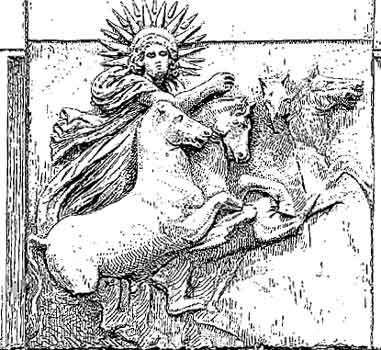
I must make obeisance to Helios at the earliest opportunity.


Sunday, August 12, 2007

The "N" Word

I was raised in a home that was pretty much devoid of racism (and religion). If I could look back and say that there was any racism at all in the household of my parents, it would be of the condescending type—as that exhibited by many white progressives of an earlier era that they would take care of black people and help guide them.

The first time I heard the “N” word (that I can recall) was when I was about five years old. I was at the home of some distant relatives and saw two kids at the split rail fence separating their yard from the one next door. Two kids about my age were at the fence so I went over to talk to them. Soon, we were chatting away, and all I cared about was making new friends. Quickly, though, the resident kid at the house we were visiting walked up. He was a distant cousin a couple of years old than I.

“What are you doing?” he asked.

“I’m talkin’ to these kids,” I told him.

“These are niggers! What are you doin’ talkin’ to niggers?” He turned to the little kids on the other side of the fence. “Go on, niggers!”

I’ll never forget that the kids smiled and then turned and ran away into the shade of their own yard. Even then, I was upset, not understanding what was going on, and I had never before heard this word that my cousin had used on the other children.

“My daddy says your family are all nigger-lovers.” And he walked away to vanish into his house.

For myself, I quickly located my father and was only too happy when I discovered that he was ready to leave, having conducted whatever family business he was about, and we climbed into his pickup truck and headed home. Along the way I asked him what a “nigger” was. He told me that it was a very nasty and evil word and told me never to use it. “Never,” he repeated.

I never did, except later in life, when I found I couldn’t get around it in portraying the language of certain fictional characters. You can’t bury the damned thing, any more than you can delete any number of hurtful and nasty ideas. All you can do is ignore it when possible and vow not to use it as it was intended—a way to dehumanize another person.

As I grew up, it almost became something of a badge of honor that my family were often referred to as “nigger-lovers”. My parents were always outspoken on civil rights for all people in a time and place that made such speech very dangerous. That my dad ran a local business that was dependent on the goodwill of the community made their speech all the more courageous. On that issue, I am quite happy to have grown up in such a home.

In recent years, as I have become more and more focused on the destruction of the ecosystems that support all of the life of our planet, I have often been accused of being a “tree-hugger”. As if this were a negative thing. And I was reminded immediately of the days when my parents, and myself, were labeled with that earlier epithet, and how similar in sound are the two terms.

I accept the sentiments of both.


Wednesday, August 08, 2007

BY HELIOS!

It's hot. That's all there is to it. 101 today, and we may hit 103 tomorrow. Southern heat, too. None of that pansy western no-humidity heat.

You don't know what hot is unless you're a laborer and have to work out in that miasma all day long.

If I hear one more asshole say that there's no such thing as man-made global warming, I'm going to kick his ass.


Mill Creek Falls. Where I went swimming in June, three years ago. I dreamed of it today.

Sunday, August 05, 2007

Libert-Aryans and Other Rude Surprises.

Sometimes I regret reading the personal views of creators whose work I admire. There are moments where one gets the nastiest surprises.

Take, for instance, Peter Bagge. For years I enjoyed everything he did, from Neat Stuff to The Bradleys to Hate. Funny stuff, and he’s one of the best cartoonists around (although why he insists he wasn’t influenced by John Stanley is beyond me). His toons are fun to look upon, generally humorous, and occasionally insightful.

Now, one of the many, many, many things in this world that I completely loathe are Libertarians. I freaking hate Libertarians. They truly and completely make me sick on my stomach. They are the same sort who would have been brownshirts in the 1930s. Republicans who like to smoke dope, one of my friends calls them. I wish they’d all fall over dead.

One day I was sitting in an office (I forget where—might have been for a medical checkup or something) and I noticed a copy of the right wing extremist Libertarian rag, REASON. Normally I wouldn’t give such a monstrous publication a second look, but either Bagge’s name was on the cover, or it was open and I noticed Peter Bagge’s name. Something made me pick up the lousy damned thing.

I opened it and saw that there was a cartoon in it by Peter Bagge. What’s this? I wondered. Have these fascistic bastards commissioned a piece by Bagge? I read the ridiculous bit of neo-Nazi propaganda and realize that not only was it not commissioned, it was a heartfelt piece by Bagge himself. Later, at home, I got in touch with some friends and learned that Bagge is a regular contributor to the Libertarian/Fascist magazine! He actually believes in that shit! GOOD GOD!!!

Now, I didn’t go about tossing out my collection of Peter Bagge graphic novels and such, but I did go through them and reread the stuff. And I realized that, specifically, the selfish bastard Buddy Bradley was not some concocted creation, but Bagge’s cartoon persona. And I realized that the golden, blessed fairy tale world in which Buddy lived was not God out of the Machine, but the twisted view of the world as envisioned by Bagge! Or, perhaps, the charmed life that Bagge was himself living—a cartoon analog of his own real world movements through the comic book industry.

At any rate, I realized that I’d have been much happier never having known that Peter Bagge is the modern equivalent of one of Mussolini’s pals. I’m sure I’ll still laugh at Bagge’s stories, but there will always be that germ of understanding that it springs from a mind infected by a truly diseased system of beliefs.

There have been other such incidents, of course. When I discovered that Steve Ditko, creator of The Amazing Spider-Man and Dr. Strange, was a follower of that monstrous whore, Ayn Rand, I was disappointed, but still went about searching out his crazed comic book manifestos. It made it easier to understand why he walked away from his gig at Marvel Comics, and also made the underlying themes of Peter Parker’s sense of personal responsibility during the years the book was written by Mr. Ditko. I really missed the overpowering angst that left that comic with the departure of its one true creator.

But it didn’t make understanding that one of my favorite comic book creators was a right wing nutcase any easier.

There have been a number of other such cases throughout the years. For some reason, SF writers tend to be pro-corporate stooges. Imagine my discomfort upon learning that many of my favorite sf writers are just a notch or two this side Uncle Adolf. Alas!

Ah, well. We can’t live closed off in a bubble. I’ll continue to read the stuff that appeals to me, and I’m sure I’ll continue to discover the unsavory belief systems of many of the folk who write and draw and direct the things that help me to while away my leisure time.

Tuesday, July 31, 2007

Hail Mark Martin!

Featured here is the latest addition to my somewhat jumbled attempt to reclaim the toys of my first childhood as I enter my second childhood. Years and years and years ago I had tons of plastic models kits and toys and giant piles of comic books. Of course I destroyed and lost the toys as I got older and sold the comic books for food money when I grew up.


Slowly, and haphazardly, I began to reassemble both the toy and comic book collections of my youth. Recently, at the web log of noted funny man/comic book creator/graphic artist Mark Martin, I saw a collection of classic Universal monster toys he’d found in a dump. I expressed some interest in the figures. As he had an extra Creature from the Black Lagoon, and the heart of a young boy (which resides in his chest and not in a jar on his desk), he mailed me the inert menacing orange critter. Out of kindness.

Mark Martin, King of Funny Books!

Sunday, July 22, 2007

Blackwater Canyon, West Virginia.


Blackwater Canyon is located in the Allegheny highlands of West Virginia. Cut by the Blackwater River, the gorge averages well over 500 feet deep and it remains a relatively pristine area filled with a vast forest of hemlocks, pines, poplars, and oaks.

A bit over 2,000 acres of the canyon is preserved as Blackwater Falls State Park, one of West Virginia’s premiere parks. There are a number of canyon rim trails, a ski slope within the park, a lodge, cabins, and a campground. For sheer physical beauty, this is one of the most beautiful parks in the Southeastern United States.

There are a number of spectacular waterfalls here, most notably Blackwater Falls, a 57-foot drop that displays the dark water for which the river and canyon (and falls) are named. The water is darkened not from soil runoff, but from the tannins created by the mildly acidic effects of the many hemlocks trees that clothe the canyon’s slopes. While the hemlock wooly adelgid that has decimated the forests farther east have recently been reported in the park, they have so far not destroyed these trees. However, unless there is a wide-scale application of the insecticide imadacloprid, these forests will fall to extinction as have those from Virginia south to Georgia.

No official trails find their ways to the canyon floor, and travel into the canyon itself is not encouraged. However, there are a number of unofficial trails and manways that weave down from the canyon rim and to the floor of the gorge. The best of these descends from Pendleton Overlook and is relatively easy to follow, if not so easy to negotiate. Some scramblers periodically leave nylon ribbons along this manway to keep hikers from straying too far into the maze of rhododendron hells. Use of these manways, while not encouraged, is not prohibited. Just use common sense when climbing down the extremely steep slopes into the rugged canyon floor.

Over the past few years, the canyon has been at the center of a drive to protect the lands that are not currently within the boundaries of the Blackwater Falls State Park. Efforts to preserve several thousand additional acres failed when the landowner sold the property to a timber company which desperately wants to log the canyon of its timber and leave the place devastated and unsuitable for a park. Additionally, this company is even lobbying to be able to move the timber from their logging operations through the existing park. Only time will tell if conservationists will prevail in creating a new National Park in this place, or if yet another corporation will succeed in raping the land for short-term profits.

There are a number of rare and endangered species that live within the Blackwater Canyon, and hopefully the presence of these living things will aid in stopping any further logging operations by the Allegheny Wood Products company. It would be a shame and a crime to lose this phenomenal landscape to the depredations of another greedy corporation.


Sunday, July 08, 2007

The Flock promotional.


(It's been almost a year since publication of my first novel, The Flock. In honor of that publication, here's the promotional packet that saw the novel through to a sales success.)

SALUTATIONS USA is the ideal town built by Berg Brothers, the studio that for generations produced family films. Constructed on a parcel of the decommissioned site of what was the Edmunds Bombing Range, it is the great Studio's intention to create a place that is what America once was, with room to expand.

But the land beyond Salutations is wilderness--450, 000 acres protected from development because of its former military status. Other forces struggle against the company for control of those acres. Vance Holcomb, billionaire ecologist wishes to construct a research center, saving the rare habitats. Winston Grisham, retired Marine colonel, wants all parties away, capitalist exploiters and meddlesome tree-huggers alike; he and his militia wish to be left alone. Ron Riggs, Fish & Wildlife officer wants to know what is lurking at the edges of Salutations. And the lawyers slug it out in the Florida courts.

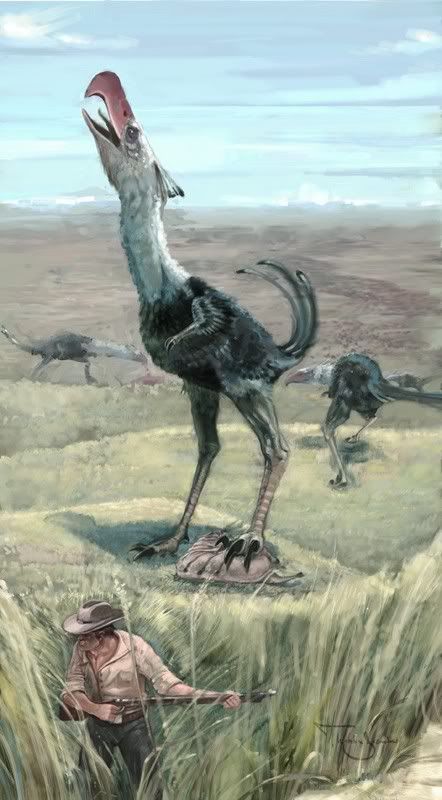
Unknown to most, this backcountry is home to the last population of a creature believed extinct: Titanis walleri, a predatory ground bird of saurian form. The creatures, possessed of near-human intelligence, have hidden since the first Native Americans came from the north. With humans on the doorstep, knocking to come in, the Flock does not wish to be disturbed.

The Flock is the story of the conflicts between developers and protectors, between warriors and thinkers, between Mankind and a creature not unlike the theropod predators they so resemble in body and spirit; an adventure and suspense novel of epic proportion.


Friday, June 29, 2007

The Legendary Big Five-Oh.

Well, I turned 50-years-old yesterday (June 28). Had my complete physical today and got a clean bill of health, (pending results of blood work). And I feel good. I’ve only gained back ten of the forty or so pounds I lost last year, so it’ll be easy to lose those. Last week, I hiked one of the toughest trails in the eastern USA, and did it without any trouble, so that’s a good sign for an old codger.

Strangely, I’m more physically active now than I have been since my high school days. I assume it’s partly due to the fact that I make more money and I have more vacation time than at any point in my life since those days of my youth. Every month finds me camping and hiking and traveling all over Appalachia where I bushwhack to waterfalls and bag various peaks that intrigue me.

My writing career is going pretty good. I’ve got a very cool deal in the works and I’m hard at work on my latest novel which has suddenly turned the corner so that I was able to work out a nagging problem with the plot. All in all, I have to say that the World is treating me pretty good right now. Yes, there are the obvious political and ecological nightmares that I have to acknowledge each day. But, for now, I find contentment in searching out the world of Nature that yet exists and celebrating that world by immersing myself in it.

So far, Fifty feel pretty darned good.


Sunday, June 24, 2007

The Black Mountains have it in for me.

Western North Carolina is home to the Black Mountains, the highest range in the eastern USA. They top out at Mount Mitchell—6,684 feet above sea level (2037 meters for all of you outside the USA). I visit the range two or three times a year, and go on extended hikes there as often as I can overnighters if I can arrange the necessary time for that.

Over the years, the roughest hikes I’ve taken in the southeastern US have been those I’ve found in this compact range of peaks. Before this past week, the toughest of these trails had been the Black Mountain Crest Trail, which traverses the spine of the range over approximately 13 miles from the base of Celo Knob to the summit of Mitchell. It’s a tortuous route of ups and downs taking you steeply to the very mountaintops and down into deep gaps over and over, hitting a number of the tallest peaks.

But I’d heard that one of the side trails connecting to the Crest Trail was notorious for its difficulty. Setting up a base camp with my fiberglass travel trailer at the Black Mountain Campground (operated by the National Forest Service) in the shadow of Mount Mitchell, I decided to finally see just how tough the Woody Ridge Trail truly is. Early on Monday, June 18, I drove out of the campground and headed for SR1155 a few miles away. After one wrong turn (the map I had showed the trailhead on SR1157, which was wrong) I found the trail at the back of a parking area on the dead end of SR1156.


Loading my pack, I headed up the trail, happy to see the familiar signposts used on trails in the Pisgah National Forest. I do a lot of hiking in wilderness areas where trails are relatively unmaintained and not signed at all, and lacking a certain sense of direction, I’m always happy to see the NFS signage. In quick order I entered a very deep and healthy cove hardwood forest, left behind the stream at the trailhead, and began to climb.

At first, I figured the stories about the difficulty of Woody Ridge were overblown. It was steep, but nothing like I’d heard. The first ¾ of a mile or so were merely a steady uphill slog through a classic southern hardwood forest. The goings was quite pleasant and I was enjoying the woods, wondering what all the fuss was about concerning this trail.

At about a mile the trail met up with a logging road and took a sharp left turn up the ridgeline. Soon after this, I began to learn why the trail had its well-deserved reputation. After passing through a strange and very pleasant section that goes through an extended patch of grasses beneath tall hardwoods, the trail suddenly begins to tackle the steep ridgeline straight-on. There are none of the familiar switchbacks of most Appalachian trailways. You go forward and up, pushing and sometimes having to grasp nearby trees and rhododendron shrubs to continue higher up the peak.


The trail map I had listed the Woody Ridge Trail at 2.2 miles in length. Trying to figure my pace, I soon realized that not only had this map gotten the trailhead wrong, but also the distance of the trail. There was no way this was a mere 2.2 miles. After a couple of hours of constant uphill, some of it tough scrambling over expanses of exposed rock and the twisted root systems of hemlock trees (dying, of course, from hwa), I was nowhere near the summit. Once again, the Blacks were proving to be home to yet another of the toughest trails I have hiked.

Knowing at this point that the map wasn’t right on distances, I realized that I was going to have a longer day than I had thought when I’d started. This wasn’t a problem, as I had loaded about a gallon of water into my daypack, along with the emergency essentials I always take when I hit the trail. A longer day was not going to be a problem. But at 50 years of age, these steep slopes were taking a toll on my old lungs and legs. I pushed on.


Finally, I broke out of the changing forest (it had gone from strictly hardwoods to a mix of dying hemlocks interspersed with oaks and some spruce) onto an exposed ridge. I thought that I must certainly be getting close to the summit, and so climbed out onto a high boulder to get a better look at the heights before me. And I realized I was still a good 1,000 feet from the top. Putting my shoulders into the mountain, I headed on and up, stopping from time to time to catch my breath, wipe the sweat from my brow, and halting now and again to catch my breath.

Once again, the Black Mountains were kicking my ass.

Finally, after passing into the spruce-fir regions of the range, I was near the summit of Horse Rock, the destination I’d set for the day, and the peak nearest Celo Knob. I came out onto a cliff face where I dropped my pack as the only other hiker I’d meet that day arrived with two dogs to join me on the cliff. I chatted for a bit with the young guy—a local who lived at the base of the mountain—and to feed cookies to one of his friendly mutts. He soon headed back down, and I had the cliffs to myself as I rested and waited while cramps traveled the insides of my legs, doing their best to twist me into pretzel of pain. But I just lay there and kept my legs straight, enduring the pain and waiting for the cramps to pass while I drank down water and ate a few cookies and tried to get some minerals back into my system.


The stroll to the very top of Horse Rock was relatively easy from that point, with the exception of having to pick my way through the confusing maze of a spruce forest. There is nothing as confusing to me as having to find my way through a maze of spruce trees. Every trunk looks the same, and the uniformity of the trees and the rusty lay of old needles on the ground produces a daunting sameness that can get you lost in a hurry. I always move slowly and deliberately in these kinds of woods, having gotten lost in this forest type no less than three times in my life.

I then headed back down the mountain, and the Woody Ridge Trail reminded me every step of the way why it has its reputation. I steadied myself on steep slopes with my hiking staff, and halted my downward gait by grasping the odd rock and tree and shrub as I went down and down. Once more I was passing through forest zones, this
time in reverse order. Out of the spruce-fir region and into hemlocks and then hemlock/poplar mix and finally into the familiar and beautiful cove hardwood stands.

At about 4,000 feet or so above sea level, I made my mistake. Gazing up at the big trees, I missed the right turn on Woody Ridge Trail and instead took a logging road in error. It was only as I reached the intersection of this logging road with another that I knew I’d taken a wrong turn and would have to turn back and climb at least a thousand feet back to the intersection. Looking back up the steep slope I just couldn’t bring myself to climb back up the mountain to where I’d made the mistake. I looked at the intersection of old logging roads and saw one that led sharply to the right and figured that would take me back to a point close to where I’d left my truck.

Heading that way I continued to descend the mountain, passing out of National Forest lands and onto what must have been private property, for the forests gave way to a vast expanse of mountainside that had been recently logged to the bare ground. All around me were tree stumps and twisted snags of trees cut and run over by bulldozers and flatbed trucks. I headed into a deep valley and after picking my way down what appeared to be a graveled drive, I found myself in the parking lot of a small Baptist church. Stopping to drink down some of my dwindling supply of water, I pushed on and came to SR1154 and knew I had to take a right to 80S and then another right to SR1155 and then back to my truck.

The four-mile hike along the highways was rough. In the full sun I soon depleted my water and by the time I made my truck, I was feeling totally exhausted and dehydrated. I had four bottles of water waiting in the cab, and soon had emptied those. I sat for a while in the cab of my truck, running my AC full blast and doing my best to cool off. As soon as I felt able, I put my truck into gear and headed back to my campsite at the Black Mountain Campground.

The trails of the Black Mountains almost always get me in ways I don’t expect. I’ve been lost in them twice, have leg cramps almost every time I go, and yet I know I’ll go back. I reckon I just like a challenge.

Friday, June 15, 2007

Cat Karma?

Almost every writer I know has at least one cat. We had three. Cinnamon, our oldest, died after 20 years. Callie, our youngest, vanished one day. We don't know what happened to her. Sophie, our middle cat, and weirdest cat, grew very happy with being the only cat in the household. She loves it, in fact. Always quirky, she came into her own once she was Lady and High Mistress of the home.

Last week, a young stray cat showed up at our door. A very sweet cat that was obviously accustomed to lots of attention. She's quite affectionate. As she was hungry and rather disheveled, we bathed her and fed her and set her up a place in the garage. We don't want the cats mixing until we've had a chance to take her to the vet for shots and a checkup.

At any rate, Sophie is NOT HAPPY with the arrival of the new cat (we've named her Molly). Every time she sees Molly through the front door or the garage door, she puffs up and hisses. Hopefully, she'll be a lot friendlier once Molly is settled in for good.

For now, though, Sophie is not the happy cat. We've mentioned the concept of karma to her, but she's having none of that.


Tuesday, June 12, 2007

Life is short.

Life is short. The wilderness beckons. The hemlocks are dying. As I approach the age of 50, I struggle to see as much of Nature as I can before She fades.


Friday, June 08, 2007

The Hemlocks are Breathing their Last.

Well, I knew the day was coming.

In western North Carolina, and especially in the Great Smoky Mountains and points north and south, it’s all but over.

The hemlock trees are all but history in those areas. What we call “hwa”, the hemlock wooly adelgid, has pretty much run its destructive course and all but a handful of hemlock groves are now completely dead or barely hanging on.

As I said, I’ve know for some years that this day was coming, but it doesn’t make it any easier to take. I feel very sad about this, but also extremely angry. Our government could have taken steps to save these trees and their accompanying ecosystems from destruction, but it was more concerned with committing mass murder in Iraq than in preserving two species of tree.

The Carolina hemlock and the eastern hemlock species are likely doomed to extinction, much as we saw the demise of the American chestnut tree. Yes, there are banks of seed and groves planted far away to serve as a source of new genetic material if the day arrives when the adelgid on these shores has breathed its sap-sucking last.

But all it would have taken is the application of an available adelgicide on our hemlock groves to save at least some of them until biologists could come up with a solution to put a stop to the invasive insects that have destroyed our southern and eastern groves of hemlocks. But more hideous priorities took the monetary pie into which we might have dipped.

And so it goes. Mankind has its twisted priorities.


Dead hemlocks along the Cherohala Skyway. (Photo by Will Blozan)

Wednesday, June 06, 2007

The descent into Scot's Gulf.


Scot’s Gulf
By
James R. Smith


Gravity
and Young Man River
conspire
to part the thighs
of Mother Earth
And, O!
Clear pools, home to
trout
and from yielding stone
there is fertile ground,
poplars and
hemlocks
And oaks and pines and
thistles and laurel
and trillium
trillium
trillium


The wilderness beckons.

Cold, clear pools.

A carpet of green ferns along the forest floor.

Virgin Falls, from a cave, down the cliff, and back to the netherworld.


The old forests clothe the yielding slopes.


And, along the way, one is never alone...

...never alone...


...never alone.

Sunday, May 27, 2007

Ernest Thompson Seton.

Every once in a while someone will ask me who was the greatest influence on me in relation to my writing.

I never hesitate. The answer has always been Ernest Thompson Seton.

I’m now almost 50 years old, and even by the time I was eight years old—when I first discovered Seton’s work—he was already largely forgotten by American youth. Between the time he began writing and the 1930s, he was one of the most popular American writers, not only for the youth at whom he aimed much of his work, but also quite popular among the general reading public.

Many of his collections and novellas were best sellers in their day, and his artwork was highly regarded and published worldwide.

For myself, I had to discover his work in the form of second-hand books I’d find in libraries and in the stacks in one or another of my dad’s used bookstores. I suspect that it was my mom who first suggested his work to me, but I can’t recall if that was actually the case. All I can say is that I discovered his books and that for about two years I pursued any of his works that I could find in my dad’s shops or in any of the libraries to which I had access.

Luckily, the elementary school that I attended in Decatur, Georgia had a number of his books on the shelves. I’d check them out and read them and go back to them time and again until such time as either my mom or my dad found a duplicate copy in the bookshop that I could keep as my own.

The most important lesson I got from Seton was illustrated in the title of the book that was his most popular, and which remains the most famous of those he released:

Wild Animals I Have Known.

At once, the title is a radical statement in and of itself. Had any writer before considered any creature other than a Man as someone? He could easily have given the book a less provocative title, but there it was. Animals were not things. They were, in effect, persons. They had emotions and desires. They were possessed of individual personalities.

I already knew this from having had animal companionship from dogs that had lived with my family. Each of these animals had personalities and qualities that I’d witnessed. Each of them were, in effect, persons to me. As a kid, I had no problem with Seton’s assurances to his readers that animals were to be known, if one were lucky enough to have the experience to make their acquaintance.

Sadly, Seton seems to be even less well known today than his fading fame at the time of my childhood. It’s a rare reader who knows the name if I bring him up in conversation, or when I answer that question concerning the writer who was my main influence.


If you wish to learn more about Seton, you can find out about him at the website for The Seton Institute. I heartily recommend his works, wherever you can find them.

Tuesday, May 22, 2007

Swimming With the Rest of the Bait.

There's nothing so humbling as thinking that you could soon be nothing more than something to be eaten by another creature. A few weeks ago I was lucky enough to be able to go snorkeling in the Dry Tortugas National Park in the Florida Keys. After having explored the area adjacent to the walls of Fort Jefferson, I asked a park ranger where the best examples of coral reef were located. She informed me that if I swam out to the area between buoys three and five, I would be well rewarded for the trip out.


The distance to these buoys seemed to be about 1/3 mile,so I set out. My wife had bought a cheap underwater film camera for our day in the park and I took this with me, pausing from time to time to snap a shot. Along the way I encountered quite a lot of fish and some nice coral formations. Pretty soon I was approaching the first of the buoys indicated by the ranger. However, looking down, I realized that I was swimming just above a shark that was longer than I was tall.


I'm marginally familiar with shark species, and I seemed to recall that this individual was a member of a rather innocuous breed of shark. However, because he was so large and because I was swimming so far from shore and alone (no other swimmers had ventured out so far), I began to feel like not so much more than something to be eaten by a big fish.


Stopping just long enough to take a couple of photos of this shark (a nurse shark, I've been told), I decided to head back to shallower waters closer to the foundation of Fort Jefferson, where I was only too happy to continue my snorkeling adventure. The better part of valor and all that.

Sunday, May 20, 2007

Landsford Canal


Landsford Canal State Park (South Carolina)


Taken along the Catawba River.


After a twelve-hour shift on Saturday, my wife and I (along with a couple of hiking/kayaking pals) drove to nearby Landsford Canal State Park. Our main goal was to paddle our canoe along the Catawba River to see the vast expanses of Spider lilies that grow in the rocky shoals protected within the borders of the park, and to see the historic site of the old canal and lock system that allowed barges to bypass those same shoals in Colonial and post-Colonial days.


The rocky shoals just before the Spider lily habitat.


The highlight of the trip was, indeed, the huge expanses of Spider lilies blooming under a clear Carolina sky, but we also managed to see river otters, gar, various turtles, herons, red-winged blackbirds, and about two dozen or more water snakes.


The vast expanse of Spider lilies.


We got a very early start on our trip, arriving at the park at opening at 9:00 am. This was a good move, as the annual Spider lily Festival was today, so the park filled to capacity while we were on the river. The water level was a bit low, which made maneuvering a canoe a bit dicey over the rocky shoals. But we had a good time exploring the river and viewing the lilies.


Well worth the canoe trip to snap this shot.


By the time I got home, unloaded and stored the canoe and cleaned up, the physical activities of the past two days caught up with me and I collapsed to my mattress to spend the next few hours in quite a deep and restful sleep. I ain't young enough to keep going at those kinds of levels and shrug it off. So much for biking the nearby greenway I'd planned for later in the day.

Snakes abound in this park.


I highly recommend a visit to the Landsford Canal State Park if you're interested in pre-Colonial engineering or American history. In addition, of course, to just viewing a slice of nature in the Carolina Piedmont area.


Red-winged blackbird.


Part of the old canal and lock system that bypassed the rocky shoals. (Based on a sixteenth century design.)

Sunday, May 13, 2007

Global Warming.

It strikes me that those who deny that global warming has been caused by the effects of Mankind burning fossil fuels are similar to those who claim that the Holocaust never happened. In fact, most of the folk who claim "there's no such thing as global warming" are among the numbers who claim Nazi Germany didn't initiate or engage in the mass murder of Jews and Slavs.

Tuesday, May 08, 2007

Mother Earth is Speaking

Every day the news gets worse.

I’m not talking about the latest wires concerning any war you might want to mention. Or the most recent Internet buzz about political turmoil. Or anything concerning any societal debate currently garnering the attention of the populace.

What I’m talking about is the health of the Planet. Each time I take a look, the news is worse than the day before. There is no large scale improvement as the human race rapidly eats everything in sight and shits anywhere is wants and belches indescribable toxins into the very air we all have to breathe and befouls every waterway and aquifer on our continents and in the crust upon which we move.

There is a current meme flittering about concerning population growth. Whereas once there was well-founded fear in the rampant explosion of the human populace, now we are told that the economy will collapse without new youths to fuel various welfare options for the aged (whether public or private). This is, to put it mildly, corporate bullshit. Once upon a time, it was religious leaders debating the sins of birth control. Now, the monsters who sit at the heads of our bloated corporate monstrosities are preaching the new Gospel of continued population growth. They’ve taken the place of old Popes and Priests and Ministers to ensure that they have a constant supply of customers. Not to some church or temple or mosque, but to their own every starving, very gaping maws fed by our endless consumerism.

So what are we going to do? While our atmosphere rebels against us? While the Earth gives up the good fight? While our seas stink and die?

We seem to be doing nothing. There are few voices speaking up to put an end to the insanity leading to the destruction of so many of the creatures with whom we share this globe. The Great Apes are our brothers, but their homes will be felled and plundered just as surely as the homes of races trampled underfoot by more advanced societies. The idea that they are persons should not even be argued. The idea that they deserve their own nations and preserves where they can live unmolested and unexploited by Homo sapiens should not even be the subject of debate. Let them have their peace and their survival.

Around us, animals are fading fast. Tasmania is losing their precious devil to some mysterious virus that causes cancer to erupt and kill them off. The government there is desperately seeking a last refuge for the tenacious little scavengers. An island redoubt where uninfected individuals can wait out the plague that is wiping out the species.

In the Gulf of Mexico and the Atlantic and Caribbean, a virus is afflicting all of the species of sea turtles there so that massive growths form on their bodies and flippers and heads, causing the animals to be unable to swim or to dive or to even see. Some few humans attempt to gather up these tumor-afflicted turtles and to surgically remove the growths and return the animals to their habitats. There is a single turtle hospital in the Florida Keys devoted exclusively to this struggle. But one group cannot stem the destruction of every type of sea turtle. A reaction to a problem spawned by the warming of the Earth and the fouling of the seas is no solution to the base problem.

Mother Earth is talking to us. With each species that is smothered out of existence we are delivered a dark warning of a fate, which ultimately awaits our own species if we refuse to take heed.

Deny the corporate greedheads what they consider their due. Fight them. Slow down. Take stock of their lies. Struggle against these new liars who are bound and determined to destroy everything by exploiting our own individual greeds to feed the black holes of their corporate hunger.


Saturday, May 05, 2007

Only One Question.

One Question
By
James Robert Smith

I’d perc’d my own coffee,
put it in a mug
and left
for work
the insulated mug on my
right
I took a hard turn
too quickly, perhaps
and the mug spilled
hot coffee
on my thigh.
IT HURT!
Driving on, more slowly,
I dabbed at the
coffee
with a handy towel.
I had only one question:
“Who would I sue?”

Friday, May 04, 2007

A Good Month!

April 2007 was a good month for me.

My family and I had a grand time on our long vacation this year. We always have fun on our trips, especially since we bought our travel trailer. This year we took two weeks and headed down to the lower Florida Keys where we camped at Bahia Honda State Park. The highlight of our stay was a day-cruise to the Dry Tortugas National Park. While one of our less visited national parks, it’s easily one of our most beautiful.

I’ve had two inquiries into the movie rights for my novel, The Flock. No one has made a firm offer, yet. Hopefully one of the producers will take on the project.

I also got my first royalty statement for The Flock, and the book has done quite well. We got the initial royalty check, which Carole and I have decided to spend on something frivolous, such as a big, flat screen TV. We’ll go shopping this weekend.

My second Amazon Shorts appearance also took place this month. "For My Father's Brother's Children", a collaboration with Taboo alumnus L. Roy Aiken is now available via Amazon.com.

All in all, this has been a really good month.


At the Hemingway House in Key West.
(That guy really knew how to live!)

Thursday, April 12, 2007

Life is...Good?

Things were looking really good.

I mean, really, really good.

I can’t recall the last time I was this happy. From about the time I was just out of high school until I was almost 40 years old, I was self-employed. Sometimes things were okay during those years, but when you own your own (very) small business, you’re always under a lot of stress. When the money’s good (and sometimes it was) you have enough to take some time off and go on a vacation. However, you can rarely do that, as the business often requires your constant presence so that it will continue to run efficiently and profitably.

For almost the past ten years, though, the Federal government has employed me. I have great benefits and decent pay and wonderful vacation time and a 401k, and so on. Things have been relatively good. I have time to do things and to go places. My position is filled when I’m not there, and the government isn’t going anywhere and it’s not going to shut down if I take a couple of weeks off.

When I’m not working for the Postal Service I can either be found writing novels, or reading, or backpacking, or camping and canoeing in a state or national park with my wife and son. I discovered a couple of years ago that I had enough disposable income to buy a travel trailer and a truck to pull it so that it could serve as a base camp for my trips into various hiking locations and wilderness areas.

Last week I was especially happy. I was planning a long vacation with my family to the Florida Keys where we would, among other things, visit the Dry Tortugas National Park. I was really relaxed and looking forward to the trip.

And then something really wonderful happened. Something most writers would see as an excuse to jump for joy and go into rapture. The chance at the brass ring that most people dream about and few see. I won’t say now what it is that happened, but be assured that I’m on needles and pins and will be until I (or my literary agent) gets the official word.

I think of it as a Woody Allen moment. I should be really happy, but now I’m stressed. I was in bliss getting ready for a long vacation, and now my thoughts be sidelined by what might be, what could be, what may very well come to be. It’ll be nagging at me until I get the final word one way or the other.

Stay tuned.

Tuesday, April 03, 2007

While There's Still Time...

A few folk have asked me about the title of this blog. It has nothing to do with the old poison termed hemlock, but rather refers to my favorite trees:


The Eastern and Carolina hemlock.


Go see them while you can.

In several sections of the Great Smoky Mountains National Park are stands of hemlock trees that were never cut when lumber companies were hacking their ways through our vast tracts of forest. These trees, while not on the order of California’s redwoods, are nonetheless impressive. To stand amidst them and look up at those evergreen branches, their trunks rising great all around, the ground carpeted in the redred rust of needles shed and coppering on the forest floor... Well, you have to go see it, I guess, to understand the experience. Words are not sufficient.


But if you want to see them, you’d better hurry.

A few decades ago, someone bringing Asian hemlocks to the area around Washington DC introduced a pest called the Hemlock wooly adelgid. A bug. Native to the Old World, this pernicious little whore is of a species that has no males. Like arthropod versions of the Tribble, they’re all female and all born with the ability to eat like a black hole and lay jillions of eggs that hatch into versions of their bitch mommas. America’s hemlocks have no resistance to them, and there is no native beetle to prey on the tiny bitches. So they have had their way with the hemlock forests of America’s east coast. The Park Service is doing what it can to stem the infestations, but it looks as if the hemlock is going to become as extinct as the American chestnut.

So. If you want to see these amazing stands of trees, then you’ll have to visit the Smokies within the next few years. After that, the trunks will still be standing, but they’ll be dead. I’ve asked folk who know where the most impressive stands are located in the park and I’ve been making an effort to see them over the past few years. Biologists are predicting the complete elimination of both the Eastern hemlock and the Carolina hemlock from our forests. If you’ve never seen a hemlock tree, you might not know how beautiful they are. They’re my favorite trees when I’m hiking and backpacking. Instantly recognizable. Always green, branches sheltering, growing very tall. I’ve seen hemlocks over 150 feet tall.

All around us, the Earth is telling us how sick it is. All around us. Our atmosphere is in turmoil, but those who control us claim otherwise. Our forests are sickening, but those who hold domain over them want to cut them down. Our wildlife is vanishing, but those who can help will not allow us to protect that life. The land itself is poisoned, but those who pull the strings won’t let us cleanse that land.

Do yourselves a favor and visit the hemlock forests of the Great Smoky Mountains and the Southeast before the only thing remaining of them are dead, drying husks that once were trees.