Showing posts with label Wally Wood. Show all posts

Thursday, September 02, 2021

Liar, Liar

 Presented as the alternative to decades of propaganda.

As I predicted long ago, with the death of the corporate shill known as Stan Lee, the truth about his career in comics is coming out at a more rapid pace than when he was still breathing. But while it's easier to get the word out concerning his moral crimes, it's no easier to deal with his fans when one is telling the truth about him.

I can only describe his fan base as religious fanatics. They have been fed a line about his divinity and if you challenge this line you are at risk of the same kind of attack you would expect from a crazed fundamentalist, or from a rabid animal. When you tell what really happened at Marvel after Jack Kirby and Steve Ditko transformed the publisher from a faltering outfit into a tremendous success the Liar's true believers will descend on you with knives out.

Here, then, are the basic truths:

What we know of today as the Marvel Universe was created mainly by Jack Kirby. To a lesser extent it was also given commercial success by Steve Ditko. There were additional contributors such as Bill Everett, Wally Wood, Dick Ayers, Don Heck, and others; but the mass of the modern fables emerged from the minds and talents of Jack Kirby and Steve Ditko.

The big liar we call Stan Lee (Stanley Lieber) was the editor for the comics arm of a publishing company started by Martin Goodman. Lee was cousin-by-marriage to Goodman, so his installation into the company was an act of pure nepotism. No talent was involved, and no meritocracy was at work. A relative was shown the ropes and was provided with a steady paycheck at a very young age. Lee's lack of talent is obvious in that he never left the employ of his relative and stayed there over the years, never venturing forth to find gainful employment elsewhere, and never proving himself as anyone valuable enough for a head hunter to come calling. It's often said that Lee was a good salesman, but I always found him to be on a level with a scamming used car salesman. His personality was odious, at best.

But what service did he provide for Martin Goodman? After Jack Kirby and Steve Ditko were allowed to create new titles to cash in on the superhero craze of the early 1960s, Goodman needed a salaried employee whose name could be attached to the intellectual property to cement the company's claim to that property. And, as the only salaried employee at the comics arm of Martin Goodman's corporation, Lee fit the bill.

So: the liar's name went on every book as writer. Later, Lee claimed to have created all of the titles and characters at the early Marvel Comics. He claimed to have created the Fantastic Four, the Incredible Hulk, the Avengers, the Uncanny X-Men, Daredevil, the Mighty Thor, Dr. Strange, the Amazing Spider-Man, Iron Man, Giant Man, Ant Man, etc. In fact, though, there is zero evidence that Lee invented any of the characters which he claimed to be writing. Also, there are credible claims that he wasn't even writing the parade of successful books appearing from the likes of Kirby, Ditko, Ayers, Wood, Everett, Heck, Romita, and company. Keep in mind that before the explosion of creativity provided from Kirby and Ditko, Goodman's most profitable enterprise was publishing a line of men's adventure fiction magazines. There was a  constant parade of talented writers in and out of the  building who were only too happy to expand dialog already provided  by the artists who were actually not only creating the characters, but plotting and writing them. For a couple of hours work these ghost-writers could earn grocery money. No big deal that another man's name went on. For in those days comic scripting was held in lower esteem than even the pulp fiction they were producing for Martin Goodman. Who cared if a no-talent bum put his signature to it?

Over the following months and years as Marvel's fortunes expanded Goodman sought to sell the company. I can imagine what he was thinking. He'd already seen his comic book business go through a boom and bust cycle from the early 1940s and through the 1950s, and he could have figured he was riding another wave that might soon crest and fall. He wanted to get out while the company was a ripe crop ready to be harvested and sold. Therefore, more than ever he needed a corporate shill that enabled him to claim ownership of the intellectual property that rightly resided with the men who had sweated it out: mainly Jack Kirby and Steve Ditko. For that purpose alone, Lee's lying presence was invaluable.

Eventually, Goodman did sell Marvel. For enough cash so that he was able to retire to Florida as a wealthy man. What he never considered was that the value of Jack Kirby's creations was far more than he ever could have dreamed. The publisher never figured that his connivance with Liar Lee was a theft that would someday be measured in tens of billions of dollars. I cannot think of another theft of intellectual property that rivals what was stolen from Jack Kirby and Steve Ditko. The monetary value of the likes of X-Men, Spider-Man, Iron Man, the Avengers, Dr. Strange, etc. staggers the imagination. And as that wealth has increased, so did the lies of the man whose professional existence was provided for that sole purpose. And also continued the willingness for the various corporate owners to go along--they still needed that lie to live on.

In fact, though, we all know who created the characters. Kirby, Ditko, Everett, and others did. Who wrote the books? The artists who illustrated it were expected to plot and also write them. The editor placed his name on the credits page as "writer" when there is zero evidence he ever wrote anything other than poorly rendered promotional blurbs and columns, and an occasional butchering of dialog and scripts in some issues. The corporations claimed ownership for everything because of the existence of a sole salaried employee.

Today, as I said, the truth is emerging. We now know who created the characters and wrote and illustrated the stories. It wasn't the lying editor.

But telling this simple truth can still be a tough row to hoe. One has to deal with the army of zealots who believe the fallacy that a slimy grifter created the characters they love. These fans equate the face of a gleaming, grinning slug with their beloved comics. And there are the professional sellouts working in the comics industry who still feel the urge to kiss corporate ass after the lying bastard they once worked for is dead and rotting. Hopefully, these prostitutes will come to their senses and find enough dignity to stop lying for a dead thief and the corporate master he served. Maybe that will happen. But I doubt it.


ACCORDING TO JACK KIRBY by Michael Hill. Highly recommended.


The Amazing Spider-Man. Created by, plotted by, written by, penciled by, inked by Steve Ditko.


Thursday, March 06, 2014

More Old Comics!

Recent additions to my comic book collection. It's been nice to add a few books after not being very active in the hobby for several months.

Fantastic Four #29. I now only need #20 to complete my run of the 20s numbering. This is a nice issue featuring the appearance of The Watcher, one of Jack Kirby's most fascinating creations. The ink work during this stretch was by Chic Stone. Some folk love his work, while others are not impressed. I was always generally happy with his inks, but I have always felt that he never really understood what Ben Grimm was all about, nor how to handle inking the character.

Tower Comics was a relatively short-lived company. But they had some of the best talent around, with Wally Wood leading not only their artist stable, but standing in as the man who was putting the company together. Wood had left Marvel after disputes with blowhard Stan Lee and took this opportunity to create some truly amazing superhero comics. I've often wondered what kinds of superhero comic EC might have produced if they'd not been driven out of business by the Comics Code Authority. I reckon Tower Comics is largely the answer to that question.

Wood's covers were absolutely stunning.

Friday, December 06, 2013

Sincerest

Flattery be damned. In 1954-55, the hottest comic on the newsstands was MAD, from EC Comics. Almost everyone publishing comics books wanted to imitate it. And the ones who didn't want to imitate it, wanted to kill it off.

But I'm not here to talk about any of the villains who wanted to destroy MAD. I want to mention what EC Comics did to protect their extremely profitable spot on those newsstands. Since almost every publisher was trying like mad to imitate MAD, Bill Gaines and company just decided that the best thing to do was...imitate MAD!

If someone was going to steal some of their sales numbers, it might as well be themselves.

So what they did was create a companion book called PANIC. It had the same writers, the same artists, the same publisher, the same Jewish sense of humor. How could it miss? And the thing was, of course, to kill off the weakest of the imitators by causing the fans to buy PANIC instead of CRAZY or GET LOST! or FLIP or CRACKED or MADHOUSE or WHACK or EH! or...you get the picture. The imitators were out there in droves. Some of them were pretty good, too.

I haven't been concentrating on completing a set of PANIC, but I pick up copies when I see them at a good price. Despite the fact that they are, in essence, exactly the same thing as MAD from exactly the same creators at exactly the same publishing house, you can get these books for a LOT less than you can issues of MAD from the same period.

The last copy I picked up was #7. Sometimes the covers of both MAD and PANIC were kind of bland or uninspiring to me. Such is the case with this issue. But there was something about these special joke covers that seem bland to look upon that inspired the kids of the day to buy the darned things. I reckon they knew what they were doing.

Some day I need to write an essay of how Harvey Kurtzman was fucked out of his position at MAD. It was his baby all the way, and it ended up making the publisher, Bill Gaines, one of the richest men in comics. But for now I'll leave that where it is and save it for another time.

PANIC #7


An ad for MAD from Kurtzman and Elder.

Just as with MAD, much of the humor in PANIC was topical. Most people today have absolutely no idea who Joe Palooka was. Palooka is just a word they heard in PULP FICTION. But it was prime material for parody in 1955.

Jack Davis, one of the most popular comedy artists at EC.

THEM was a hot commodity and still new to the screens. Wally Wood has a go at it.

Wally Wood was a great caricaturist and nobody did women like Woody.


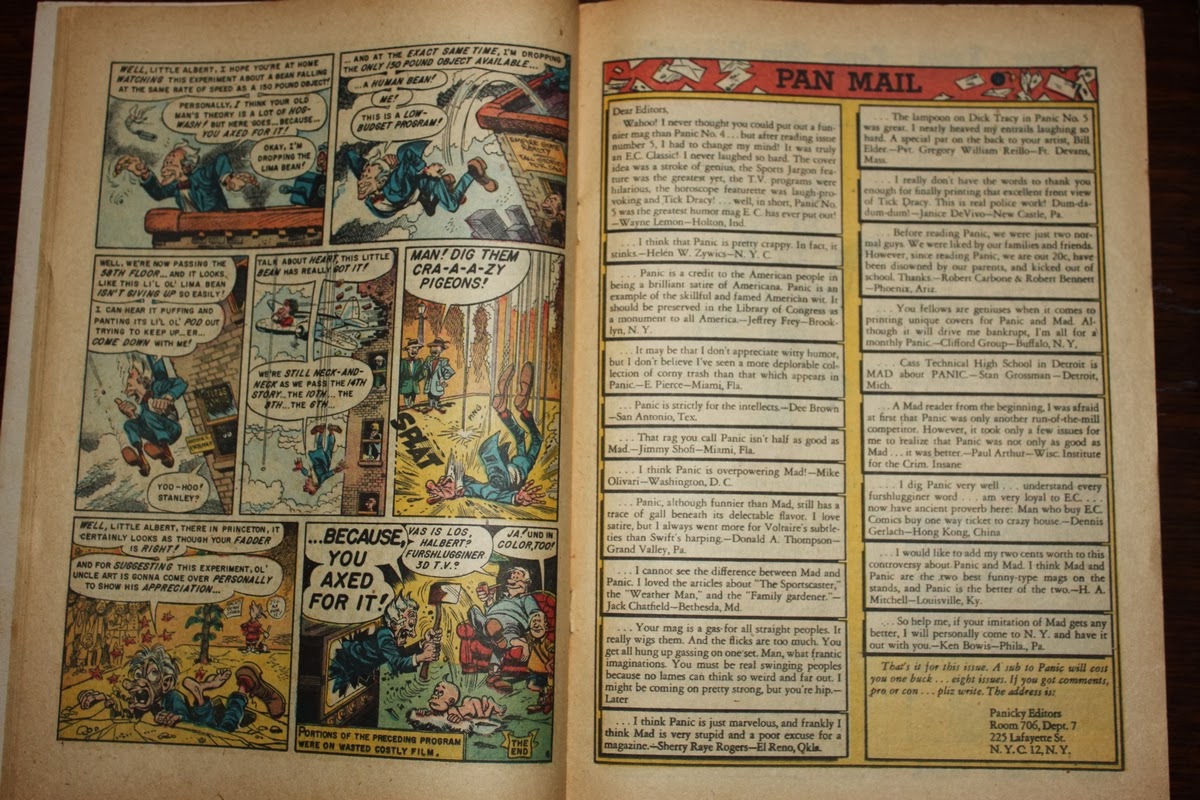
Everyone thinks Marvel was the first publisher to connect with the fans. How wrong those people are! EC was adept at making (and keeping) a connection with its fans. The editors printed fan mail, and they bragged about the men who were writing and illustrating the stories that the fans kept coming back to read.

The average American is introduced to Jewish and Yiddish humor. Nobody did that better than the guys writing MAD and PANIC.

Sunday, October 06, 2013

Jack Kirby Does Drama

The two greatest Silver Age comics artists at depicting and handling high drama were Jack Kirby and Steve Ditko. I've already covered Ditko's amazing talent at drama and angst in earlier essays, so today I want to (very) briefly cover Kirby's ability to use building drama in his stories.

The two-issue story arc in FANTASTIC FOUR #39-40 was commercially supposed to be a way to showcase the relatively new Marvel character of Daredevil. Lee and Goodman had probably not been especially happy with the sales of their new superhero title and so they'd recruited Wally Wood to write and illustrate the title. And the general practice at Marvel was to do crossover stories with the characters to show that everything in the Marvel Universe was connected and contiguous and related. DC already did this to some extent, but their characters were far more autonomous than at Marvel--and this kept fans grabbing more than one title, to watch the continuity that Jack Kirby kept up with his amazing juggling act.

Kirby decided to utilize the FF's greatest villain, Dr. Doom, for this story. It bleeds over in many ways from the FANTASTIC FOUR ANNUAL #2, at the end of which Dr. Doom was basically drugged into believing that he'd killed his arch-nemesis, Reed Richards. Brought out of this drugged stupor, Doom is of course enraged beyond reasoning with the way the FF had fooled him, and so sets about getting a new measure of revenge.

The first part of this story (FF #39) was inked mainly by Frank Giacoia, using the pseudonym of Frank Ray. This was, I've heard, a common attempt to fool editors at other companies so that their competing bosses didn't cop that they were working elsewhere. The inks are okay, but not the best. However, all of the figures of Daredevil in this issue were inked by Wally Wood, the man who was writing and illustrating the DAREDEVIL title. This was a cool tactic on Marvel's part, and I wonder if it was Kirby's idea, or Wood's, or Goodman's. I'm sure someone out there knows the answer to that one. At any rate, it was a cool move and I really liked it when I was a kid.

By the second part of the story, the inks were being done by unfairly reviled Vince Colletta. The inks are not the best, but are decent. However, gone is the gimmick of having Wally Wood ink the Daredevil figures in each panel. Why? I have no idea. Had Wood tired of the move? Was he too busy writing, penciling, and inking the regular DAREDEVIL title? Or had he already moved on. His tenure at Marvel was not a happy one, as he locked horns with Lee and did not appreciate having to give up his writing credits on DD. At any rate, Colletta inked every bit of the issue.

Previously, the main rivalry in the Fantastic Four was between Richards and von Doom. This was always the way it had been and that's what the readers expected. But in this issue, Kirby turned the tables somewhat by focusing on what had become Ben Grimm's absolute, white-hot hatred for von Doom. This animosity builds and escalates over the course of the story which ends with Grimm using his inhuman strength and impervious body to power through Doom's gadgets and to literally crush the villain's body. It's one of the most intense sequences I read in comics when I was a kid and I never forgot it.

This seemingly simple, two-issue story arc shows what a phenomenal story-teller Jack Kirby was. It is a crime that over the years the wrong man has received credit for these accomplishments.

 
My copy of FANTASTIC FOUR #40.
Inks in this one are mainly by Frank Giacoia, but ingeniously all of the Daredevil figures were inked by Wally Wood, who was writing and illustrating the main Daredevil title at the time.
Most inkers didn't quite know how to handle the Thing. Colletta was no exception. He wasn't the worst inker to delineate Kirby's alter-ego, but he darned sure wasn't the best. However, second-tier inking could not hide the sheer emotion that Kirby poured into his illustrations of Ben Grimm.

The final battle between Grimm and Doom goes on for almost half the book! Doom keeps throwing his earth-shattering technology at Grimm and the Thing keeps fighting through it, eager beyond description to get his hands on the bad guy.

And when Grimm finally gets his mitts on Doom...well, he doesn't pull any punches. He crushes not only von Doom's metal gauntlets, but the flesh and bone fingers beneath them. In a great move, it takes Doom months to physically recover from the beating he suffers at the hands of Grimm. You want drama?! Kirby delivered it up, ten-fold!

Tuesday, August 07, 2012

Dynamo #4

Tower Comics was a company that tried to enter the comic book marketplace in the 1960s. Encouraged by the success of DC and Marvel with their revived superhero lines, the publishers thought it was a risk worth taking. To that end, they hired some of the finest creators around to write and illustrate the new books they were going to introduce.

Aboard for the the project were folk such as Reed Crandall, Gil Kane, Steve Ditko, Roger Brand, Steve Skeates, Dan Adkins, Len Brown...and in charge of most of the projects, Wally Wood.

Wally Wood was already a comics legend when he was tapped by the owner of Tower Books to create the new line of comics. Because of Wood's reputation, it was no trouble for the company to attract other top talent. It didn't hurt that Wood knew many of the greats from his days at EC Comics.

The flagship title for the new company was T.H.U.N.D.E.R. Agents. It was a clever combination of superheroes, James Bond, and the Man from U.N.C.L.E.. It should have been quite the success, and in in many ways. But neither DC nor Marvel were going to stand around and allow an upstart comics company to intrude on their newly realized resurgence in comics. What followed was one of the earliest uses of flooding the market with product in an effort to squeeze out a new publisher by denying it space on the newsstands and within the very weird and monopolistic world of newsstand distribution. Thus, the project was all but killed off before it could set up a solid foundation.

One of my favorite characters from the company was Dynamo. For a brief time, he had his own comic title, illustrated by Wally Wood. Wood's covers for this book were amazing. I'm not sure they'd have passed unobstructed through the offices at Marvel, but they were effective works and stand the test of time.

My copy of DYNAMO #4. Cover by co-creator Wally Wood, one of the best comic artists ever.

Thursday, July 26, 2012

FRONTLINE COMBAT #14

I just got another old EC for my collection. This one is FRONTLINE COMBAT #14 with a cover and first interior story illustrated by Wally Wood. Also in this issue is a great Civil War yarn drawn by Jack Davis. I was surprised to see a story by Joe Kubert in here. He certainly was someone who would have fit right in at EC, but I don't recall seeing his work in any of the EC books I've owned in the past. And there's a beautifully drawn WWI story by George Evans who excelled at illustrating tales of the flying aces.

Nice Wally Wood cover. A bit of a departure from his regular style.