Showing posts with label Silver Age. Show all posts

Tuesday, June 01, 2021

Working Class Writer.

I'm getting closer to completing the second of the Working Class Hero superhero novels. I was well into the book when the previous publisher refused to promote the first one and wouldn't commit to the second book. I also, at the time, couldn't get him to relinquish the rights to the first book so I essentially stopped working on the sequel. Then, unexpectedly last year, the publisher returned to me the rights to all of my books and I could proceed.

My  Working Class Hero novel has been selling consistently well for several months. Learning how to advertise on my own has been a learning process, but I've gotten the hang of it.

When the publishing rights were returned to me, I reworked the second book and moved it in an altered direction from where it had been headed. I'm getting a kick out of creating new characters, and adding additional backstory to many of the heroes, villains, and assorted folk from the first novel. My idea all along for Billy B and his cohorts was to emulate the periodical comics of the Silver Age. I want to deliver continuing tales, sometimes with cliffhangers, sometimes wrapping the narrative neatly with a satisfying conclusion.

I've set myself a deadline for BILLY B VERSUS THE TROUBLE BOYS (WORKING CLASS HERO #2), and hope to announce a publication date in the near future. The third book (tentatively titled WORKING CLASS HERO: A BAKER'S DOZEN) is already plotted and outlined. I hope to get both books published in 2021.


WORKING CLASS HERO: The Autobiography of a Superhuman.

Wednesday, December 24, 2014

FF 17

I just got this beauty in the mail. Gosh, I sure do like Ebay.

I have not read this comic since I was about nine or ten years old. It has been that long. Yes, I've had many copies over the years, but it was when I was a collectibles dealer and I didn't have time to read them. Back then, old comics were just a commodity to me. Yes, I liked them and felt affection for the old books, but all I was concerned with was selling them as fast as I could at a profit to enable me to buy the next collection coming down the line.

Nowadays, all I do is collect. I'm not in it to sell them. I buy them because I love the old comics and because of the nostalgia element.

Kirby realized what a cool character he'd created in Doctor Doom. I'm not sure if the fans in the early 60s were clamoring for more of his appearances, or if Kirby just wanted to write more stories with him. But by the time Fantastic Four #17 rolled 'round, this was Doom's fifth appearance! He was already on his way to becoming the Fantastic Four's arch-nemesis.

Sunday, July 13, 2014

It Sold for HOW MUCH?!

Some years back, when I got out of the comic book retailing business, I swore off the industry. I didn't even want to write for the comic book industry anymore, abandoning my nascent career in selling comic scripts to various publishers. I was completely burned out on the literary/art form.

Years passed. For a long time I didn't so much as crack the covers of a comic book or enter the doors of a comic book shop. If I passed by a rack of comics in any kind of retail establishment I tended to ignore them.

But, somewhere along the way, nostalgia began gnawing at the old bones. So I picked up a few low-grade copies of The Amazing Spider-Man created/written/penciled/inked by Steve Ditko. I got a kick out of the books (I think they were issues #16 and #19), so I figured, 'What the heck? I could probably buy all of the Ditko issues in low to mid-grade without too much trouble'. So, I set about doing that.

Then I decided that I wouldn't mind owning a lot of the pre-hero Marvel comics that Jack Kirby and Steve Ditko created together, and I started collecting those, too. And then, I decided to take a crack at buying a complete set of Fantastic Four, but only the issues created/written/penciled by Jack Kirby.

I was, of course, hooked again on comics. And I've been at it for some time, carefully assembling a collection of the titles that I want the most and having no desire whatsoever to again enter the business of retailing at any level. But one of the things that amazes me is that I got back into it buying lower grade copies of the books I grew up loving. That way I could actually handle and read the books without having to worry about risking my "investment". And I do read my old comics, unlike so many who just pursue it as a kind of pure investment strategy, seeking to keep them in as high a grade as is possible

But something really weird has happened in the past couple of years. And it's that lower grade copies of the Silver Age books that I have been buying have exploded in value. Books that I thought would never be in high demand are just that. People are paying crazy prices for the kinds of books that I would once never have considered selling for anything more than pennies.

It's a crazy world.

My copy of Strange Tales 89, the first appearance of Jack Kirby creation, Fin Fang Foom. Kirby really liked alliteration.

My copy of Kirby creation Fantastic Four #8.

My copy of The Amazing Spider-Man #1, created by Steve Ditko.

My copy of Strange Tales #114. Captain America returns! (Or does he?!)

Wednesday, August 07, 2013

Lousy Inks!

I only had one issue remaining to complete all of the last fifteen issues of FANTASTIC FOUR that Kirby wrote and illustrated. That issue was #97. Like most of the stories Kirby was writing for the book toward the end, this one was very simple in theme and plot. It involved the FF being met with a nebulous menace that turned out to be a monster somewhat like the Creature from the Black Lagoon. In the end, the fellow turns out to be a lost alien with its mate in tow and they both escape from the Four and into outer space on their ship. It's the kind of thing Kirby was writing and illustrating in his very earliest days at the embryonic Marvel Comics.

I had not seen this issue since I first read it as a kid. And I have to say that while the story is simple it was not a bad effort on Kirby's part. However...the inking job performed by Frank Giacoia is one of the worst I've ever seen. It's possible that he was rushed and was pulled in on the job because Joe Sinnott was not available for some reason. I have no idea what the deadline was like, but the result is easily one of the worst inking jobs I have ever seen over Kirby's pencils. Some of the panels are excruciatingly awful because of Giacoia's slap-dash work.

But, anyway, I've got that last issue in that particular bit of the collection, so that was a relief to finish that section. In addition, the condition of the book was quite nice, so I won't ever have to worry about getting an upgrade.

My copy of FANTASTIC FOUR #97.

Saturday, April 06, 2013

The Amazing Spider-Man #31-#35.

We're approaching the home stretch for Ditko's final months on the comic book character he created for Marvel Comics and which was stolen from him by the publisher and the editor. From all accounts, Ditko was getting fed up with the way he was being treated. The personal philosophy that he followed to the letter precluded him from putting up much of a fight for his creator rights, but he was coming close to the only option allowed him by the dogma that controlled his outlook: walking away.

But until that point, he was creating some of the finest superhero comics of his day and actually did concoct what--to me--is the single finest superhero story ever to grace the pages of a periodical. I've already written one essay on the Master Planner story arc, but it's such a fine work that I may be forced to revisit it with a critical eye and do yet another essay.

Continued from #26-30.


This is yet another brilliant cover from Ditko. When the folk in the office allowed him, he could come up with stuff that was just purely brilliant--like nothing else in comics in those days. Here he was incorporating some themes and ideas that must have been percolating through the culture via spy movies (such as the Bond films). With this issue, he began the Master Planner story. Once more Spider-Man is faced with a criminal force that is being directed by a foe he cannot name or recognize and which is also a mystery to the otherwise omniscient reader. It didn't get any better than this in superhero comics, and it still hasn't been matched.

This was Spider-Man! Because he often battled villains who were not much more than regular guys with guns or hyped up weaponry, the fans sometimes forgot just how physically powerful and overwhelming Spider-Man could be. In this issue, with Aunt May's life on the line, Spider-Man has had all he can stand from the criminal element and by Jove he's not going to take it anymore. Here he roams around the city hitting at the criminal underbelly, terrorizing the thugs to get the information that he needs to save his aunt.

The best single superhero comic book ever done. Created by Ditko. Written by Ditko. Penciled AND inked by Steve Ditko. Possibly spurred by Wally Wood's inability to be bullied and taken advantage of by Stan Lee and Martin Goodman, Ditko had finally demanded that he--at the very least--receive plotting credits for the book. Since Lee was altering the dialog and acting as editor, Ditko obviously relented and allowed Lee to keep stealing the "writer" credits. But at the very least he was letting fandom know who was really concocting the stories: STEVE DITKO!

Ditko brings back Kraven the Hunter for the last time during his tenure. After the emotionally exhausting work of #31-33, Ditko returns to a typical superhero slug-fest with this one. The story is fun, but nothing like the intellectual yarn he had told in the previous three issues.

And another return engagement from Ditko's the Molten Man. In many ways, this story is similar to the previous issue. Not much going on here other than a big superhero/supervilain fight. However, Ditko was beginning to plant more seeds that hinted at another great story arc that would feature a final confrontation with the Green Goblin. Alas, we never got to see that, since Ditko would leave the company before he could complete that tale. This issue is also interesting because it's another example of Lee interfering with the cover art because he didn't like seeing Spider-Man's butt cheeks. He had someone in the bullpen alter the Spider-Man figure to erase the offending anatomy.


Here is the cover generally conceded to be the version that Lee killed.

Amazing Spider-Man #25 through #30.


The next five issues from my collection are on display here. Ditko was becoming more and more ambitious in his storytelling. He was not only expanding what had been the limitations of the classic comic book panel, he was also pushing the limitations of what had been the formulaic superhero script. Much has been written about the angst of the Ditko Spider-Man stories (credit going to someone other than Ditko on that). This was heartfelt material from the artist/writer--material so powerful that not even a pushy editor could screw up the emotional power of Ditko's storytelling.

(Continued from: 21-25.)


I've mentioned this issue in other essays. Here we have the Crime Master, another of Ditko's villains whose secret identity is even secret from the reader. We find the Crime Master and the Green Goblin at odds over which of them is going to rule the underworld turf. With Spider-Man caught in the middle.


Spider-Man at the mercy of the villains and their henchmen! But this is the old Spider-Man who was one of the most physically powerful characters in the old Marvel Universe. Back then, only a handful of super-powered dudes were stronger than Spidey--Hulk, Thing, Thor...that was about it. Battleship chain? That would slow him down, but ultimately...something he could break!


Good grief this is a brilliant cover. And not just a brilliant cover, but an inspired super-villain. The Molten Man was a fellow given super powers by accidentally getting drenched in a metallic alloy that was liquid at room temperature. The stuff is absorbed by the guy's body turning him the same golden hue as the metal, and giving him both super-strength and a measure of physical invulnerability. As with the Scorpion, it's stated that he's probably even stronger than Spider-Man, so the hero has to really use his wits to defeat him. Because of the black cover, this issue is almost impossible to find in the highest grades (even the slightest crease or blemish is spotlit against that ebony background). Thus, it's in very high demand as a collectible comic in grades higher than fine. I settled--as I generally always do--for a lesser condition copy. As I like to say, I actually read my old comics.


Another issue I've written about. Once more Spider-Man has to face off against a villain who is stronger than he. And once more Parker has to use his wits to find something that gives him an edge. The Scorpion costume is one of the best villain uniforms Ditko ever created. He took the basic segmented appearance of the arachnid animal and incorporated it brilliantly into the costume. No one was better at this kind of iconic thing than Ditko.


This is actually not one of my favorite Spider-Man covers. It's almost ineffective in many ways. I'm not quite sure what Ditko was after with this one, but it made it past the editor. Ditko was constantly trying to pit Spider-Man against foes who were human. The Cat was one of the most human of his early villains. No super powers whatsoever. Just a highly trained burglar with some weapons at his disposal. Of course some explosives can cause a lot of trouble for even a guy who can pick up 12 tons and cling to walls.


Wednesday, April 03, 2013

The Amazing Spider-Man #16 through #20.

Today, it's issues 16 through 20. Evolution of writer/artist Steve Ditko on his creation, THE AMAZING SPIDER-MAN.

Continued from 11-15.

It was company policy to have stories from time to time that were crossovers. That is, a character from one title would guest-star in another hero's book. When Ditko got the suggestion to do such a story he generally handled it with unique imagination. Since Daredevil and Spider-Man are very similar characters this issue seemed almost natural. Whenever I see this cover, I laugh. One of the stories about the early days of Marvel is that Stan Lee had a thing about illustrations that showed the heroes' asses. He didn't care for it and would demand such illustrations be redrawn so that no one could see the superhero butt cheeks. This one, however, made it past Lee. How? Why? We'll never know.

Ah, the return of the Green Goblin. This story also featured the Human Torch. It seemed that Goodman and Lee had a hard-on trying to turn the Human Torch into a fan favorite. To that end they tried everything; but the fans were having no part of it. Ditko did seem to have a good feel for creating a working chemistry between the two super-powered teenagers, but the public was not impressed enough to make the Human Torch a bankable solo star.

I love this story. Spider-Man seems to "run" from a confrontation with one of his more powerful villains in this story (the Sandman). And he really does high-tail it. But not out of cowardice. It's because he has a personal reason for avoiding the confrontation until a later date. Ditko has Spider-Man acting in a mildly selfish way here, perhaps in a kind of reflection of the influence of the insane writings of the Queen of Selfishness, Ayn Rand.


More Human Torch guest-star stuff. The Enforcers return--they were an early and reliable foil for Spider-Man. And, of course, Spider-Man kicks Sandman's ass to even the score of his apparently cowardly run from the previous issue. On a side note, this is the book that got me back into collecting. For some damned reason I bought this copy at a comic convention and enjoying the reading of it I decided: Fuck it. I'm going to collect all of the Ditko issues.

I've always liked the villain the Scorpion as created and portrayed by Ditko. Gargan/Scorpion is a brutal thug given superpowers for the sole reason to capture Spider-Man. Unfortunately, the process that turns him into a super-villain also drives him mad with power (and insane, too). He has most of Spider-Man's powers and is actually physically stronger. But Spider-Man defeats him by using his wits rather than relying merely on brute strength. He gets his ass all but kicked in the process. The result, later in the book, is that Parker appears in public looking as if he's had his butt whooped (which he of course has). It was Ditko showing that there were consequences to what the character did, just as in reality there are consequences for anyone's actions.

Tuesday, April 02, 2013

Amazing Spider-Man Collection...

Next five issues of my collection of Steve Ditko's THE AMAZING SPIDER-MAN:

Continued from 6-10.

Ditko brings back Dr. Octopus. Everyone thinks of the Green Goblin as Spider-Man's arch-enemy. But in fact it was Otto Octavius. He appeared most often as Spider-Man's foe and came the closest most often to defeating him. Octopus was, in fact, a really scary cat with the power and intellect to put Spidey away permanently.

The cover is not misleading, either. Doc Ock really did unmask Parker here. This was the first time that I can recall of any writer on the title using the idea that the flu virus had some kind of ability to cancel out Spider-Man's powers. Thus, when the suffering hero attempts to battle Octopus and is easily beaten and unmasked, everyone assumes that it was just a stupid kid trying to be a hero. Spider-Man's powers return as soon as his immune system fights off the viral infection. (But everyone ends up thinking Peter Parker is an idiot.)

Ditko cutting loose with a really twisted story. In this one, Ditko tackles psychiatry. (Maybe someone had appropriately suggested that he see one.) Scientologists would probably love this issue of the book.

Considered by many to be the most important issue of Ditko's run of his creation. Here we are introduced to The Green Goblin. This villain has no super powers, instead relying on brilliant contraptions and super-science weaponry. This would be the second time Ditko would use the idea of a continuing villain whose identity was secret not only from other characters within the story, but also from the reader! A stroke of brilliance. His character The Chameleon (from the first issue) was also unknown to the reader, but he turned out to be a minor experiment for Ditko and was rarely used again in the book while Ditko was around. This began an underlying story for the book that would continue throughout Ditko's time at Marvel. He never even got to complete the long-running Goblin story arc, walking away from his creations at the company before he could complete the task. (I was able to land this copy because it has tape on the spine, but is otherwise in decent condition. These days this is one of the hardest issues of the book to find and purchase.) Also of note here is the inclusion of The Incredible Hulk. Ditko was handed the character, created wholly by Jack Kirby, when Kirby got angry over interference from his editor (Stan Lee) on the direction Kirby was taking with the Hulk. Kirby walked away from it (it's not like he was stuck for other ideas) and they handed it off to Ditko who wrote and illustrated the character for a while in Tales to Astonish.

Another classic Ditko villain, Kraven the Hunter. Kraven was a dirty Russian, apparently. Obsessed with hunting wild animals, he was based on the character of the crazed Cossack General Zaroff from the 1924 Richard Connell story, "The Most Dangerous Game". Kraven does have super-powers--enhanced strength and heightened senses created by the consumption of a special potion he discovered in his travels. In addition, he keeps a few weapons hidden within his animal-skin costume that he uses against Spider-Man, whom he has chosen to be his ultimate prey. Ditko ended up using Kraven in three stories during his time writing Spider-Man.


Sunday, March 31, 2013

Amazing Spider-Man #6-10

Returning to the posting of scans of my run of The Amazing Spider-Man comic book. As stated before, since the character here was created by Steve Ditko, I never wanted to collect any issues that he didn't also write and illustrate. Thus, I collected only the first thirty-eight issues and the two annuals. The book that continued without its creator wasn't worth collecting for me. The later writers, most notably John Romita, just had no feel for the character and you folk in the rest of the world are welcome to those issues.

(Continued from 1-5.)

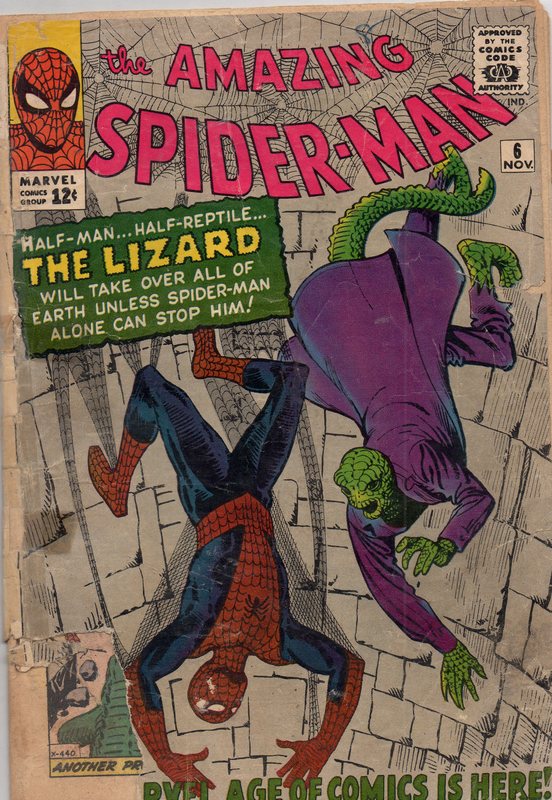
This issue is, by far, the worst condition copy in my collection. I picked it up because the price was right, but it's one of the few issues that I'm actually going to upgrade. I try to keep copies in lower grade...but not this low. The Lizard was one of Ditko's more interesting villains. Knowing Ditko's penchant for black/white characters--this one is rather odd. He's the only gray area villain that I can recall coming from Ditko. He's a bad buy but with a good heart. Ditko used Dr. Connor again, but not as the Lizard. It was only after Ditko walked away from Marvel Comics that the evil Mr. Hyde aspect of his personality was used again.
Thanks to Steve Adelman selling his copy of Amazing Spider-Man #7 I have this one in my collection.
The cover to The Amazing Spider-Man #8 remains one of my favorites. Ditko was really cutting loose, and this is a particularly dynamic cover. He was also beginning to do some cool stuff with his scripts, creating some real tension among the characters and putting Peter Parker into some really dangerous situations.
Electro is another cool villian, but in the classic Ditko mode. He's an asshole with no redeeming values whatsoever. He's just a thug and a criminal who was lucky enough to become a super-villain.
Occasionally Stan Lee, in his role as managing editor, would overrule his artists on covers. The cover for The Amazing Spider-Man #10 was such an instance. He did not care for the one that Ditko turned in, and so had the bullpen cobble this one together. The villains are obviously Ditko art, but the main form of Spider-Man is not. It may have been Kirby who produced the figure, but I've also read that it was Dick Ayers.

Fortunately, somehow the original cover art survived, and we can see what Ditko wanted to do. This was the first time Ditko used a masked villain whose true identity was kept even from the reader. Later, he would go back to this plot device with the Master Planner, the Crime Master, and the Green Goblin.


Thursday, March 21, 2013

Ditko's Early Issues of The Amazing Spider-Man

I'm so busy working on THE NEW ECOLOGY OF DEATH that it may be a week or so before I can take the time to do any detailed blogging.

For now, I'll post scans that I'm making of my comic collection that I'm storing away for security reasons. Today: my first five copies of Steve Ditko's THE AMAZING SPIDER-MAN.

This is my copy of #1. I can't afford higher grade books of some of the titles I collect, so I settle for what I can comfortably buy. (Besides, I like to actually read my old comics, which is a no-no with high grade comics.) This one has had some restoration and is autographed by the corporate thief who claims to have created Steve Ditko's work. The dealer who sold it to me knows how I feel about that creep, and so he told me up front. "Sorry, but it has his autograph in it." I bought it anyway.


The guy I bought this from claimed it had no restoration. However, when I examined it at my leisure, I found that it has quite a lot of restoration work done to it. But that's okay. Again, I land the copies that I can afford to buy.


Tuesday, February 26, 2013

FANTASTIC FOUR #55

FANTASTIC FOUR #55.

This was a bit of a breathing space for Jack Kirby. A moment to pause and catch his wind.

After the unparalleled explosion of creativity between issues numbers #44 and 53 of FANTASTIC FOUR, Kirby did a couple of stand-alone yarns, as if to give himself a much-needed rest. What's interesting during this time is that even his one-issue stories are superlative. Whether he was showcasing Ben Grimm (obviously his favorite character), or trying once more to make a superstar out of Johnny Storm, the Human Torch (it never worked), he was writing and illustrating some genuinely memorable stories without resorting to long story arcs.

Issue #55 brings back the Silver Surfer who we had not seen since he took his leave of the Fantastic Four at the end of the Galactus story-arc (#48-50). What had he been up to? Where had he been? Kirby fills us in, showing us what it must be like to be--for all intents and purposes--a god who is imprisoned on one tiny speck of rock when he had been accustomed to exploring the wide expanse of the galaxy. If Kirby had initially created the Surfer as a herald (Gabriel) to Galactus (God), now the Surfer was more akin to Satan, God's angel fallen for daring to challenge God.

But this was a more sympathetic figure than Lucifer. Here was a genuinely saintly figure, lost among men and feared by even the demi-gods among those men.

Of all of the super-folk that Jack Kirby created alone during this time, the Silver Surfer stands out. And he stands out because, like Ben Grimm, his misled foe in this story, he is a character packed with sadness, the very image of pathos.


My copy of FANTASTIC FOUR #55

Kirby's creation, the Silver Surfer. Stan Lee had absolutely NOTHING to do with the creation of this character. Nothing.

Superheroes in regular clothes who don't have to hide their "real" identities. Wotta world! A Kirby World!


Kirby illustrates just what it is that makes a superhero a superhero.

Dark analog of the panel of the Surfer from the previous page. Perfect storytelling on Kirby's part. You don't have to see Ben Grimm punch the Surfer. But you know it happened.

The Surfer tries to reason with the emotional galoot.

Man! Nobody drew comics like Kirby drew them! Richards the stern father figure. Grimm the petulant kid.

Again...I'm left to wonder how much Lee deviated from and mucked about with Kirby's dialog and script. That last panel just doesn't align with the story told in the previous six panels. If anything, Ben would be lamenting his behavior since the story began. Instead, his mouth is filled with dialogue of dark warning, as if he learned nothing from his mistakes and from the gracious actions of the misunderstood Silver Surfer. Grimm was no dope, so I assume Lee messed it up once more.

Sunday, January 06, 2013

Kirby Does the Human Torch

The inclusion of the character the Human Torch into the Silver Age Marvel Universe was done to keep dibs on the name and iconography connected to that name. The character was, of course, created wholly by Carl Burgos and claimed by Martin Goodman as spoils of his company, which published the character. Along with the Sub-Mariner, the two are actually the oldest superheroes in the Marvel pantheon (circa 1939). And both were taken from their creators (Burgos in the case of the Torch, and Bill Everett in the case of Namor, the Sub-Mariner).

Later in his life, Burgos tried to present a legal challenge to Marvel and reclaim his intellectual property, but he was far too poor to mount an effective effort and the suit wilted on the vine, abandoned. This is usually the way of things when regular folk try to struggle against corporate power. The one who can throw the most money at the courts wins by default.

While Goodman was not as hands-on as some publishers, he did send down his wishes through his proxy, Stan Lee. You can tell from the publishing end of things that he must have wanted the Human Torch as an ongoing character to protect what may have been a problematic copyright. To that end, the Torch was, for several years, featured prominently in his own adventures as the cover feature every month in Strange Tales. He was also frequently popping up in stories that featured the Amazing Spider-Man. It was obvious that they were trying to create a star, forcing the matter and trying to make the readers adore a character who was actually just a co-star, at best.

Of all of the characters that Kirby wrote on a regular basis, the Torch always seemed to me to be the weakest of them all. I can almost hear the editor constantly nagging. "Make him a teenager. Make him hip. Make him all Rebel-Without-A-Cause. Make him like hot rods. Make him go through girlfriends." Blah blah blah. I think Kirby obviously tried to comply, but to no real success.

The only time the character seemed to click with readers was as part of a kind of comedy team, serving as the hot-head foil for the otherwise stoic Ben Grimm. In the sometimes funny, sometimes pathetic, sometimes heart-warming exchanges between the two, the character worked well. But outside of that combination, the fans just didn't seem to give a damn about the Human Torch.

I think the last time Kirby tried to consciously push the matter and to force the readers to embrace the Human Torch as an upper echelon character for Marvel was during the period when this cover appeared, for FANTASTIC FOUR #54. It's almost as if Kirby was saying, 'Okay, guys. Here it is. I'm going to give it one last shot.' And he tried. And he failed. The Torch was just not first flight material in the Silver Age.

My copy of FANTASTIC FOUR #54.

Wednesday, September 05, 2012

Ditko Dr. Strange Cover

Looking back over my STRANGE TALES collection, I have to backtrack on the statement about the Dr. Strange covers. Ditko did finally get sole cover feature for Strange Tales for Dr. Strange with issue #146. It also was, in fact, Ditko's swan song at Marvel for his character. Just as with Spider-Man, Ditko had taken all he could stand from Marvel and he turned his back on his other major hero creation, Dr. Strange.

Poring over the credits for the first time in some years, I was struck by what I read. Stan Lee is listed merely as "Editor", which is what he was all along. He was always an accomplished editor, nudging the projects to completion, corralling talent, tweaking dialogue. But at some point Ditko had demanded that he get some of the credit that he deserved and settled for far less than what was rightfully his. However, that was Ditko's decision, and I will always assume that he was satisfied with the few concessions that Lee & Goodman begrudged him.

The "scripter" for the story in this issue is not Lee, but Dennis O'Neil, with whom Ditko was able to work from time to time over the years (notably THE CREEPER).

As with The Amazing Spider-Man #38, this was Ditko going out at Silver Age-era Marvel Comics. He'd had more than enough and was heading for greener creative pastures. With the Spider-Man story ("Just a Guy Named Joe") you have to read carefully to realize the implications of the narrative and see the imagery that is stamping "nevermore" on his greatest superhero creation. But with "The End...At Last!" Ditko is obviously walking away from the title and tying up all loose ends.

For years Ditko had delineated the adventures of the Master of the Mystic Arts, pitting him against his most tenacious foes, the Dread Dormammu and the evil Baron Mordo. Knowing that this was his chance to wrap it all up in a neat bundle, he took the opportunity and left no errant fabric to flap in the blowhard winds from Lee. In this yarn he did not leave the identity and fate of the Green Goblin hanging, a grand story arc incomplete for John Romita to write and illustrate. In this case Ditko was able to do it all himself and at least have that much satisfaction as he packed his bags at Marvel and walked his own path.

This cover seems to be by Ditko, but it could very well be something cobbled together by production staff.

Tuesday, August 07, 2012

Dynamo #4

Tower Comics was a company that tried to enter the comic book marketplace in the 1960s. Encouraged by the success of DC and Marvel with their revived superhero lines, the publishers thought it was a risk worth taking. To that end, they hired some of the finest creators around to write and illustrate the new books they were going to introduce.

Aboard for the the project were folk such as Reed Crandall, Gil Kane, Steve Ditko, Roger Brand, Steve Skeates, Dan Adkins, Len Brown...and in charge of most of the projects, Wally Wood.

Wally Wood was already a comics legend when he was tapped by the owner of Tower Books to create the new line of comics. Because of Wood's reputation, it was no trouble for the company to attract other top talent. It didn't hurt that Wood knew many of the greats from his days at EC Comics.

The flagship title for the new company was T.H.U.N.D.E.R. Agents. It was a clever combination of superheroes, James Bond, and the Man from U.N.C.L.E.. It should have been quite the success, and in in many ways. But neither DC nor Marvel were going to stand around and allow an upstart comics company to intrude on their newly realized resurgence in comics. What followed was one of the earliest uses of flooding the market with product in an effort to squeeze out a new publisher by denying it space on the newsstands and within the very weird and monopolistic world of newsstand distribution. Thus, the project was all but killed off before it could set up a solid foundation.

One of my favorite characters from the company was Dynamo. For a brief time, he had his own comic title, illustrated by Wally Wood. Wood's covers for this book were amazing. I'm not sure they'd have passed unobstructed through the offices at Marvel, but they were effective works and stand the test of time.

My copy of DYNAMO #4. Cover by co-creator Wally Wood, one of the best comic artists ever.