Showing posts with label Panic. Show all posts

Friday, December 06, 2013

Sincerest

Flattery be damned. In 1954-55, the hottest comic on the newsstands was MAD, from EC Comics. Almost everyone publishing comics books wanted to imitate it. And the ones who didn't want to imitate it, wanted to kill it off.

But I'm not here to talk about any of the villains who wanted to destroy MAD. I want to mention what EC Comics did to protect their extremely profitable spot on those newsstands. Since almost every publisher was trying like mad to imitate MAD, Bill Gaines and company just decided that the best thing to do was...imitate MAD!

If someone was going to steal some of their sales numbers, it might as well be themselves.

So what they did was create a companion book called PANIC. It had the same writers, the same artists, the same publisher, the same Jewish sense of humor. How could it miss? And the thing was, of course, to kill off the weakest of the imitators by causing the fans to buy PANIC instead of CRAZY or GET LOST! or FLIP or CRACKED or MADHOUSE or WHACK or EH! or...you get the picture. The imitators were out there in droves. Some of them were pretty good, too.

I haven't been concentrating on completing a set of PANIC, but I pick up copies when I see them at a good price. Despite the fact that they are, in essence, exactly the same thing as MAD from exactly the same creators at exactly the same publishing house, you can get these books for a LOT less than you can issues of MAD from the same period.

The last copy I picked up was #7. Sometimes the covers of both MAD and PANIC were kind of bland or uninspiring to me. Such is the case with this issue. But there was something about these special joke covers that seem bland to look upon that inspired the kids of the day to buy the darned things. I reckon they knew what they were doing.

Some day I need to write an essay of how Harvey Kurtzman was fucked out of his position at MAD. It was his baby all the way, and it ended up making the publisher, Bill Gaines, one of the richest men in comics. But for now I'll leave that where it is and save it for another time.

PANIC #7


An ad for MAD from Kurtzman and Elder.

Just as with MAD, much of the humor in PANIC was topical. Most people today have absolutely no idea who Joe Palooka was. Palooka is just a word they heard in PULP FICTION. But it was prime material for parody in 1955.

Jack Davis, one of the most popular comedy artists at EC.

THEM was a hot commodity and still new to the screens. Wally Wood has a go at it.

Wally Wood was a great caricaturist and nobody did women like Woody.


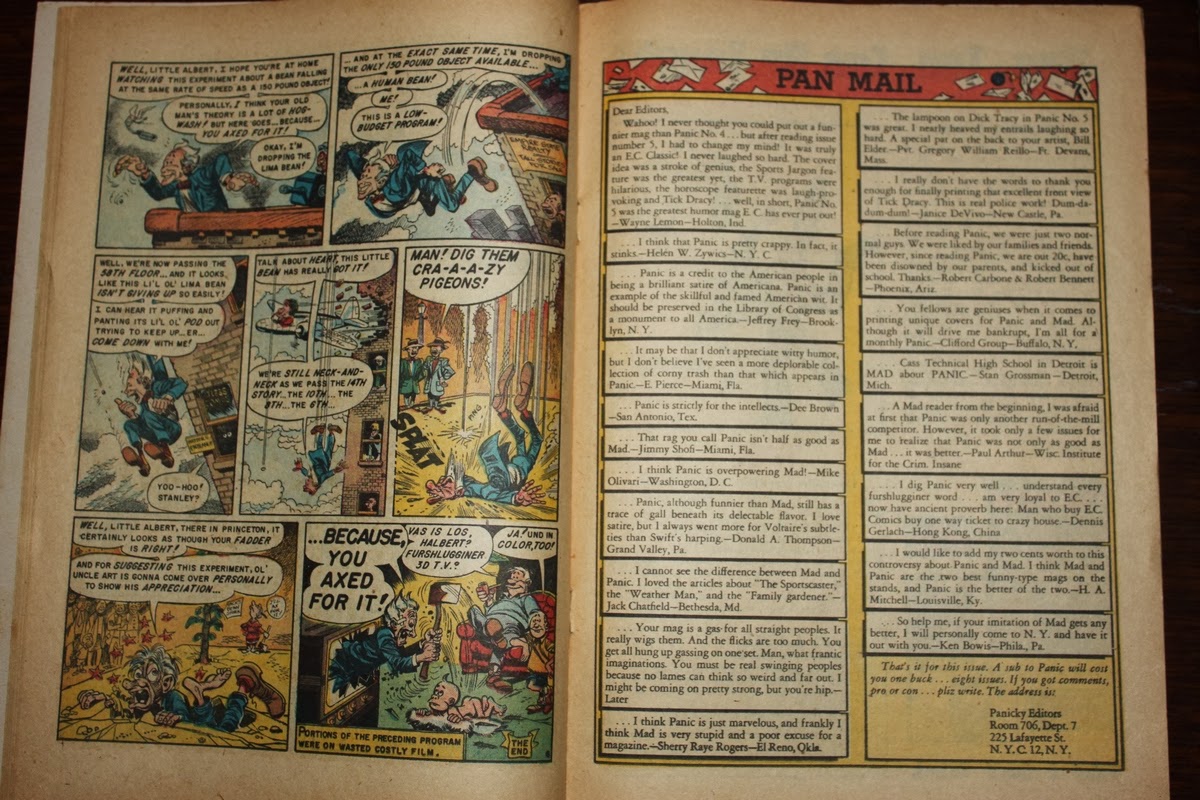
Everyone thinks Marvel was the first publisher to connect with the fans. How wrong those people are! EC was adept at making (and keeping) a connection with its fans. The editors printed fan mail, and they bragged about the men who were writing and illustrating the stories that the fans kept coming back to read.

The average American is introduced to Jewish and Yiddish humor. Nobody did that better than the guys writing MAD and PANIC.

Saturday, November 19, 2011

Adventures on Ebay

I landed a copy of Panic #10 via Ebay. This was the first comic I purchased since a crooked dealer tried to rip me off there. I had bought three copies of Panic from a fellow I will leave unnamed for now. The books had been graded at "VG", which means very good. When the books arrived they were flaking, coming apart, two of them had detached covers, and the one that still had its cover attached was because the spine was heavily taped. I, of course, immediately demanded a refund which he did not want to grant. Hilarity ensued.


I have to say that Ebay was really good during this minor tussle. They demanded that the dealer in question refund my money and they even took a portion of it from him and added it back to my Paypal account, the remainder to be refunded as soon as I returned the worthless books, which I did.


This latest issue I got (from a more reputable dealer) is classic Harvey Kurtzman material. I will assume that he did the layouts. Much of the material seems to have his hand in evidence. But the bulk of the book was illustrated by Will Elder and Jack Davis, both of whom did their usual exceptional work. Davis, in particular shows his talent, but I have to think that Elder was filing off the edges of his art here--I think that while Kurtzman and Gaines intended Panic to be pretty much a carbon-copy of Mad, they were making some minor moves to tone down the harsher aspects of the humor of Mad in favor of appealing to a wider audience...or at least a slightly different audience. Unlike Mad, the last few issues of Panic received the Comics Code Authority approval. But obviously the sales were not up to Mad's level and the title was snuffed out.

PANIC #10.

Sunday, October 23, 2011

PANIC #8

You know the old saying about how imitation is the sincerest form of flattery.

In comic books, however, that flattery was picking the pockets of someone else. In some cases it led to lawsuits and the destruction of the flattering entity. National Periodicals (DC) sued Fawcett over their Capt. Marvel (which had outstripped Superman in popularity and sales) and thus Fawcett was undone and it can be argued that superhero comics almost went away with the destruction of Billy Batson and his alter-ego.

Whenever one comic book publisher came up with a popular idea, there were always at least a few other publishers around ready, willing, and able to try to rip off that idea. When Harvey Kurtzman's MAD hit the stands it was an enormous sales success. In fact, Mad Magazine outlived its parent company and went on to spawn one of the highest selling publications in the world, and a couple of TV series.

And so it was that in this case other publishers fell all over themselves trying to ape Kurtzman's vision of the humor comic book. Most of those imitations fell flat, of course, but the threat was very much there and Bill Gaines and company figured that if someone was going to imitate MAD, then it might as well be the guys who were already publishing the original! Thus, was PANIC born.

PANIC lasted for twelve issues and was, in almost all ways, MAD with just a different title. It sported the same writers, same artists, same feel. If you pick up and read an issue of PANIC you wouldn't know you weren't reading MAD unless you looked at the cover title. And that's what they wanted. When you pick your own pocket the money ends up in the same place.

I've never read or heard what sales of PANIC were like, but they must have been decent for the title to have lasted as long as it did. The only thing that killed it off was the demise of EC as a comic book publisher. When William Gaines decided to leave comics and move strictly to the magazine format (thus escaping the Comics Code Authority), he allowed PANIC to be almost totally forgotten and vanish with his small raft of other Comic Code approved titles such as INCREDIBLE SCIENCE FICTION, PIRACY, VALOR, ACES HIGH, etc.

One of the main reasons for the existence of the Comics Code Authority in those days was to put EC Comics out of business. In this, they succeeded. Of course they ended up creating the single most profitable independently owned publication on Earth, but that's beside the point. the Code put EC down for the count, and that has to be one of the greatest crimes ever committed in the sad history of comic book publishing.

PANIC #8. Yeah, I'm buying old comics again. Newest addition to the collection. Here was Kurtzman and his team putting Jewish humor into the hands of every good little boy and girl. (Who are we kidding? It was almost all boys.)

Modern readers have pretty much no idea at all what the popularity of newspaper comic strips was once like. The American people once adored the funny papers. A popular strip could become a cultural phenomenon. The influence of a popular newspaper comic could not be underestimated. And once upon a time one of the most popular strips was ALLEY OOP. Here, Kurtzman and his band of humorists parody the caveman, Alley Oop. (Strangely--to me, a least--although Alley Oop had been around since 1939, the strip enjoyed its greatest popularity in the 1950s and early 1960s.)

Joe Orlando's humor. Quite different from his more dramatic work at EC, but still effective.

And the great Wally Wood lends his talent to skewering GONE WITH THE WIND.