Showing posts with label Fascism. Show all posts

Tuesday, December 01, 2015

Loving the Fascist Loon

All comic fans know that the Silver Age of comics began when DC made a concerted effort to revive the superhero genre by redesigning The Flash in Showcase Comics. It was a success, soon spinning off into a renewed title. They then followed suit by reviving a newly realized Green Lantern which was equally successful. Then followed things like the Justice League, etc.

Estranged from his editor at DC, Jack Kirby had retreated to working at Martin Goodman's outfit (which was not then called "Marvel"). He had been trying to talk his editor is allowing him to create superheroes at the nascent Marvel the way they had done it at DC (including Kirby's Challengers of the Unknown). Finally, with Goodman threatening to shut down the comics arm of his publishing business, Jack Kirby and Steve Ditko were given the task of creating, writing, and illustrating a raft of new superhero characters.

Kirby, of course, created most of what we would later call the Marvel Universe; and Steve Ditko also made tremendous contributions.

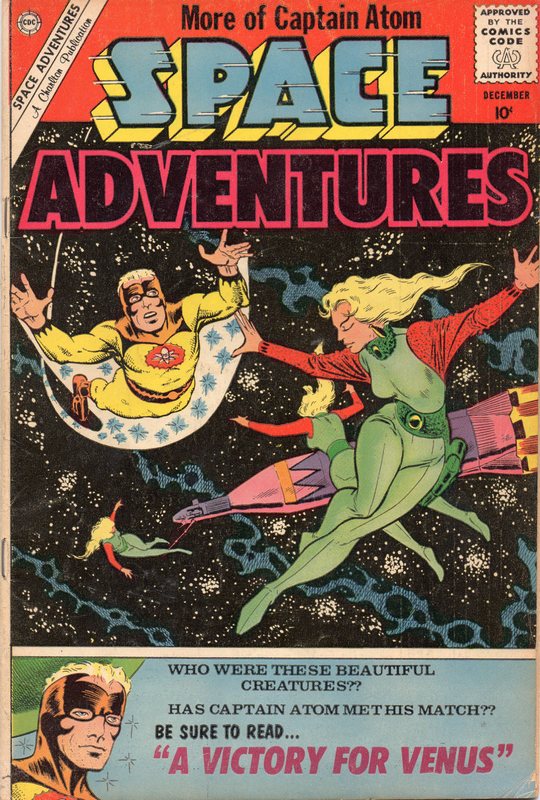
But Spider-Man and Dr. Strange were not the first superheroes that Steve Ditko created for a publisher. A full year before Kirby changed everything with his Fantastic Four, his co-worker had already had a hand in creating a new superhero for Charlton Comics:

Captain Atom.


Captain Atom was a classic superhero transformed by radiation into something more than human. In his case, he was Allen Adam, a technician who, accidentally launched into orbit in an experiment craft, has his body destroyed, but whose existence is altered by radiation so that he is able to reform his atoms and consciousness. His powers were explained as being of nuclear energy origins and he quickly becomes a super-powered agent for the US government. (If this sounds familiar, Alan Moore slightly altered the story for his own version of Captain Atom as Doctor Manhattan in the comic book THE WATCHMEN.)

The creation is officially shared between writer Joe Gill and Steve Ditko. But I have always wondered about the details and know nothing of them. I can only surmise from the collaborations between the two how much credit should be attributed between them. Sometimes it is obvious in Ditko stories that are credited to Gill that he, in creating the dialog, had almost no idea what Ditko had written--for the dialog sometimes bears no relation to the illustrated story! This is not the case with the Captain Atom tales, with the dialog generally being logical to the sequential storytelling, if somewhat campy and sophomoric.

But one thing that does stand out in these stories is the right wing politics and subtle philosophy that comes through. This aspect of the comics makes them classic neo-Fascist Ditko polemics. Yes, most politics in late 50s and early 60s comic books was right wing, but Ditko's take on politics is almost unique in the industry. That wacky sense of the sociopath as hero does glimmer between the cracks. And so I am left wondering if the writing was actually all Ditko, with only the dialog being from Joe Gill.

It would, of course, be a familiar story for Ditko and Kirby very soon after.

My personal copies of Space Adventures starring Ditko's Captain Atom.


Thursday, March 19, 2015

SF is Right Wing?

I have never been a huge science fiction fan. I know that sounds weird coming from a guy who grew up reading tons of science fiction anthologies and magazines and novels. But it never made up a large percentage of what I consumed. Perhaps five percent of the fiction I was reading for most of my life has been sf.

In the past decade or so I began to read more of it. Again, it still was not making up a majority of what I was reading, but I had been picking up science fiction novels and anthologies more than in my youth.

And I was struck by something:

A lot of the science fiction I was reading, (and a lot of the science fiction fans I was meeting), are politically right wing. I'm not talking just a tad to the right. I mean full-on Libertarian Fascism. With the exception of Richard K. Morgan, most of the speculative fiction I was discovering is, it seems, being written by people with right wing extremist motives and sympathies.

Has this always been the case?

Yes, I know that shit-hole Robert Heinlein has always been a darling of sf fandom. And I used to encounter right wing creeps on most of the sf-oriented chatrooms back in the early days of the Internet.  For instance, when I tried to interact with Bradbury fans to get information I needed for a project I discovered that they were almost all politically to the right and eager to bombard the Internet with their poisonous dogma. (This should not have surprised me terribly because I already knew that Bradbury had obviously gone from a politically progressive young man to a right wing shithead by his later years.)

But is the majority of the modern science fiction literary scene infected with right wing mania?

I do know that I have quickly grown sick of trying to read these Libertarian/religious/Objectivist/Fascist screeds in the form of science fiction novels and stories. I've reached a point where I'm prepared to swear it all off and go back to reading non-fiction to get away from the endless drone of science-fiction's neo-Fascist themes.

Alas!

Is all modern SF nothing but Fascistic shite?


Friday, February 13, 2015

The Sledgehammer in a Scalpel World

One of my favorite tools is the sledgehammer. Since my teens I've been strong enough to use them effectively. I've always had one in my kit and there are often jobs to be done that no other chunk of wood and steel can accomplish.

These days I most often use my sledgehammer to split wood when I'm camping. I use a steel wedge or an old hand axe as the cutting edge and the heavy hammer to make my point with the firewood. It is the best way I've found to handle the chore of creating a big stack of manageable and effective fuel for our campfires.

My affection for the sledgehammer is even reflected in my fiction and essays and arguments. Often, I don't bother with the reasons and causes of a situation so much as attacking that happenstance with a handful of probability (or the inevitable). In addition, I prefer the wake of the sledgehammer in matters of reason. Yes, the application of blunt force trauma is sometimes the best tack.

This is partly due to the way I perceive the world, these days. Blacks and whites. Good and evil. Champion and villain. Society is largely made up of the fact that the bad guys won the only battles that count and every struggle in our times is the grudging surrender by the folk who do the work to the few who reap the rewards of that labor. We are given the illusion that we have won an inch, when in fact the antagonists have taken a mile. (This is why liberals sicken me.)

In such a world, why worry with details? It's a fallacy that we can use a skillfully wielded scalpel to repair the damage. What is needed is the only approach remaining: the sledgehammer.

Smash it all down and start the fuck over.

Sooner or later, it's gonna drop.

Ah, those Russian boots tromping all over shattered Berlin. Music!

Friday, September 26, 2014

The Myth of the Benign Fascist

Everyone seems to love them. You know, those bad-ass pulp fiction characters who let their male emotions do their thinking and their giant muscles do the talking. I've taken to calling them 'the benign Fascists'.

Of course, there really is no such thing. But that's part of the allure right? Reading fantasies that there might actually be such. We call them things like Batman, or The Equalizer, or Jack Reacher. It's a nice thought, I suppose. I mean, them taking out the human garbage and all.

But it just ain't so. It finally became such a reach for me to believe in that kind of fantasy that I put down the novels that are basically a gun-humper's wet dream. I got sick of those violent concoctions about men who are somewhere between the outlaw and the good guy.

My latest excursion into such territory was THE WEIGHT by Andrew Vachss. When I was younger I was a huge Vachss fan. I read several of his Burke novels, the title character kind of like Doc Savage if all Doc Savage did was go around slaughtering child molesters. Those were fun for a while, but then they got old and I stopped reading them well before I finished the whole series.

When I saw THE WEIGHT I figured I'd see what Vachss was up to in more recent times. This book came out around 2011 or so. At least the version I have is dated 2011. And he mentions such topical things as what a douche Eliot Spitzer is. Yeah, it's that kind of novel.

The book focuses on a professional criminal named "Sugar". He's a thief who is usually part of a team who go after high-dollar targets and then lay low for a long time. Sugar is not naturally violent (despite being well over six feet tall and composed of 240 pounds or so of solid muscle) and he cares a lot about the welfare of children and women and the mentally disadvantaged. And probably puppies, but we never get to hear about that.

The plot kicks into high gear after a big heist when Sugar is falsely accused of raping a woman and he can't voice his alibi because that would be admitting that he was in on the theft of five million dollars worth of jewelery. So he ends up having to take the blame for the rape so that he won't have to give up his fellow thieves. This is "the weight" of the title. He has to serve five years in the pen.

And there he has to do business with all sorts, including the Aryan Brotherhood, because Sugar is a white dude and he has to buy his shank from the AB. And the way the Brotherhood is described is that some of them aren't really bad sorts. They're just misunderstood fellows who happen to be covered in Hitler and Nazi tattoos. You dig that, right?

Most of the first half of the book deals with Sugar talking about the life of a career criminal. It's pretty good stuff and holds your interest. Because whatever Vachss may be feeding us about his benign Fascist, he's a very skillful writer. When the serious plot does finally kick in, it's convoluted and detailed and so crazy that mostly it makes no sense whatsoever. And that's generally okay in crime books, because many of the classic crime novels involve criminal plots that make absolutely no sense at all. But here it doesn't work. For me...it utterly failed.

But the book held my attention. I have to give it that. I think in the final analysis I just can't believe in the theory of the benign Fascist. Because those guys whose careers are built around breaking the law and stealing and such...they're almost all stupid assholes. And they have little to no morals when it comes to the welfare and safety of children, and women, and the mentally disadvantaged. To them, kids and women...those are targets.

THE WEIGHT by Andrew Vachss.

Sunday, December 01, 2013

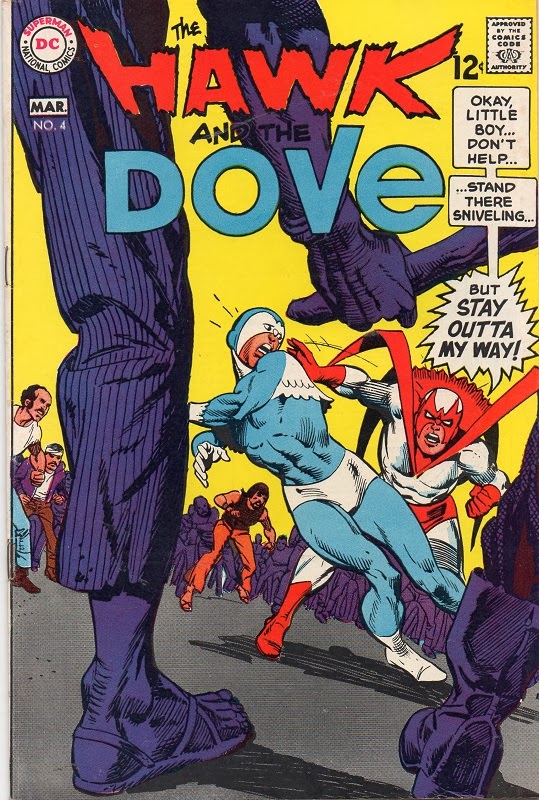
The Hawk & the Dove.

To me, Ditko's move to DC to try to reignite the fire under the fan base is rather sad. He was still, of course, bursting with ideas and was one of the best and most imaginative artists then working in comics. And for their part, DC was heavily promoting his move to DC...almost to the point of howling about how it was Ditko who had arrived at their doors rather than the titles he had brought with him.

By now, we all know what happened. He entered the marketplace with two new titles: BEWARE THE CREEPER and THE HAWK and THE DOVE. True comic book fanatics know the history of how this move coincided with serious health problems for Ditko that prevented him from working at his desired pace and intensity. 

Both of these books reflected his right wing philosophy more than the two titles he had created at Marvel (THE AMAZING SPIDER-MAN and DR. STRANGE). And of the pair, the one least like anything he'd done at Marvel was THE HAWK and THE DOVE. It was also the first title he had to abandon due to his serious health problems. Ditko completed three stories featuring the Hawk and Dove. The issue of SHOWCASE in which they were introduced, and the first two issues of their regular title. As always, the artwork in all are superb. The stories, to my way of thinking, were rather strange and dogmatic. Apparently, Ditko was trying to present a balanced view of the political turmoil running through the USA at that time, but his particular brand of Fascism ruins any such attempt. I cannot see how the title could ever have been anything other than a failure.

After Ditko left the book due to those health troubles (tuberculosis, from what I've been able to discover), the book was left in the hands of Steve Skeates as writer and Gil Kane as artist. If anyone was going to do that book, I would think that Kane was as good a choice as any. But the writing was on the wall, and Ditko's initial tenure at DC as a superhero creator was soon at an end. Both of his titles ended after just six issues.

As with just about everything Ditko has created, though, the characters and their images live on in revivals and animation. Ditko was not quite the machine Jack Kirby was, but he is still one of the best who worked the superhero comic book world.

Was Martin Goodman worried? At this point, I rather doubt it. He'd already seen Ditko's new superhero creations at Charlton fail to attract the fan base he'd established at Marvel. Would the work at DC bring them in? Nope.

The mincing, cowardly Dove.

The manly Hawk dominates.

From here on out, it was Skeates writing and Kane illustrating. And both ultimately failing.

You have to admit...Ditko could create some iconic superhero imagery to be used effectively by artists who followed in his wake.


And then...half a dozen issues was all that DC could justify.

Sunday, October 28, 2012

Why (Some of) Ditko's Underlying Philosophy Appeals to Me

Most of the underlying philosophy of Steve Ditko's work is, to me, abhorrent. I interpret it as nothing more than a form of Fascism. That point has been argued artfully by many and more eloquently than I could argue, so I leave that as self evident.


However, there is something almost hideously attractive about parts of Ditko's message. I would struggle to wonder just what it was. Because while I found myself drawn to the stories and that message, I was always repelled by the totality of it. What is there that keeps me coming back?

And, finally, I realized that it's Ditko's interpretation of the world at large as being either black, or white. That is, one can make choices that--for all practical and philosophical reasons--are either good, or evil.

To an extent, I do like that reasoning.

When one is going to argue a point or be swayed by an argument, there is a right and a wrong. I do believe that. So Ditko's persuasion that to be on the wrong side is bad and the right side is good appeals to me. My parting of ways with Ditko and his company of Ayn Rand slaves is that I think that he is solidly on the wrong side. That is, I find his arguments and conclusions to be evil rather than good.


In the sub-culture defined by comic book fans, Ditko has attracted the neo-Fascist crowd who look to him almost as a kind of messianic figure who stands in these days for the departed Ayn Rand. I find these people--absolutely without exception--to be an execrable lot. So I doubly owe Mr. Ditko a debt of gratitude for giving these sorry excuses for quasi-humanity a central place to gather. It's always good to know the bad guys are huddled in one poisonous spot.

I've written briefly before of the few bits of Ditko's form of logic that I do find worthwhile, so I won't belabor those strands again. For now I choose to acknowledge that Ditko's characters do appeal to me for their take on the basic ideas of good and evil. The irony being, of course, that I find Steve Ditko and his fans to be on the very wrong side of the good/evil equation.


Thursday, August 04, 2011

Evolution of a Super Hero: Steve Ditko's STATIC


Many times over the years, after I finally pieced together how the early Marvel comics characters were created, I used to wonder what would THE AMAZING SPIDER-MAN have been like if the Marvel editors had not been there to tweak the dialog and storylines after Ditko had gotten the issues written and the pen and ink artwork down on the page? Would it have been as good as the stuff with that sophomoric, faux-hip dialog? Would it have been as dramatic? More dramatic?

Well, I finally got a chance to see what it might have been like when I got my paws on this omnibus edition of STATIC from Robin Snyder's outfit.

Static was a character created by Ditko in the early 80s. The initial stories appeared from Eclipse/Charlton Comics, but over the years the story continued and when Charlton ceased to operate as a publisher Ditko moved his efforts to other venues. I recall the stuff as it appeared but didn't read them at that time. In those days I was a comic book retailer and part-time writer (sometimes working in comics) and I was so overwhelmed by the sheer volume of superhero product coming out that I allowed STATIC to slip past me almost unnoticed.

But later on Snyder and Ditko teamed up to publish the entire Static story arc in one volume which you can buy for the very reasonable price of $15.00. I heartily encourage all Ditko fans, superhero fans, and comic book historians to read these. They're actually a lot of fun.

With a caveat.

What we see here is what I can only describe as religious fanaticism and a very twisted kind of philosophical fundamentalism. While I can enjoy reading this material for the pure sake of the fiction, it's disturbing on the level that I am also aware that this is a political/religious tract that reflects its creator's actual belief system. And what a savage and twisted system it is! Other people's insanity is fun!

And, finally, I think, I see what Spider-Man would have been if not for the moderating influence on the dialog and after-the-fact story changes by his editors. For this superhero novel is nothing less than some of the most bizarre attempts at logic that I've ever seen. At times, the prose is almost unreadable. Once again, I'm struck by the fact that Objectivists are nothing more than religious fanatics. Like Christians and Communists and Nazis they have their prophet; in this case the fascist monster Ayn Rand. And they have their Holy books such as The Bible, or MEIN KAMPF, or DAS KAPITAL; in this case ATLAS SHRUGGED and THE FOUNTAINHEAD, etc. are the fuel to their disgusting blaze of madness. Added to this fact are their rabid attempts to coerce and proselytize to save the rest of us from damnation by leading us to the truth--instead of Christianity or Communism or Racism, we are fed repackaged Fascism under the laughable name of Objectivism. If you buy into this sick shit you are one hideous creep.

But despite all of this--or, in part, because of it--the story is classic stuff!

By the time Ditko was turning his hand to this project, there was nothing at all new under the Comic Book Sun as far as superheroes are concerned. By this point it was all repetition and revisionism. One just had to take a well-intentioned look at the form, and Ditko does that well with STATIC.

The foil for creating the superhero in this book is a supersuit. Nothing original there. But Ditko has fun with it and adds a different twist to the concept, especially over the long run as the suit evolves and the forces that give that suit its power begin to infuse the man who wears it--Stac Rae--until you don't know if the power comes from the suit, or the man, or if indeed the power was always within the man from the beginning.

Ditko pulls a very neat trick with this!

I can't recommend this book to everyone, because of the didactic that Steve Ditko uses to try to convey to the reader the ideas he has lifted from Ayn Rand. It's his attempt at a religious tract, and the closest thing I could compare it to would be to one of Jack T. Chick's Protestant fundamentalist rants. It has that kind of raw power, but, as with Chick's hate tracts, it can induce more than a little nausea when you realize it's to be taken seriously. The trick is to not take it seriously but to enjoy it as a very good and very bizarre adventure yarn.

Another thing that I like about it is that in so many ways it is old-fashioned, despite Ditko's really novel way of pushing the story along and moving toward that truly inspired finale. The villains are classic ones from the days of early Marvel comics. Larger-than-life monsters more human than not, and made from stock material that marks them as instantly recognizable as the bad guys they are. As with so many Ditko characters, you don't have to wonder who is good and who is bad: there is black and there is white. And that is mainly all there is.

The only character in the series who waxes and wanes, who alters philosophically to any great degree is Fera Serch, the daughter of the suit's creator, Dr. Ed Serch. In the main, Fera is a typical Ditko woman. Chaste and pinned back on a physical level, she spends most of the long story in hand-wringing agony and sometimes locked in the throes of pure, unbridled (almost orgasmic) hysteria. Like SPIDER-MAN's Betty Brant, she tears at her hair, covers her face, and lashes out in the most outrageous manner.

She's really stupid and a lot of fun.

Her father, Dr. Ed Serch, the owner of a modestly successful research lab ("Serch", get it?), seems added to merely give the other characters an anchor. He is mostly sensible, mainly agrees with the implacably fascist hero, Stac Rae, and rarely shows much in the way of high emotion. (There is one instance in which he strikes out at Rae, and it's pretty good for its surprise.)

If you want a copy of this book, I think it's still in print. You can get it here. These are all creator-owned books, so Mr. Ditko makes the rules and, I hope, the highest profits available to him.


By the mid-1980s, Steve Ditko's power as a superhero comic book artist was not diminished. It's classic Ditko reminiscent of his best turns on THE AMAZING SPIDER-MAN.

At times, the art is inspired, as good as anything in its day.

Here we see Fera in her typical hysterics. Her reasoning is suspect and she is to be contained and mollified if at all possible. Stupid females!

Here we see Ditko able to cut loose with the masked hero. His superman doesn't pull any punches and kills without mercy, delay, or regret. In this instance he takes care of the filthy, lying, goddamned publisher of a liberal newspaper.

The "reasoning" at work here is easy to laugh at. How dare you become violent? I'll KILL YOU! Stac Rae racks up a huge body count over the story arc. I didn't even want to try to count the number of men he beats, shoots, explodes, burns, or crushes to death. He even drowns one guy in a barrel of motor oil! There is some sick shit here that is the equal of some of the death scenes in the old DICK TRACY strips.

Over and over we see Fera reduced to her unreasoning dramatics. Men can't deal with her! Silly woman! Alas!

And this panel, toward the very end of the book, is one of my favorites! The look of utter shock, awe, surprise, and pleasure as Fera (a woman!) actually says something that makes sense! I don't think any feminists will give this book high marks. But it's still tons of hilarious fun!

Thursday, January 13, 2011

Ditko in Opposition

When you enjoy art you have to take the creator of the art along with what he or she has created. And in doing so, you should accept that creator, warts and all.

Often, I find myself enjoying the work of someone with whom I would not want to associate on any other level. For instance, I love reading the fiction and poetry of Jack Kerouac, William S. Burroughs, and Allen Ginsberg. But I wouldn’t have wanted to spend one minute in the company of any of those men. Kerouac was a chronic drunk and a right wing jackass. William Burroughs was a murdering drug addict, and both he and Allen Ginsberg were pedophiles.

But I admire the artwork those creeps created.

I suppose this is how people who like the poetry of Ezra Pound must feel. They admire his skill as a poet, but remind themselves constantly of what a disgusting human he was.

I consider the world of comic books and their creators to be important parts of Americana. Comic books are a uniquely American art form. Things similar to comic books appeared before America coalesced, but by and large the form is completely our own. It rose out of New York publishing and flowered in the 1930s and 1940s and continued to grow from then and survives today. It is an important literary and art form, especially for Americans.

One great creator who came out of the second or third wave of creators spawned from the comic book industry was Steve Ditko. His work began to see print in the early 1950s, well after the pioneers of comics had established themselves, but relatively early in the history of comics. From the time I was an eight-year-old reading my Marvel Comic books, I admired Mr. Ditko’s style and would scour through the stacks of comics seeking out anything that he illustrated. His work was striking, imaginative, quirky, different. I liked it then and I continue to admire it now.

Even as a child I could tell that Ditko’s comic books were different in many ways. No one else drew like Ditko. There wasn’t another artist in the field who could understand anatomy the way he did and use that knowledge to adjust the images in such a way that one immediately recognized his work simply by glancing ever so briefly at a single panel. There was only one Ditko.

And of course the crowning achievement of his career was then, and remains, the Amazing Spider-Man. There had never been anything like Spider-Man, and there really has never been anything to equal it since. Ditko covered every base when he created Peter Parker and his alter ego, the Amazing Spider-Man. Who has since come up with iconography to match that costume? Those colors? What writer/artist has conceived a hero imbued with the qualities of that fantastic kid? Why has no one ever been able to create a comic book that held the sense of tension and angst that filled the pages with such emotion?

Also, beneath the surface, Ditko was teaching his readers subtle lessons. He was telling the boys and girls who were reading this book that people had moral choices to make with almost every decision. He was trying to tell his readers that there was a right way and a wrong way and that you had to think hard to take the proper path. These were messages that stuck with me from the days when I was a child. Comics were far deeper than many in those early days would admit. If Jack Kirby was every kid’s rabbi, then Steve Ditko had become the chief philosopher of comic book fandom.

Then, later in life as I came to inspect and read of Ditko’s personal philosophies—things spelled out in no uncertain terms in his self-published comics—I discovered that his political and chief philosophical beliefs were quite the opposite of my own. I found the path that he chose to celebrate to be utterly fascist. His beliefs were (and apparently are) diametrically opposed to mine. I am not as far to the left as he is to the right, but I cannot imagine a person whose political and philosophical and moral ideas to be any more repugnant.

And, yet, I still admire his work. I still enjoy his comics and I seek them out to read and see and collect. Why is that? What did I see in Ditko’s work that still attracts me?

There’s the obvious, yes. I just like looking at what he does with two dimensional images. He achieves things with pen and ink that no other comic book artist can equal. His work is different. It is singular.

And, in the end, Steve Ditko did teach me two important lessons, philosophically, that stuck with me from the times I was a kid and which echo now that I’m an adult:

He taught me that it’s important to be self-sufficient, and that one must take responsibility for one’s actions.

Those are two very good lessons, and universal ones. Those are things that transcend politics, and even the concepts of what is “good” and what is “right”.


Sunday, August 24, 2008

Moral Dilemma

I'm a writer. As an author, I'm always looking for publications where I can place my work.

Recently, it came to my attention that a certain author sponsors a magazine that pays professional rates and which also publishes the kinds of fiction that I write. Pretty neat, eh?

Unfortunately, no.

This author holds and promotes religious, political, and moral philosophies that I find not only horrifying, but totally wrong-headed and beyond the borders of evil. I mentioned this to some other writer pals who basically had one question:

"Does the publication overtly express the author's ideas and philosophies that so bother you?"

Well...looking at the publication, I have to say that I didn't see much in there that I found objectionable. There might be material in it that does promote these things, but I didn't see it at first reading.

"Then go ahead and submit," they tell me.

But, frankly, I'm left with a further problem. I just don't want to be in the company of this writer, whom I feel to be quite a loathsome individual. Whose ideas and beliefs are actually monstrous, to my way of thinking.

So, for now, I'm tending to forget about this market as a place where I would want to be seen. It could be construed as some kind of approval of certain philosophies that I think are not only wrong, but harmful.

I was reminded of the fact that my first professional payment for a story was from funds provided by Dave Sim, whose own political and sexual philosophies I find to be execrable. Of course I didn't know what kinds of poisons were in that monster's head in those days, and so I excuse myself that sale on that account.

At any rate, I should be out hiking. But the job was hard on me this week, and I just didn't have the energy to wake up early enough to head into the mountains. Ah, the life of a laborer and part-time author. Jove.