This is a chapter from another of my works-in-progress, Port City, a novel.
Ed stood in the dark of the barn and ancient scents of old hay and horses and rich manure long gone floated up in the dust. The Nazi's jeep had come to a halt in the wide door and the lights were still on so that they could all see. Ed pumped the Coleman lantern and the wick began to glow with an almost supernatural incandescence. There was a slight ratcheting of steel as the jeep doors opened up and the pair of racists climbed out, their booted feet settling into the dirty sand, crunching down on the nubs of broken sandspurs and beggars lice and other weeds. Ed's right arm pistoned a time or two more, his great biceps filling with blood, coming to a pump as the muscles had been trained to do through constant, brutal exercise.
"You boys can shut them headlights off, now. We won't be needin em and I don't want nobody noticin us through the woods and comin down to see what we're doin here at night." To prove it, he lifted up the Coleman lantern, its glow dispelling the shadows to vague corners of the old barn. In obedience, the head Nazi reached through the door of the jeep and slammed the light switch down; the jeep ceased to glare at Ed.
"While you're standin over there, go ahead and shut the barn door." Again, in silence, the big Marietta Nazi grasped the old, weathered wood and pulled the heavy door to. Ed figured by then that he followed his orders right well.
The other two came on into the barn, the smaller men as if facing off against Ed. He wondered if they could feel the hate burning off of him; but he doubted it.
"This here's Ed Jones," Tow said.
"Nice to meet you, Ed." The big shot Nazi didn't offer his own name.
"Hello." Ed's face in shadow despite the blazing lantern. His eyes maybe lit from something other than the Coleman.
The Nazi looked around the barn. Most of the contents had been removed before the farm had been abandoned, and thieves and kids had long since ransacked whatever had remained. A disc plow gone almost completely to rust deteriorated at the rear. The horse stalls were stacked with graying lumber of various lengths and dimensions, and straw gone from gold to pale yellow was scattered here and there. The fine dust in the corners was everywhere pocked with the inverted cones of ant lions lying in wait for six-legged meals. Spiders moved and crawled in the joists overhead, in and out of webs.
"Well," the North Georgia racist finally said. "We got some business to conduct here, so let's get to it. My friend, Phillip here, says that you have a large amount of marijuana which you are willing to let go for a bulk price."
"At's right," Ed told him.
"Exactly how much are we talking about here? In kilos."
Ed placed the lantern on the floor of the barn where it settled in an inch or two of powdered filth. "I ain't got the slightest idea how much in kilos we're talkin about here. What I got is an entire bale of weed."
The Nazi smiled. Ed could see his chiseled face wrinkle in the weird light. "And how did someone like you come to be in possession of that much contraband?"
"You want to buy it?"
"Hell, yes, he wants to buy it!" Tow spoke up, sounding more strident than he probably had intended, trying to impress the right-winger.
"Well," Ed crossed his thick arms, the muscles accentuated and exaggerated in the glow of the lamp. "It really ain't no concern of yours how I come by it, so don't ask. I've got it and I want to sell. Never mind where it came from."
The Nazi cleared his throat, but he didn't spit. "We just want to make sure that we're not buying merchandise that might belong to someone who might take offense at our purchasing stolen property."
"You ain't got to worry about that. I got it fair and square, and ain't nobody goin around sayin it's theirs and not mine. So don't worry about it.
"And anyway, what is it that J.C. Steiner wants with a pile of marijuana?"
Marietta man wiped his mouth. Ed could hear his callused hands rasp on stubble.
"Well, I'm on tell you. You want to make a profit, and we want to make a profit. You got to make a livin' and we got niggers to kill. Takes bullets to defend the white race from niggers and Jews."
The Nazi just stood there for a second, and then he asked to see some of the stuff. Ed reached into the deep right pocket of his overalls and drew out a huge five-finger bag of reefer, stems and buds and leaves the color of green-pea soup. The Nazi moved over to where Ed was, the lantern between them glowing like some magic doorway you had to know the secret word to pass through; he peeled the flap of the sandwich bag free and dipped his nose to sniff. Almost as strong as the pungent scent of weed there was.
"Diesel," he said. "You found this shit washed ashore, didn't you? How much you find, son?"
"Plenty."
"A bale, plenty? More? You found yourself a whole bale? Do you know who tossed it overboard? You think they might want to know where it is?"
Ed stood there, blank faced, the color draining from his flesh. In the weird light, the Nazi could not see the warning sign. Ignorant, he continued to talk, now hoping to scare the yokel into giving away the contraband.
"There's suppliers who might not think this is your dope, son. There's boys out there just as soon have this back."
"They threw it overboard when the Coast Guard was chasin em," Ed droned. His voice was starting to go shaky, and the Nazi mistook the warble for fear. "It's mine, now. I found it. I dragged it across the beach. I loaded it up and hid it. Ain't nobody's but mine."
"You know, Ed. You look like a white man. You talk with a fine southern accent and Tow tells me you born and raised in this great state of Georgia. But he also tells me you a nigger lover. Why you want to be a nigger lover?"
Ed's face had gone almost completely to white, nearly no color there at all. In the white glare of the Coleman wick, though, neither the Nazi nor Tow could tell. Ed said nothing, for to speak would have been to act, and to act would have been to kill two men. He swallowed, and then the Nazi put his hand out and patted Ed's gigantic shoulder, all muscle and solid as a grizzly's neck.
"Just jokin son. No call to get choked up. Why don't you just let me see the bale and we can begin to talk some numbers. What say?"
Ed looked across the barn. Tow was still where he had been; only now he was leaning against the barn door. He looked like a guard standing there at the exit.
"Wait here. I got to climb up and haul it down for you fellahs to see."
"Fine. Fine." The Nazi smiled and patted Ed once more, as if feeling to test again this inhuman flesh.
Leaving the lantern, Ed walked across the barn to a shadowed rear corner and put his hand on the dry, flaking wood that made the ladder. He climbed up, his sneakered feet making heavy scraping sounds. Old nails groaned beneath his weight but he paid them no mind. On the floor of the loft, he swatted at trailing webs and seemed not to feel at all the tickle of spiders that dashed along the flesh of his back and exposed shoulders before launching themselves off of the giant.
Below, the Marietta Nazi saw Ed's face appear from the lip of the loft, his face white, white as an avenging ghost. Two lengths of nylon rope, frayed and yellow, drifted down in slow motion. "You and Tow grab holt of these," he said, his voice quaking. "Y'all hold these and we'll ease this son of a bitch down for you to see."
He looked to see that the two did as he requested, both men standing about three feet apart, gripping the tethers. Then he vanished into the dark beyond the edge of the loft.
Beneath his flannel shirt, laid in tight to his ribs, the Nazi felt the holster of his little 9mm Beretta chafe against his cotton tank. He smiled at Tow, and Tow smiled back. Above them, they heard the small grunt that escaped through Ed's clenched teeth, and they barely noticed how the loft groaned above them, nails and old staples doing the suddenly damned difficult job to hold tight.
Up there in the shadows, the figure of pure rage lifted up the bale, hundreds of pounds, a goddamned miracle like some crazed mother levering a mass of steel off of her trapped child. Inside Ed, somewhere in his back, ligaments stretched, muscles painlessly tore, and the bale somehow like one of Hercules' tasks went over his head and he stutter-stepped to the edge of the loft and not really looking down dropped the enormous weight on the two fools who stood holding nautical rope attached to nothing save a heavy beam.
Below, he heard the bale come down with a soft thud, amidst the earthen sound a dry popping. Or two. He went to the edge and looked. A great gout of dust full of fine sand and horse shit gone to powder. As it settled, he saw legs jutting out, the yellow nylon ropes dangling down. The Nazi's fingers were splayed, his right hand, on the far side of the bale. A stream of urine was creeping out first between the Nazi's legs and then Tow's. Ed screamed. "Mother," pause, "FUCKERS!" He leaped down, his two hundred and fifty pounds landing solidly atop the bale, his knees locked even after a plunge of eight feet; he barely felt the sting of impact in his heels. Something beneath popped like a hard, unripe watermelon taken too soon from the vine.
"GotDAMNED shits!" He stomped on Tow's calf jutting out from the diesel-y bale. He did it again, the rage not gone yet, the adrenaline still pouring through his system. His mind was effectively shut down, and everything he saw he saw through a haze of red. The barn was a big red screen upon which were scrawled wooden beams and discarded lumber and old straw and dust floating lazily in the dead air. Ed gritted his teeth, grinding them, his jaw muscles bunching and clenching and he had bitten his tongue and the insides of his mouth so that blood was seeping in through little cuts leaving that coppery taste.
And then he saw what he'd done.
"Oh, god. Shit," he said.
The bale rested atop Tow and the nameless Nazi. Both were dead. A smell of spewed urine was rising up from the bodies, and in the seat of Tow's jeans Ed could see a soft round bulge of feces excreted beneath the weight of baled weed. There was also the stench of human excrement just beginning to pollute the close air of the barn. Ed smelled it through the diesel and the dope. Not far from one corner of the bale, the Coleman lantern burned on, showing the deed. "Shit."
Ed put his hand out, feeling the tight, dry burlap that held his marijuana together. Fifteen grand if he'd sold it by the pound. More if he'd been patient and let it go a quarter of a pound at a pop. Forty thou if he had set up shop somewhere and sold lids and dime bags and reefers to kids and skinflints. He looked around him. In the shadow of one of the old horse stalls he saw the edge of a croaker sack jutting up from a pile of dry-rotted two by fours. He went over and picked it up, felt to see if it retained any strength in its moth-y fibers. It was solid.
He shuffled back to the bale, reached into one deep pocket and drew out his pocketknife, the one his daddy had given him the year before he'd died. "A good pocketknife can be a lifesaver," he'd said. The bale sang a short, ripping song as he plunged the blade home, opening up the burlap skin to expose the leafy flesh beneath. Ed reached deep, jamming his monster arm in, far down where the diesel had not tainted the stuff, and he began to fill the sack. He reached in, drew out the stuff, dropped it in the sack, reached in, drew out, dropped in, reach, draw, drop.
When the sack was full, he went to the barn door, and he peeked out. Nothing moved except for the weeds in the warm breeze. He bunched the mouth of the bag together into a pucker and put it in the front seat of the Nazi's jeep. The keys were still in the ignition. "Thank you, fucker," he said.
Going back into the barn, Ed picked up his lantern and slowly turned the wick down until the light dimmed and dimmed and then was a tiny orange glow that lit nothing and then was gone. He put the lantern down, and in the pitch dark he drew out the book of matches and struck one, sulfur against rough. A tiny stink of what Hell was supposed to smell like and then a quick yellow flash. He waited while the flame ate the matchstick and grew fat. Then he bent carefully at the waist, feeling a twinge in the base of his spine, hardly noticing it, and he placed the plump little orange babe to the bale. The babe grew and made a twin of itself so Ed went to another spot on the bale and touched it again, made a triplet, then down and another sibling appeared and another and another until the family was crackling and popping having a party. Ed backed away, picking up his extinguished lantern, watching as the fire rose up and began reaching for the timbers and he could see Tow's rawhide belt steaming and the Nazi's pants catching fire and the bale was a great big gout of flame hissing out a tale of nastier things to come, arms reaching up and up sending fat yellow sparks to the loft which erupted with a low roar.
Ed went out the door and slammed it shut behind. From out there, you could see the sun inside the barn trying to get out. Thin lines of fire flickered and roared in there, saying that they were about to jump out, to cover the exterior of the barn and give off a show such as this old forgotten farm had never seen.
And when it did, when the barn went up like a ball of Hell, Ed was gone, taking the Nazi's jeep with him, taking it deep into the woods down logging roads thick with sassafras trees and post oaks and slash pines standing up like poles amidst the palmetto. There he left it, the keys hanging from the ignition, waiting for the next driver. An hour later, he was in the front of his pickup, the sack of dope stuffed behind the seat and his lantern on the floorboard.
And then he was home.
The next morning, black children, whose families had seen the orange glow of the burning barn in the night, came through their secret paths and they poked about in the cooling ashes. One of them found a little blob of silver, never knowing that it was silver, or that it had once been a twisted swastika.
Nothing else. There was nothing else except for vague, dark ashes that had ceased to smolder waiting for rain.
Saturday, November 25, 2006


Friday, November 24, 2006
Woo HOO!
At last!
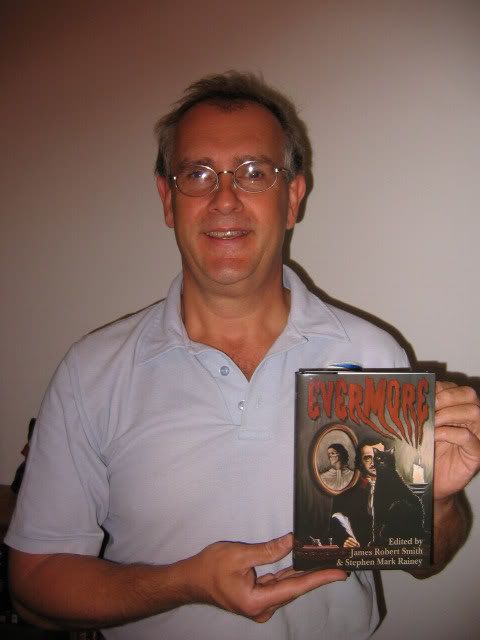
Ten years after I conceived the project, the anthology EVERMORE has seen publication from Arkham House Books!
I apologize for my appearance in this photo, but I'd just arrived home from a rough day at work. But I was too excited not to have my photo taken with this gorgeous volume from Arkham House! One of my dreams was to see my name in print on an AH title. And here it is!
Ten years after I conceived the project, the anthology EVERMORE has seen publication from Arkham House Books!
I apologize for my appearance in this photo, but I'd just arrived home from a rough day at work. But I was too excited not to have my photo taken with this gorgeous volume from Arkham House! One of my dreams was to see my name in print on an AH title. And here it is!
Tuesday, November 21, 2006
Casino Royale
I've never been a James Bond movie fan. In fact, I've only sat through two of them--one Roger Moore and one Pierce Brosnan. I was never much impressed with the Bond films, except that most of them seem to have kickass opening credits and some really nifty action sequences.
So I wasn't expecting a whole lot when I went to see the new Bond movie featuring a new actor in the role of James Bond.
It was really cool.
Go see it.
So I wasn't expecting a whole lot when I went to see the new Bond movie featuring a new actor in the role of James Bond.
It was really cool.
Go see it.
Sunday, November 19, 2006
Youth, a poem.
Youth
By
James Robert Smith
We may look
back
in time
at photos of our
golden, glowing
youth.
And we may say,
Where did it go,
My youth? Where did I
Spend it?
But
we don’t spend our
youth.
We invest it.
And if it bears
a child, or two,
and golden, glowing
grandchildren who light
the world with
unknown promise and
smiling, innocent eyes,
then that was
indeed
a wise and wise investment.
By
James Robert Smith
We may look
back
in time
at photos of our
golden, glowing
youth.
And we may say,
Where did it go,
My youth? Where did I
Spend it?
But
we don’t spend our
youth.
We invest it.
And if it bears
a child, or two,
and golden, glowing
grandchildren who light
the world with
unknown promise and
smiling, innocent eyes,
then that was
indeed
a wise and wise investment.
Wednesday, November 15, 2006
Neandertals Did This, Too. (A Poem)
Neandertals Did This, Too
By
James Robert Smith
My
father-in-law is
dead
Frank,
dead.
I know it isn’t
generally
supposed to be
that way,
but,
he was my friend.
On visits to
her parents’
home,
my wife would have to pry me
out
because of the long
conversations.
Frank
was a great guy. He
should have run
for office.
At the memorial
service I
am pissed off.
I am still
angry
with Frank.
For dying, for leaving
us.
He killed himself,
to my way of
thinking.
Cigarettes killed him.
I’ve never known
anyone
as addicted to that
stuff
as Frank was. I’m angry because
he robbed us
of his company,
his conversation,
his laugh,
his voice,
his father’s way
with love.
So.
I stand in the funeral home
and the people are there
in
freaking
droves.
More than one
thousand.
I kid you
not.
He should have run for
office, before it was
too
late.
No more plans to drive
his truck and trailer out
west. No more
plans for me
my wife
my son
to fly out and meet them in
Seattle
and travel up
the Al-Can
Highway to Denali.
Dreams die, too.
I’m pissed off.
With Frank.
With everyone.
The whole process of
memorial service
and funeral
pisses
me
off.
How stupid.
How much money has
his wife spent on
this dark shindig?
I’m full of myself.
I’m full of contempt for
everyone there.
Stupid apes,
I think.
His only son,
my wife’s brother,
approaches Frank’s casket
where
Frank lies pasty and white
and dead.
What is Ed
doing?
This yokel? This welder?
This wanna-be cowboy?
This womanizer?
This hellion?
This party animal?
This divorced jerk?
What is he doing?
He leans over the
casket.
I drift over.
To see.
Ed slips a
hunting magazine
into the casket
with Frank. Field & Stream,
Frank’s favorite.
And Ed puts a snapshot
of himself,
a small color
photo
into the pocket of the
coat
Frank wears.
I freeze.
The anger flows out
of me.
Back at
myself.
I feel
small.
And stupid.
And selfish.
And
alone.
It is all I can do
not to burst into
insane
laughter.
This man,
this son,
has shamed me
with this primitive,
touching
act of love.
By
James Robert Smith
My
father-in-law is
dead
Frank,
dead.
I know it isn’t
generally
supposed to be
that way,
but,
he was my friend.
On visits to
her parents’
home,
my wife would have to pry me
out
because of the long
conversations.
Frank
was a great guy. He
should have run
for office.
At the memorial
service I
am pissed off.
I am still
angry
with Frank.
For dying, for leaving
us.
He killed himself,
to my way of
thinking.
Cigarettes killed him.
I’ve never known
anyone
as addicted to that
stuff
as Frank was. I’m angry because
he robbed us
of his company,
his conversation,
his laugh,
his voice,
his father’s way
with love.
So.
I stand in the funeral home
and the people are there
in
freaking
droves.
More than one
thousand.
I kid you
not.
He should have run for
office, before it was
too
late.
No more plans to drive
his truck and trailer out
west. No more
plans for me
my wife
my son
to fly out and meet them in
Seattle
and travel up
the Al-Can
Highway to Denali.
Dreams die, too.
I’m pissed off.
With Frank.
With everyone.
The whole process of
memorial service
and funeral
pisses
me
off.
How stupid.
How much money has
his wife spent on
this dark shindig?
I’m full of myself.
I’m full of contempt for
everyone there.
Stupid apes,
I think.
His only son,
my wife’s brother,
approaches Frank’s casket
where
Frank lies pasty and white
and dead.
What is Ed
doing?
This yokel? This welder?
This wanna-be cowboy?
This womanizer?
This hellion?
This party animal?
This divorced jerk?
What is he doing?
He leans over the
casket.
I drift over.
To see.
Ed slips a
hunting magazine
into the casket
with Frank. Field & Stream,
Frank’s favorite.
And Ed puts a snapshot
of himself,
a small color
photo
into the pocket of the
coat
Frank wears.
I freeze.
The anger flows out
of me.
Back at
myself.
I feel
small.
And stupid.
And selfish.
And
alone.
It is all I can do
not to burst into
insane
laughter.
This man,
this son,
has shamed me
with this primitive,
touching
act of love.
Tuesday, November 14, 2006
Look! (A Poem)
Look!
By
James Robert Smith
Look how FAR
we’ve come,
they brag
(as if they’d done it themselves).
Jumbo jets!
Computers!
DVD players!
Interstate highways!
Skyscrapers!
Sewage systems!
Automobiles!
Modern medicine!
MORE computers!
Cell phones!
Satellites!
Space stations!
Planetary probes!
We’re great! We’re #1,
they say.
But do they EVER
stop to think
that we should have
achieved all that
stuff
500 years ago?
1,000 years ago?
That we should be
sitting, perhaps,
in the lap of luxury in
Paradise,
either here on Earth
or in orbit around
Betelgeuse? or Barnard’s Star?
or Proxima Centauri?
Or hauling black holes
around the Universe like tinker toys
while God kisses our ass?
No. I doubt
that ever occurs
to them.
By
James Robert Smith
Look how FAR
we’ve come,
they brag
(as if they’d done it themselves).
Jumbo jets!
Computers!
DVD players!
Interstate highways!
Skyscrapers!
Sewage systems!
Automobiles!
Modern medicine!
MORE computers!
Cell phones!
Satellites!
Space stations!
Planetary probes!
We’re great! We’re #1,
they say.
But do they EVER
stop to think
that we should have
achieved all that
stuff
500 years ago?
1,000 years ago?
That we should be
sitting, perhaps,
in the lap of luxury in
Paradise,
either here on Earth
or in orbit around
Betelgeuse? or Barnard’s Star?
or Proxima Centauri?
Or hauling black holes
around the Universe like tinker toys
while God kisses our ass?
No. I doubt
that ever occurs
to them.
Saturday, November 11, 2006
Celebreation Gone Wrong, a poem.
Celebration Gone Wrong
By
James Robert Smith
This happened a few years ago,
at a strip club on Monroe Road
right here in town,
one block from where I now
work.
Three brothers were out
celebrating
the medical school graduation of
the youngest of the three.
He was going to be a dentist.
So they went out eating
and drinking
and capped it off with a visit to
a titty bar.
While in this establishment
they became a little louder than
they might otherwise have become
due to the celebration of the
youngest brother becoming a
doctor.
The manager of the joint,
a recent parolee named
Shorty McGuire
got in their faces.
They told him to go to Hell.
He told them to leave.
They did so,
but
turned around one last time
to tell Shorty where to stick
it.
Shorty waited for them to get out of the door
and
standing in that glass partition
on the titty bar side of it
he put three slugs from his
.38
into the new, young doctor
killing him
instantly.
Back to the pen for Shorty.
Off to the worm ranch for
the young dentist who would
never get to
ply his trade
make his mark
earn a good living
buy a huge house
fix a bad smile
pull some teeth
marry a pretty girl
raise a family
be happy.
I don’t remember the kid’s
name
but I recall Shorty,
and his ugly, worthless, bearded
face in the newspaper.
Seems he needed some
dental work.
Shorty’s gone now.
In prison forever.
The titty bar is still there.
By
James Robert Smith
This happened a few years ago,
at a strip club on Monroe Road
right here in town,
one block from where I now
work.
Three brothers were out
celebrating
the medical school graduation of
the youngest of the three.
He was going to be a dentist.
So they went out eating
and drinking
and capped it off with a visit to
a titty bar.
While in this establishment
they became a little louder than
they might otherwise have become
due to the celebration of the
youngest brother becoming a
doctor.
The manager of the joint,
a recent parolee named
Shorty McGuire
got in their faces.
They told him to go to Hell.
He told them to leave.
They did so,
but
turned around one last time
to tell Shorty where to stick
it.
Shorty waited for them to get out of the door
and
standing in that glass partition
on the titty bar side of it
he put three slugs from his
.38
into the new, young doctor
killing him
instantly.
Back to the pen for Shorty.
Off to the worm ranch for
the young dentist who would
never get to
ply his trade
make his mark
earn a good living
buy a huge house
fix a bad smile
pull some teeth
marry a pretty girl
raise a family
be happy.
I don’t remember the kid’s
name
but I recall Shorty,
and his ugly, worthless, bearded
face in the newspaper.
Seems he needed some
dental work.
Shorty’s gone now.
In prison forever.
The titty bar is still there.

Wednesday, November 08, 2006
New chapter of Coda.
I've posted a new chapter of my online novel, Coda.
You can read the new segment here.
You can read the new segment here.

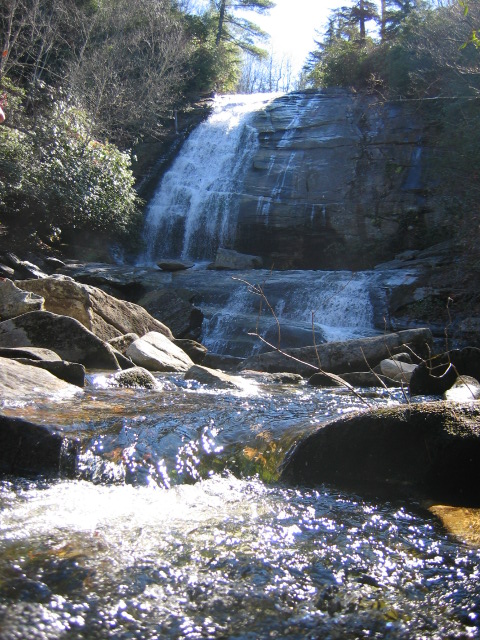
Myself, my son (Andy), my nephew Mark and his son, Harris.
On the summit of Sam Knob, in the NC high country.
Sunday, November 05, 2006
Waterfalls and peaks.

Thursday, November 02, 2006
Back to Panthertown Valley!
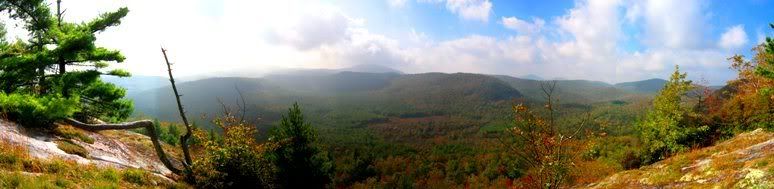
I haven't been hiking in Panthertown Valley wilderness since October of 2004. So I'm headed up there for two days and two nights to show my son, and my nephew and his son why it's called "the Yosemite of the East".
I'll post here when we return!
I'll post here when we return!
Wednesday, November 01, 2006
Tuesday, October 31, 2006
Liss Gap, a poem.
Liss Gap
By
James Robert Smith
My first long
backpacking trip,
at fifteen years of age,
I labor up
from Dick’s Creek Gap.
Up.
Up from the highway,
deep
into woods
climbing
the slopes of a 4,000
foot peak.
We slab along
the sides, climbing.
My pack weighs 65
pounds, I 180.
I sweat,
my heart beats,
hard,
sweat pours down,
into my eyes,
my hair wet, my back
drenched,
my legs tired.
We walk,
we four,
high school pals,
on a seven-day
trek.
At the top, we pause,
briefly,
in deep hardwoods,
silence,
then push on.
Tired, gasping for
breath, hoping for
relief, I wonder
why I’m here,
in woods,
on high ridges,
sweating, gasping,
wondering.
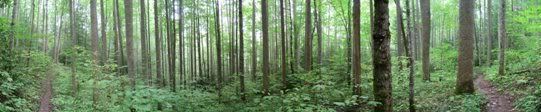
And then,
we come to Liss Gap.
Level, between
peaks. Forests, as
far as one can
see.
Deep.
Green. Dark.
The ground is hidden
by ferns that hug
the forest floor
and carpet it in hues
of lighter green.
Above it all,
a stand of
tall, vertical, proud,
pale poplars.
Acres of them.
On and on.
Straight, like some
natural exercise in
Geometry.
I shed my pack.
I sit
among the ferns,
soft leaves a
cushion,
and I admire
the poplars, the ferns,
the greens,
the sunlight and shadows,
on and on.
I breathe,
I smile,
I know why I’m here,
By
James Robert Smith
My first long
backpacking trip,
at fifteen years of age,
I labor up
from Dick’s Creek Gap.
Up.
Up from the highway,
deep
into woods
climbing
the slopes of a 4,000
foot peak.
We slab along
the sides, climbing.
My pack weighs 65
pounds, I 180.
I sweat,
my heart beats,
hard,
sweat pours down,
into my eyes,
my hair wet, my back
drenched,
my legs tired.
We walk,
we four,
high school pals,
on a seven-day
trek.
At the top, we pause,
briefly,
in deep hardwoods,
silence,
then push on.
Tired, gasping for
breath, hoping for
relief, I wonder
why I’m here,
in woods,
on high ridges,
sweating, gasping,
wondering.
And then,
we come to Liss Gap.
Level, between
peaks. Forests, as
far as one can
see.
Deep.
Green. Dark.
The ground is hidden
by ferns that hug
the forest floor
and carpet it in hues
of lighter green.
Above it all,
a stand of
tall, vertical, proud,
pale poplars.
Acres of them.
On and on.
Straight, like some
natural exercise in
Geometry.
I shed my pack.
I sit
among the ferns,
soft leaves a
cushion,
and I admire
the poplars, the ferns,
the greens,
the sunlight and shadows,
on and on.
I breathe,
I smile,
I know why I’m here,
in Liss Gap.
Monday, October 30, 2006
Evil Biscuit
Evil Biscuit
By
James Robert Smith
While my wife
is in surgery
yet again,
I take
the elevator up to
the Mezzanine where
the fast food sells
and
I order a large
iced tea
and a chicken biscuit
for $3.34
and the girl at
the register
says, “Your change is
666.”
Was the biscuit
evil?
Or was it
the tea?
Or both?

By
James Robert Smith
While my wife
is in surgery
yet again,
I take
the elevator up to
the Mezzanine where
the fast food sells
and
I order a large
iced tea
and a chicken biscuit
for $3.34
and the girl at
the register
says, “Your change is
666.”
Was the biscuit
evil?
Or was it
the tea?
Or both?

Friday, October 27, 2006

Thursday, October 26, 2006
Online novel.
I've decided to publish an online novel. Entitled Coda, it's something I'm working on as I labor to finish another novel which is close to completion.
My intent is to publish a new chapter or segment each week until it's done.
If you want to take a look, you can see it here, at JamesRobertSmith.net.
Enjoy!
My intent is to publish a new chapter or segment each week until it's done.
If you want to take a look, you can see it here, at JamesRobertSmith.net.
Enjoy!
Wednesday, October 25, 2006
Look at him.
Look at Him
By
James Robert Smith
Look at that bastard
sitting there
in the waiting room
with those two volumes
of modern
poetry
reading like he’s some kind of
stuck-up snob.
Look at him!
He’s got a hardbound notebook!
One of those hoity-toity
composition books!
Look at him.
He opens it up on his fat damned lap
and writes in it.
Probably thinks he’s writing
some great, bloody poem.
What an asshole.
Wait a minute!
That’s me!
By
James Robert Smith
Look at that bastard
sitting there
in the waiting room
with those two volumes
of modern
poetry
reading like he’s some kind of
stuck-up snob.
Look at him!
He’s got a hardbound notebook!
One of those hoity-toity
composition books!
Look at him.
He opens it up on his fat damned lap
and writes in it.
Probably thinks he’s writing
some great, bloody poem.
What an asshole.
Wait a minute!
That’s me!
Tuesday, October 24, 2006
Man-Hater's wet dream destroys the forests.
Man-Hater’s wet dream destroys our Eastern forests.
By
James Robert Smith
Go see them while you can.
In several sections of the Great Smoky Mountains National Park are stands of hemlock trees that were never cut when lumber companies were hacking their ways through our vast tracts of forest. These trees, while not on the order of California’s redwoods, are nonetheless impressive. To stand amidst them and look up at those evergreen branches, their trunks rising great all around, the ground carpeted in the redred rust of needles shed and coppering on the forest floor... Well, you have to go see it, I guess, to understand the experience. Words are not sufficient.
But if you want to see them, you’d better hurry.
A few decades ago, someone bringing Asian hemlocks to the area around Washington DC introduced a pest called the Hemlock wooly adelgid. A bug. Native to the Old World, this pernicious little whore is of a species that has no males. Like arthropod versions of the Tribble, they’re all female and all born with the ability to eat like a black hole and lay jillions of eggs that hatch into versions of their bitch mommas. America’s hemlocks have no resistance to them, and there is no native beetle to prey on the tiny cunts. So they have had their way with the hemlock forests of America’s east coast. The Park Service is doing what it can to stem the infestations, but it looks as if the hemlock is going to become as extinct as the American chestnut.
So. If you want to see these amazing stands of trees, then you’ll have to visit the Smokies within the next few years. After that, the trunks will still be standing, but they’ll be dead. I’ve asked folk who know where the most impressive stands are located in the park and I’ve been making an effort to see them over the past few years. Biologists are predicting the complete elimination of both the Eastern hemlock and the Carolina hemlock from our forests. If you’ve never seen a hemlock tree, you might not know how beautiful they are. They’re my favorite tree when I’m hiking and backpacking. Instantly recognizable. Always green, branches sheltering, growing very tall. I’ve seen hemlocks over 150 feet tall.
All around us, the Earth is telling us how sick it is. All around us. Our atmosphere is in turmoil, but those who control us claim otherwise. Our forests are sickening, but those who hold domain over them want to cut them down. Our wildlife is vanishing, but those who can help will not allow us to protect that life. The land itself is poisoned, but those who pull the strings won’t let us cleanse that land.
Do yourselves a favor and visit the hemlock forests of the Great Smoky Mountains and the Southeast before the only thing remaining of them are dead, drying husks that once were trees.
Yours,
Bob.

By
James Robert Smith
Go see them while you can.
In several sections of the Great Smoky Mountains National Park are stands of hemlock trees that were never cut when lumber companies were hacking their ways through our vast tracts of forest. These trees, while not on the order of California’s redwoods, are nonetheless impressive. To stand amidst them and look up at those evergreen branches, their trunks rising great all around, the ground carpeted in the redred rust of needles shed and coppering on the forest floor... Well, you have to go see it, I guess, to understand the experience. Words are not sufficient.
But if you want to see them, you’d better hurry.
A few decades ago, someone bringing Asian hemlocks to the area around Washington DC introduced a pest called the Hemlock wooly adelgid. A bug. Native to the Old World, this pernicious little whore is of a species that has no males. Like arthropod versions of the Tribble, they’re all female and all born with the ability to eat like a black hole and lay jillions of eggs that hatch into versions of their bitch mommas. America’s hemlocks have no resistance to them, and there is no native beetle to prey on the tiny cunts. So they have had their way with the hemlock forests of America’s east coast. The Park Service is doing what it can to stem the infestations, but it looks as if the hemlock is going to become as extinct as the American chestnut.
So. If you want to see these amazing stands of trees, then you’ll have to visit the Smokies within the next few years. After that, the trunks will still be standing, but they’ll be dead. I’ve asked folk who know where the most impressive stands are located in the park and I’ve been making an effort to see them over the past few years. Biologists are predicting the complete elimination of both the Eastern hemlock and the Carolina hemlock from our forests. If you’ve never seen a hemlock tree, you might not know how beautiful they are. They’re my favorite tree when I’m hiking and backpacking. Instantly recognizable. Always green, branches sheltering, growing very tall. I’ve seen hemlocks over 150 feet tall.
All around us, the Earth is telling us how sick it is. All around us. Our atmosphere is in turmoil, but those who control us claim otherwise. Our forests are sickening, but those who hold domain over them want to cut them down. Our wildlife is vanishing, but those who can help will not allow us to protect that life. The land itself is poisoned, but those who pull the strings won’t let us cleanse that land.
Do yourselves a favor and visit the hemlock forests of the Great Smoky Mountains and the Southeast before the only thing remaining of them are dead, drying husks that once were trees.
Yours,
Bob.
Monday, October 23, 2006
James Dickey Wasn't Writing Metaphor: Gilmer County & Ellijay, Snookie Fodder
Dickey Wasn't Speaking In Metaphor
By
James Robert Smith
In what now seems to me to be a very long time ago in a place very, very far away, I lived with monsters.
My father, fleeing an arrest warrant in Macon, Georgia where he'd been convicted of selling Playboy Magazine and then breaking conditions of his subsequent release by selling another such magazine, took himself and what remained of his family to the mountains of northern Georgia. He had bought a one hundred and twenty acre tract of barely accessible land in a backwater county named Gilmer. There are one hundred and sixty-nine counties in the great state of Georgia. Gilmer may very well be one of the strangest.
My father's acreage was bounded on all but one side by land owned by the gigantic Rome-Kraft Paper Company. I recall that they had accidentally planted part of a grove of pines on our side of the property line. This amused me until I realized that at some time they must have "accidentally" crossed the line to cut the hardwoods that had formerly been there; you could see some mighty oak stumps that had once formed the basis for some impressive trees. Oh, well.
Our human neighbors were few and far between. Perhaps the term "mountaineer" would best describe these folk. Human seems not to be the correct word. Denizens, perhaps, seems much more appropriate. At any rate, we basically had no neighbors. Most of the inhabitants of those mountains had fled for the lowlands-- where there were jobs--during the decades leading up to the Great Depression, so there were less people living there in the 1970s than there had been at the turn of the century. Our nearest neighbor was more than two miles from our front door. Our driveway was a shade over a mile long.
It took many bulldozers many repeat visits and dump trucks many trips to level and gravel our driveway. I have no idea how much my father spent on that road, but it must have been a pile.
The first five or six loads of gravel were sucked up by the thick, clinging red clay as if they had been illusions. It was only in the second year we were there that the gravel stopped being devoured by the road. One would have supposed that the Earth there had enough rock in it.
Our property was studded with former home sites and the low walls of rock picked out of former fields by ignorant dirt farmers long ago. The houses were all gone, save for vague foundations amid the pines and red oaks. The walls that marked the boundaries of former fields were quite evident and indicative of the struggle between the poor bastards who had lived there and the damned land that didn't want to give up a decent living. Well, they were almost all gone, by then. The denizens, that is.
When my parents fled Macon on the wrong end of that arrest warrant issued by that motherfucker Mayor Ronnie Thompson, they had about $60,000 in the bank. Enough to scrape out that road into the wilderness and build us a three bedroom house way, way down in the farthest reaches of our land: a place my father called Bear Scare Valley (another story for another time).
I recall that my father thought that he would enjoy this land and the people who lived there. He had read much of the friendliness and the generosity of the mountain people. Many stories.
They were all lies.
Now, all these years later, I am convinced of something. After I left Gilmer County and the land and the people there became bad memories and tenacious nightmares, I read a book called DELIVERANCE, written by a man named James Dickey. It's funny, for while I was living in Gilmer County a movie was released based on Mr. Dickey's book. I'm convinced that the fictional town in his novel was Ellijay, in our very own Gilmer County. I'm convinced that his "Cahullowassee River" was actually the Coosawattee River, which was being dammed to create the Carters Reservoir. The seven hundred foot deep gorge we used to stand and look down upon is now a vast lake. A pity.
When I finally read that book and later viewed that movie, I was chilled with the familiarity of it all. He nailed that place and those folk, for I lived among them and can vouch as sordid fact the things he spelled out in those works. Thinking of it, I shudder. I recall the barely human things who lived in those isolated hills, their dialect a remnant of people long dead elsewhere in this country, their flesh warped and twisted like their minds by vicious inbreeding to the point of the closest of incestuous relationships, their minds little more than urges to survive, their brains merely lust generators.
My earliest exposure to these folk were rides on the school bus, which picked me up roughly at 6 am and deposited me many miles away at the high school some two and one half hours later. I repeated that ride each afternoon. I was only fifteen years old, a kid. I didn't know any better than to sit and take it. There were books to read, and I often conversed with the kids who rode with me. It only took me a week or so to decipher their dialect. "The Fire" was the Fair. When those kids kept asking me if I was going to "the fire", images of vast bonfires surrounded by pale, jabbering faces kept appearing in my mind. Oh, I finally surmised. The Fair. I didn't go.
Eventually, I made acquaintances with some of these kids. I can't call them friends, for I shared no true common interests with them, nor secrets. But people do what people can to exist in a normal way. One day, on the bus, I agreed with my younger brother and two of the local boys to go camping at a certain place along a small river called Talking Rock Creek, a tributary feeding into the Coosawattee River. We were going to descend the steep gorge down to the edge of the creek and sleep at the foot of a precipice called Cedar Cliffs by the locals.
Cedar Cliffs was an impressive formation. It loomed a good two hundred feet above the torrent of Talking Rock Creek. Pale and gray, it was a jagged, cave-pocked wall that stood horribly high, overlooking the whitewater that thrashed at its feet. Below it, just above the level of the creek, was a great overhang that afforded shelter from the rain; it was an ideal camping spot. We went.
My father took us in his pickup truck to gather the other two boys. My younger brother and I rode up front with him. When the two acquaintances from the bus tumbled into the back of the truck, my father emerged to help them load their quilts and pillows and other supplies. One stayed in back with their stuff, the other followed on a dirt bike. From a dark porch hanging onto a shack of a house, someone who may have been a parent watched us ride off with their son. As we bounced along the rutted logging road that led to the lip of the gorge behind Cedar Cliffs, my father looked back at our rider and then at me and he said, "You're going to learn about cleanliness on this trip." I saw that he was eyeing their quilts. Later, helping move stuff down the slopes beside the cliffs, I touched one of those quilts. I scrubbed my hands in the churning waters of Talking Rock Creek.
By mid-afternoon we four boys had our camp set up to our satisfaction. My father was long gone and there was only us: Myself, brother, D-- W-- K-- and R-- C--.
D-- W-- was a picture of inbreeding. His head was misshapen in a way that was hard to describe. One could only say that there was something not quite right about his skull. His skin was pale almost to the point that there didn't seem to be any pigment there. His hair, what there was of it in a thin thatch over that skull, was a dirty blond going to dark brown at the crown. His teeth, what there were of them, bucked out from his thick lips. Mostly they were yellow, but some of them were green. A lot of his teeth were gone, and a few of those that remained seemed to be hanging on out of spite of my eyes.
R-- C-- was short and solidly built. He was only about six inches over five feet tall, if that. His hair was thick, so thick that it formed a kind of cap on his ugly head. I could imagine rain shedding off of that brown stuff effectively. I'd heard that his parents dearly loved him, and unlike K--, his teeth were all in his head and his hair was regularly washed so that it did not mat on his scalp as D-- W--'s did. But his quilts were equally as filthy.
We spent the day exploring the cliff. We climbed up to the top and looked down at the caves which could be reached by way of a thin ledge but which I was afraid to venture upon. I'd heard that feral goats lived there, and sure enough I could see mounds of goat droppings outside of one of the caves. I also recall chasing lizards--green anoles fading to brown and back as we ran them down and into cover. They all got away. The fish were not so lucky, and we cooked them over a fire we built in our campsite beneath the overhang under Cedar Cliffs.
Darkness came.
We made pallets under the cliff. We talked well into the night, although I have absolutely no recollection of what was said. No recollection at all. We built up our fire and gathered wood and looked out into the darkness. The creek roared and splashed and we could hear nothing else but the creek. Talking Rock Creek spoke and blathered and never stopped. At last, though, we faltered and I fell into a deep and tired sleep. My younger brother to my back, I dreamed.
I awoke.
It was very dark. I was looking up at the roof of the overhang, uncounted tons of solid stone somehow supported as if my some Frank Lloyd Wrightian magic. The fire was almost out. Not quite, but almost. There was only the pitch-blackness of a moonless, overcast, starless night amidst the dark and piney woods. But for that faint, barely revealing luster of the fire's fading afterglow. It was almost as if the fire was loaning my immediate surroundings some kind of infrared gift of sight.
Had I heard a sound? No. No sound but the rushing water. Had I seen something? There was nothing but us. Nothing had moved. No one had risen. No one was mov..
In the dim orangey glow of the fire I could see something move. I peered across at the quilt-covered form of R-- C-- and DW K--. They were a clothed lump in the blackness; a mass, one might say. A single mass in the night. In the dark. Far and far and away down in the gorge at the foot of Cedar Cliffs beside the babbling scream of Talking Rock Creek.
It took a long time for me to comprehend. I was an innocent and naive fifteen-year-old.
The quilt rose. It fell.
It rose. Fell.
There was no sound. No sound, I tell you. No one spoke. No one grunted or squealed or even seemed to breathe.
There, far away from my home, from my mother and father, I was watching R-- C-- fuck DW K-- in the ass. As I realized this I felt the lump of fish in my stomach freeze like a tray of solid ice. And I recall that I slowly reached back to make certain that my little brother was still with me, still at my back.
Seconds passed. I realized that I was staring and so squinted my eyes so that no one could see anything reflected in them should they turn my way. A long time seemed to flow slowly by, unlike the water in Talking Rock Creek, which bubbled and roared on and on and on. The quilt rose. And it fell. I waited for it to stop, but it didn't. I thought of R-- C-- there, locked over DW's boney frame, and I wondered if he had a knife, if he were aware that I was awake, if he were human. I waited for that slow, almost bellows-like movement to end. I stopped watching.
Somehow, I made myself become drowsy. I felt that, somehow, if I let them know I was awake, that I was seeing what was happening, then something bad would happen. I wasn't physically afraid of the two: I felt I could fight them easily. I was taller and heavier and stronger than both of them. But they could even have brought a gun, I thought. And so, strangely, I not only became drowsy, I slept.
Morning came. I got up. DW and R-- were still asleep. My father was picking us up early there at the top of the gorge, and I was happy for that. Oh, man, was I happy for that. Quickly, my little brother and I gathered our stuff and began to take it up the steep trail to the top of the cliffs. "Ain't you'ns a-goin' to fish no more," DW called to us.
When my father came, my brother and I jumped a bit too eagerly into the truck. My father asked us if we had fun and we made small talk. "We caught some fish," I told him. "We cooked them over the fire."
The next day I was out at the edge of the woods that pressed in all around our little house down there in Bear Scare Valley at the end of that mile-long driveway with the nearest neighbor two miles away and the nearest paved road three miles away and the nearest phone five miles distant. My brother saw me out there and joined me as I sat in the brown and brittle forest floor.
"Did you see anything last night," he asked.
"What," I said.
"Did you see or hear anything last night?"
"No," I said. "What are you talking about?"
"Fuck yes, you did, too. You know damned well what I'm talking about."
"I don't know what you're talking about," I told him and retreated to the house.
In time, we all retreated completely from our mountain home. We abandoned it and sold it when my parents died. The locals savaged the place after we left. We had no way to secure it from the mindless creatures who inhabit those hills, and there was nothing to do but sell it away. By the time we left, my father held no more illusions concerning the “people” who exist in those green and stunted mountains in the north of Georgia. Dickey knows them. There are some who say that there is something of value in them. I hear that Don West, the working class poet that was spawned by this same Gilmer County professes some worthiness to these mountain folk. But, not I.
When I think of them, I think of their black and distrustful eyes shining dark and flinty out at you. I think of their filth and their rotted teeth and the dark, tilted hovels in which they spawned their offspring: children of their own, out of their own children. And I think of Talking Rock Creek blathering like a party of madmen. And I think of that quilt rising, like a great beast drawing breath; and falling, like a monster huffing. Rising and falling. Like that. Not stopping.
And I think of my own prudent silence. I made myself sleep. I kept my mouth shut, that night on Talking Rock Creek.
And, by God, Dickey wasn’t speaking in metaphor.
By
James Robert Smith
In what now seems to me to be a very long time ago in a place very, very far away, I lived with monsters.
My father, fleeing an arrest warrant in Macon, Georgia where he'd been convicted of selling Playboy Magazine and then breaking conditions of his subsequent release by selling another such magazine, took himself and what remained of his family to the mountains of northern Georgia. He had bought a one hundred and twenty acre tract of barely accessible land in a backwater county named Gilmer. There are one hundred and sixty-nine counties in the great state of Georgia. Gilmer may very well be one of the strangest.
My father's acreage was bounded on all but one side by land owned by the gigantic Rome-Kraft Paper Company. I recall that they had accidentally planted part of a grove of pines on our side of the property line. This amused me until I realized that at some time they must have "accidentally" crossed the line to cut the hardwoods that had formerly been there; you could see some mighty oak stumps that had once formed the basis for some impressive trees. Oh, well.
Our human neighbors were few and far between. Perhaps the term "mountaineer" would best describe these folk. Human seems not to be the correct word. Denizens, perhaps, seems much more appropriate. At any rate, we basically had no neighbors. Most of the inhabitants of those mountains had fled for the lowlands-- where there were jobs--during the decades leading up to the Great Depression, so there were less people living there in the 1970s than there had been at the turn of the century. Our nearest neighbor was more than two miles from our front door. Our driveway was a shade over a mile long.
It took many bulldozers many repeat visits and dump trucks many trips to level and gravel our driveway. I have no idea how much my father spent on that road, but it must have been a pile.
The first five or six loads of gravel were sucked up by the thick, clinging red clay as if they had been illusions. It was only in the second year we were there that the gravel stopped being devoured by the road. One would have supposed that the Earth there had enough rock in it.
Our property was studded with former home sites and the low walls of rock picked out of former fields by ignorant dirt farmers long ago. The houses were all gone, save for vague foundations amid the pines and red oaks. The walls that marked the boundaries of former fields were quite evident and indicative of the struggle between the poor bastards who had lived there and the damned land that didn't want to give up a decent living. Well, they were almost all gone, by then. The denizens, that is.
When my parents fled Macon on the wrong end of that arrest warrant issued by that motherfucker Mayor Ronnie Thompson, they had about $60,000 in the bank. Enough to scrape out that road into the wilderness and build us a three bedroom house way, way down in the farthest reaches of our land: a place my father called Bear Scare Valley (another story for another time).
I recall that my father thought that he would enjoy this land and the people who lived there. He had read much of the friendliness and the generosity of the mountain people. Many stories.
They were all lies.
Now, all these years later, I am convinced of something. After I left Gilmer County and the land and the people there became bad memories and tenacious nightmares, I read a book called DELIVERANCE, written by a man named James Dickey. It's funny, for while I was living in Gilmer County a movie was released based on Mr. Dickey's book. I'm convinced that the fictional town in his novel was Ellijay, in our very own Gilmer County. I'm convinced that his "Cahullowassee River" was actually the Coosawattee River, which was being dammed to create the Carters Reservoir. The seven hundred foot deep gorge we used to stand and look down upon is now a vast lake. A pity.
When I finally read that book and later viewed that movie, I was chilled with the familiarity of it all. He nailed that place and those folk, for I lived among them and can vouch as sordid fact the things he spelled out in those works. Thinking of it, I shudder. I recall the barely human things who lived in those isolated hills, their dialect a remnant of people long dead elsewhere in this country, their flesh warped and twisted like their minds by vicious inbreeding to the point of the closest of incestuous relationships, their minds little more than urges to survive, their brains merely lust generators.
My earliest exposure to these folk were rides on the school bus, which picked me up roughly at 6 am and deposited me many miles away at the high school some two and one half hours later. I repeated that ride each afternoon. I was only fifteen years old, a kid. I didn't know any better than to sit and take it. There were books to read, and I often conversed with the kids who rode with me. It only took me a week or so to decipher their dialect. "The Fire" was the Fair. When those kids kept asking me if I was going to "the fire", images of vast bonfires surrounded by pale, jabbering faces kept appearing in my mind. Oh, I finally surmised. The Fair. I didn't go.
Eventually, I made acquaintances with some of these kids. I can't call them friends, for I shared no true common interests with them, nor secrets. But people do what people can to exist in a normal way. One day, on the bus, I agreed with my younger brother and two of the local boys to go camping at a certain place along a small river called Talking Rock Creek, a tributary feeding into the Coosawattee River. We were going to descend the steep gorge down to the edge of the creek and sleep at the foot of a precipice called Cedar Cliffs by the locals.
Cedar Cliffs was an impressive formation. It loomed a good two hundred feet above the torrent of Talking Rock Creek. Pale and gray, it was a jagged, cave-pocked wall that stood horribly high, overlooking the whitewater that thrashed at its feet. Below it, just above the level of the creek, was a great overhang that afforded shelter from the rain; it was an ideal camping spot. We went.
My father took us in his pickup truck to gather the other two boys. My younger brother and I rode up front with him. When the two acquaintances from the bus tumbled into the back of the truck, my father emerged to help them load their quilts and pillows and other supplies. One stayed in back with their stuff, the other followed on a dirt bike. From a dark porch hanging onto a shack of a house, someone who may have been a parent watched us ride off with their son. As we bounced along the rutted logging road that led to the lip of the gorge behind Cedar Cliffs, my father looked back at our rider and then at me and he said, "You're going to learn about cleanliness on this trip." I saw that he was eyeing their quilts. Later, helping move stuff down the slopes beside the cliffs, I touched one of those quilts. I scrubbed my hands in the churning waters of Talking Rock Creek.
By mid-afternoon we four boys had our camp set up to our satisfaction. My father was long gone and there was only us: Myself, brother, D-- W-- K-- and R-- C--.
D-- W-- was a picture of inbreeding. His head was misshapen in a way that was hard to describe. One could only say that there was something not quite right about his skull. His skin was pale almost to the point that there didn't seem to be any pigment there. His hair, what there was of it in a thin thatch over that skull, was a dirty blond going to dark brown at the crown. His teeth, what there were of them, bucked out from his thick lips. Mostly they were yellow, but some of them were green. A lot of his teeth were gone, and a few of those that remained seemed to be hanging on out of spite of my eyes.
R-- C-- was short and solidly built. He was only about six inches over five feet tall, if that. His hair was thick, so thick that it formed a kind of cap on his ugly head. I could imagine rain shedding off of that brown stuff effectively. I'd heard that his parents dearly loved him, and unlike K--, his teeth were all in his head and his hair was regularly washed so that it did not mat on his scalp as D-- W--'s did. But his quilts were equally as filthy.
We spent the day exploring the cliff. We climbed up to the top and looked down at the caves which could be reached by way of a thin ledge but which I was afraid to venture upon. I'd heard that feral goats lived there, and sure enough I could see mounds of goat droppings outside of one of the caves. I also recall chasing lizards--green anoles fading to brown and back as we ran them down and into cover. They all got away. The fish were not so lucky, and we cooked them over a fire we built in our campsite beneath the overhang under Cedar Cliffs.
Darkness came.
We made pallets under the cliff. We talked well into the night, although I have absolutely no recollection of what was said. No recollection at all. We built up our fire and gathered wood and looked out into the darkness. The creek roared and splashed and we could hear nothing else but the creek. Talking Rock Creek spoke and blathered and never stopped. At last, though, we faltered and I fell into a deep and tired sleep. My younger brother to my back, I dreamed.
I awoke.
It was very dark. I was looking up at the roof of the overhang, uncounted tons of solid stone somehow supported as if my some Frank Lloyd Wrightian magic. The fire was almost out. Not quite, but almost. There was only the pitch-blackness of a moonless, overcast, starless night amidst the dark and piney woods. But for that faint, barely revealing luster of the fire's fading afterglow. It was almost as if the fire was loaning my immediate surroundings some kind of infrared gift of sight.
Had I heard a sound? No. No sound but the rushing water. Had I seen something? There was nothing but us. Nothing had moved. No one had risen. No one was mov..
In the dim orangey glow of the fire I could see something move. I peered across at the quilt-covered form of R-- C-- and DW K--. They were a clothed lump in the blackness; a mass, one might say. A single mass in the night. In the dark. Far and far and away down in the gorge at the foot of Cedar Cliffs beside the babbling scream of Talking Rock Creek.
It took a long time for me to comprehend. I was an innocent and naive fifteen-year-old.
The quilt rose. It fell.
It rose. Fell.
There was no sound. No sound, I tell you. No one spoke. No one grunted or squealed or even seemed to breathe.
There, far away from my home, from my mother and father, I was watching R-- C-- fuck DW K-- in the ass. As I realized this I felt the lump of fish in my stomach freeze like a tray of solid ice. And I recall that I slowly reached back to make certain that my little brother was still with me, still at my back.
Seconds passed. I realized that I was staring and so squinted my eyes so that no one could see anything reflected in them should they turn my way. A long time seemed to flow slowly by, unlike the water in Talking Rock Creek, which bubbled and roared on and on and on. The quilt rose. And it fell. I waited for it to stop, but it didn't. I thought of R-- C-- there, locked over DW's boney frame, and I wondered if he had a knife, if he were aware that I was awake, if he were human. I waited for that slow, almost bellows-like movement to end. I stopped watching.
Somehow, I made myself become drowsy. I felt that, somehow, if I let them know I was awake, that I was seeing what was happening, then something bad would happen. I wasn't physically afraid of the two: I felt I could fight them easily. I was taller and heavier and stronger than both of them. But they could even have brought a gun, I thought. And so, strangely, I not only became drowsy, I slept.
Morning came. I got up. DW and R-- were still asleep. My father was picking us up early there at the top of the gorge, and I was happy for that. Oh, man, was I happy for that. Quickly, my little brother and I gathered our stuff and began to take it up the steep trail to the top of the cliffs. "Ain't you'ns a-goin' to fish no more," DW called to us.
When my father came, my brother and I jumped a bit too eagerly into the truck. My father asked us if we had fun and we made small talk. "We caught some fish," I told him. "We cooked them over the fire."
The next day I was out at the edge of the woods that pressed in all around our little house down there in Bear Scare Valley at the end of that mile-long driveway with the nearest neighbor two miles away and the nearest paved road three miles away and the nearest phone five miles distant. My brother saw me out there and joined me as I sat in the brown and brittle forest floor.
"Did you see anything last night," he asked.
"What," I said.
"Did you see or hear anything last night?"
"No," I said. "What are you talking about?"
"Fuck yes, you did, too. You know damned well what I'm talking about."
"I don't know what you're talking about," I told him and retreated to the house.
In time, we all retreated completely from our mountain home. We abandoned it and sold it when my parents died. The locals savaged the place after we left. We had no way to secure it from the mindless creatures who inhabit those hills, and there was nothing to do but sell it away. By the time we left, my father held no more illusions concerning the “people” who exist in those green and stunted mountains in the north of Georgia. Dickey knows them. There are some who say that there is something of value in them. I hear that Don West, the working class poet that was spawned by this same Gilmer County professes some worthiness to these mountain folk. But, not I.
When I think of them, I think of their black and distrustful eyes shining dark and flinty out at you. I think of their filth and their rotted teeth and the dark, tilted hovels in which they spawned their offspring: children of their own, out of their own children. And I think of Talking Rock Creek blathering like a party of madmen. And I think of that quilt rising, like a great beast drawing breath; and falling, like a monster huffing. Rising and falling. Like that. Not stopping.
And I think of my own prudent silence. I made myself sleep. I kept my mouth shut, that night on Talking Rock Creek.
And, by God, Dickey wasn’t speaking in metaphor.
Sunday, October 22, 2006
When Messiahs Come
When Messiahs ComeBy
James R. Smith
When messiahs first
realize they are
special,
do they,
for instance,
as certain gays
taking those initial
tentative steps out of
the closet,
gather, perhaps,
a dozen pals,
and say to them, (shyly),
“So. Like, would you…
follow me?”
James R. Smith
When messiahs first
realize they are
special,
do they,
for instance,
as certain gays
taking those initial
tentative steps out of
the closet,
gather, perhaps,
a dozen pals,
and say to them, (shyly),
“So. Like, would you…
follow me?”
Friday, October 20, 2006
Ark
Ark
By
James Robert Smith
Species, going two by two
into Extinction’s black ark.
Trees
on LeConte
drinking poison rain.
The tall, once green trunks bleaching
white, bone white
dead
dry
in air, once cool
once good
now dangerous, biting, killing,
white death
blowing on and on.
I walk in sun,
dangerous,
that once fed us all
and now burns
in some new
sub-cellular
way.
I walk in sun
where shade was once,
protecting the earth,
providing cover,
making a canopy
that now is gone,
branches gone
needles gone
deep balsam fragrance gone.
Where are the little
red squirrels who once
chattered?
Who once gathered food?
Who once lived?
Where are they?
Gone to that black ark,
or on their ways,
some few stragglers hanging back
to say goodbye.
I walk up the mountain,
maybe walking like the red squirrels
up the ramp of that black ark?
Does anyone else see
it?
Don’t they know? Don’t they see
the trees,
my trees,
the forests of my youth
once tall and strong
climax rain forest clothing
the slopes like a black cloak
healthy and dark
the fragrance I can still recall
but barely,
barely as even the trees tilt
toward that ramp
that leads ever upward to
that black ark.
Everything is going.
Beautiful cats,
lynx, tiger, lion
once proud and numbering the
plains are fading fast.
The elephants, largest
that yet remain of the old
Pleistocene masses that
Man recalls, that Man destroyed
that Man will put away in that black ark
closing up the door as they go
two by two
to that final journey into
Oblivion
hastened by a poisonous mouth that has no
parallel in Greed
in Ignorance.
I stand on the peaks
and feel the poison clouds
enveloping me, invisibly
burning with a touch so feather soft
that it’s the perfect poison.
How can such a thing be deadly?
And I turn and look,
the trees,
our trees,
the forest of my youth,
once tall and strong and black
with green so green it was once
dark like shadows, dark like the pupils in
the eyes of patient tigers
lying in wait.
Only a few see. And they have
no power to
make things right. No power
to stop the poison
to close up the ark
to tear down that ramp
where the creations of
Creation are shoved
two by two
into the white, dead, sterile place
from whence there is no return.
I stand on that mountaintop
and I see the ramp!
I’m standing on it!
My son is standing on it! My family is standing on it!
You are standing on it!
Pushing all before you!
I’m doing it along with you. I’m nudging small
bodies, green things, large things,
needed things, unknown fellows we will never
now know for they will
be gone before we meet them.
And we’ll follow.
Going with our brothers,
Our sisters,
Our fellow creations
As one of two
by two
Into that white, dead place
in that great
black
ark.

By
James Robert Smith
Species, going two by two
into Extinction’s black ark.
Trees
on LeConte
drinking poison rain.
The tall, once green trunks bleaching
white, bone white
dead
dry
in air, once cool
once good
now dangerous, biting, killing,
white death
blowing on and on.
I walk in sun,
dangerous,
that once fed us all
and now burns
in some new
sub-cellular
way.
I walk in sun
where shade was once,
protecting the earth,
providing cover,
making a canopy
that now is gone,
branches gone
needles gone
deep balsam fragrance gone.
Where are the little
red squirrels who once
chattered?
Who once gathered food?
Who once lived?
Where are they?
Gone to that black ark,
or on their ways,
some few stragglers hanging back
to say goodbye.
I walk up the mountain,
maybe walking like the red squirrels
up the ramp of that black ark?
Does anyone else see
it?
Don’t they know? Don’t they see
the trees,
my trees,
the forests of my youth
once tall and strong
climax rain forest clothing
the slopes like a black cloak
healthy and dark
the fragrance I can still recall
but barely,
barely as even the trees tilt
toward that ramp
that leads ever upward to
that black ark.
Everything is going.
Beautiful cats,
lynx, tiger, lion
once proud and numbering the
plains are fading fast.
The elephants, largest
that yet remain of the old
Pleistocene masses that
Man recalls, that Man destroyed
that Man will put away in that black ark
closing up the door as they go
two by two
to that final journey into
Oblivion
hastened by a poisonous mouth that has no
parallel in Greed
in Ignorance.
I stand on the peaks
and feel the poison clouds
enveloping me, invisibly
burning with a touch so feather soft
that it’s the perfect poison.
How can such a thing be deadly?
And I turn and look,
the trees,
our trees,
the forest of my youth,
once tall and strong and black
with green so green it was once
dark like shadows, dark like the pupils in
the eyes of patient tigers
lying in wait.
Only a few see. And they have
no power to
make things right. No power
to stop the poison
to close up the ark
to tear down that ramp
where the creations of
Creation are shoved
two by two
into the white, dead, sterile place
from whence there is no return.
I stand on that mountaintop
and I see the ramp!
I’m standing on it!
My son is standing on it! My family is standing on it!
You are standing on it!
Pushing all before you!
I’m doing it along with you. I’m nudging small
bodies, green things, large things,
needed things, unknown fellows we will never
now know for they will
be gone before we meet them.
And we’ll follow.
Going with our brothers,
Our sisters,
Our fellow creations
As one of two
by two
Into that white, dead place
in that great
black
ark.
Subscribe to:
Posts (Atom)