Tuesday, October 30, 2007

My Fiberglass Sedative

Over the years my wife and I found that the best way for both of us to enjoy the outdoors was to visit nice campgrounds that I could use as a base from which to day hike, since Carole doesn’t care for the tough hikes I generally take. So we bought all of the camping equipment a family needs to have a great time in a state park, or National Forest campground. We had a great tent, a canopy for the picnic table, lanterns, stoves, cots, sleeping bags; we had the works.

In our time as campers we hit dozens of state parks and National Forest Recreation Areas, in addition to several National Parks. We were generally having a great time wherever we went, even when the weather didn’t cooperate, such as the time we experienced sub-freezing temperatures and snowfall in October (in West Virginia), and unseasonably cold weather and extremely high winds one May (Shenandoah National Park). No matter what, though, we managed to have a good time.

Two years ago, however, we were camping at the Standing Indian Campground near Murphy North Carolina. This is an amazingly beautiful National Forest campground and we had a great spot right by the river. At night we would fall to sleep to the sound of water rushing over polished stones. It was great.


(Our last all-tent campsite.)

Until, one evening at around midnight, we were awakened by a loud crashing noise. I immediately knew that it could be only one thing: a bear. Whatever it was, it was trashing our campsite, despite the fact that all of our food and food items were packed up tight in our truck. I grabbed a flashlight and pointed it out through the door of the tent at the picnic table and, sure enough, an enormous black bear was hovering over our picnic table while scattering all of the things we tend to leave out in the night—things that are not associated with food, but which the bear was trying out anyway.

So I did what one is supposed to do in such a situation. I came out of the tent, put the light on the bear, and shouted for it to leave. Indeed, the bear did leave, vanishing into the thick rhododendron that hemmed in the campsite. We came out of the tent and began to clean up. I was on one side of the picnic table and my wife on the other. After a few minutes of tidying up, my wife screamed as the bear reappeared, shoving his enormous head out of the brush right beside her.

This was too much, as I realized that this bear was just too big and too aggressive to face down a second time. We scrambled into the cab of the truck and watched the bear for a few seconds. I decided to start the truck, with an idea that I might even try to nudge the bear away with it, but as soon as the engine fired, the bear took off in great haste, racing down the campground loop road in front of us. We waited for a bit and then got out of the truck and finished cleaning up and returned to our tent. My wife went right to sleep, but I wasn’t able to nod off until a couple of hours passed.

The following morning we learned that the bear had traversed the length of the campground (188 campsites!), hitting many along the way as he scrounged for food. Even though all of our food was secured, he wasn’t going to pass us by without checking to open up everything he could grab that looked as if it might harbor something good to eat. Since we didn't want to be something good to eat, we decided that it was time to ditch the tent and buy some kind of trailer.

For some months, Carole and I had been contemplating purchasing a travel trailer. We’d considered a number of options, including a pop-up, a hybrid model, and a 21-foot aluminum model. But a friend at work showed me a molded fiberglass RV he’d purchased and we were sold on the trailer he had:

The Casita.

At only 17 feet in length, it’s small enough and light enough to be able to be towed by my V-6 truck to any of the very out-of-the-way National Forest campgrounds that we prefer. In addition, it’s self-contained and has a complete bathroom in case you’re staying somewhere a bathroom is not available (the case in many National Forest sites). So we went with the Casita, and picked up our very own in August 2005. Since that time, we’ve taken it camping up and down the east coast and all over the high country of the Appalachians. It has been nothing but a delight and has made camping not only as much fun as before, but also far more secure. I can’t recommend these fiberglass trailers enough. Whether you buy a new Casita, Scamp, Escape, Bigfoot, or one from a new manufacturer, or a used model from one of a number of out-of-business companies, you are going to be sure to have a quality trailer that will give you many years of camping pleasure.


At Bahia Honda State Park, Florida Keys.

Saturday, October 27, 2007

Teenage Lobotomy

When I was 19 years old, I met a guy who was about 17 at the time. He was rather strange and I didn’t care to get to know him any better, as I found his presence to be disturbing. I don’t even recall his name, but I do remember that I later learned that he was one of the last people in those days to be lobotomized as part of medical therapy.

Apparently he’d been quite wild and uncontrollable, so the family physician finally suggested that a lobotomy would be the best way to go. His parents conceded and the deed was done, the crime committed, the travesty fulfilled.

After the lobotomy, among the things he did was break into a family mausoleum in the Brunswick Cemetery, open up the urns he found inside, examined their contents (“they looked like dried up bones,” he said, “not ashes”) and then scattered the contents of those urns all over the cemetery lawn. Shortly after that he climbed up into the water tower on Jekyll Island, just off the Georgia coast, opened the hatch in the roof, leaped in, and swam around in the island’s drinking water for half an hour or so before climbing back out (I always assumed he had a rope, but I never asked the witnesses for details).

I don’t know what happened to him after that, as I did my best to avoid him and anyone with whom he ran.

Thursday, October 25, 2007

The Creators.

When I walked away from both the retail and creation side of the comic book industry more than a decade ago, I swore that I never wanted anything to do again with either. I never wanted to buy or sell a comic book again, and I’d lost the urge to write them.

And for a very long time I didn’t pay more than a bare look at the medium. I didn’t go into a comic book shop, and only visited a couple of comic book conventions to visit with a friend who was still selling old comics. Of course I still had a very few friends who were comics creators, so I would see them from time to time, but avoided the subject of comic books, save for the single exception of a pal who was making his living creating an indie comic book.

But in the last few years I slowly came out of my self-exile. I visited a few comic conventions expressly to buy some comics by folk such as Chris Ware and Eddie Campbell that I couldn’t locate in comic book shops. And I recalled why I loved comics in the first place:

The works of Steve Ditko and Jack Kirby. These two guys created almost the whole of the mythology that we’ve come to know as the “Marvel Universe”. These two fellows, together, revitalized the commercial comic book industry and their work has gone on to become an economic engine that creates vast wealth and employment for untold numbers of craftsmen, artists, clerks, executives, lawyers, technicians, and laborers (and others).

Steve Ditko created The Amazing Spider-Man and Dr. Strange and the characters and villains and plots that moved those characters along. Kirby, of course, created everything else at Marvel in those days. Thor, and Capt. America, and The Avengers, and The X-Men, and The Fantastic Four, and Iron Man, and The Incredible Hulk, and The Silver Surfer, and a world of other heroes and villains and normal folk who live in his pulp fiction pages.

And, since Ditko’s Spider-Man was my favorite comic book of my youth, I decided to begin to rebuild a set of the issues that Ditko plotted, wrote, and illustrated:

Amazing Fantasy #15 and The Amazing Spider-Man #s 1-38.

I’m moving along, assembling the set. It’s going to take a while, but I’m well on my way. I don’t want any of the issues that came along after Ditko left the book. His vision is the definitive one, since it was, and always will be, his creation. I don’t care a whit for the hundreds of issues that followed The Amazing Spider-Man #38. Ditko’s work transcends the commercial and elevated the form into true art. There is a power in those 39 issues that promote a vision and a philosophy, which is what makes his work superior to anything that anyone attempted after he left the project he solely created.

I admire that. I’d forgotten why I admired it, but now I’ve recalled it.

Steve Ditko:


Sunday, October 21, 2007

Turn Out That Fire!

I do a lot of hiking and backpacking in wilderness areas in the Southeastern USA. Mainly, I stick to the limited high country of my native South, but occasionally I will venture into low country or Piedmont wilderness areas.

One of the things that I always liked about the wilderness concept was that of “leaving no trace”. As such, these places always had rules and laws in effect that were to prevent the building of campfires. Campfires consume deadwood, create smoke, and definitely impinge on the wilderness experience for those who don’t wish to see, hear, or smell wood smoke when they’re in wilderness.

Recently, I was appalled to visit the site of a certain (asshole) wilderness writer who posted many photographs of him proudly sitting around his hideous campfires in various wilderness areas in the Southeast. Sitting so smug and arrogant and ignorant while engaging in this destructive practice of bygone days. True, I suspect that it can be a pleasant experience to sit by a campfire and stare dumbly into the flames like a moron. But there are tons of non-wilderness lands in which this can be practiced without shattering the wilderness experience for others.

For myself, I go into wilderness for solitude and to escape from the influences of Mankind (as far as I am able). I don’t want to smell wood burning, and I don’t want to see light in a place where there is not supposed to be any light beyond that cast by the moon or the stars or the bioluminescence of some wild creatures who exist there.

In past years, it was public policy that campfires were not allowed at all in any of the wilderness areas in which I hiked. Now, it seems, the rules have been reinterpreted to merely state “limit campfire impact”, which basically means nothing, save that any moron can now plunge into our wilderness areas and begin dragging deadwood and piling it up to build a stinking campfire. I suspect that such ignorant sub-normals will soon begin to chop live wood from the forests to feed such fires, as the rules that were in place have been relaxed.

Alas, the wild places are dwindling fast. Soon, they will be ruined. I have resigned myself to this very sad fact and have been doing my best to see as much of it as I can before it succumbs to the destruction we’re bringing upon it.

However, if you’re going into wilderness, do it a favor: don’t build any goddamned campfires. And don’t take your dog with you—they spread diseases against which much wildlife has no defense. Just hike in and observe it and try to leave no fucking trace of your passing. I would ask you to destroy the traces of past fire rings, but I fear this would just encourage the idiots who follow you to create newer fire rings.

Basically…please don’t be a rude, arrogant, fire-building moron.


Wilderness campsite: no campfire!

Tuesday, October 16, 2007

Pulver-ized.

Wayne Pulver
By
James Robert Smith

Wayne Pulver was my best pal
in the third grade.
Wayne was a mutant.
At the age of eight he was taller
than our teacher.
He was 5 feet 6 inches, and huge,
a belly like an ape’s.
He was happy, and friendly, and smiling
and jolly.
Wayne lived one street over.
I had to go through my back yard
past the apple trees
climb the steep hill in the neighbor’s yard
to emerge on Wayne’s street
two houses up and across the road
from his place.
Wayne had a mom
who was a lousy cook,
crunchy grits!
but a sweet lady,
an absent dad claimed by divorce.
But he had an older brother who was
cool as shit;
he built all
of the models I didn’t have—
Dracula, The Creature, Godzilla, The Old Witch,
all of the Ratfink models,
the Big Daddy Roth rods,
the Weird-Ohs
and custom stuff he created from
castoff parts he got from other
kids.
Wayne and I spent a lot of
time looking at his brother’s models;
his brother didn’t mind.
One day, we were in the front yard at
my house.
A new kid in our third grade class
walked up; a jackass,
a bully
named phil.
He was a pissant next to Wayne,
but he was aggressive and mean and bound by
CRUELTY to pick a fight with smiling, kind
Wayne.
I stood by, did nothing
and watched.
Wayne tried to avoid fighting,
but the little shit phil
insisted.
Huge, heavy, unfortunate Wayne was forced
to fight.
It was a very, very short fight.
When phil picked himself up
had fled, bloody nose, bloody teeth, fat lips,
it was Wayne who was crying.
He looked at me.
“Why didn’t you do something?”
he asked.
“Why didn’t you stand up? He would have
backed off if you’d stood up
with me.”
I could have said,
“I was scared.” But
it wouldn’t have mattered, because I’d done
nothing, either way.
So Wayne left,
And other than in class,
I never saw him again. By year’s end,
they had moved
away
forever.

Sunday, October 14, 2007

Bushwhacked

I did a lot of hiking today. I bushwhacked up Little Sam Knob, a 5,900 foot peak that has no trail on it, and so if you want to bag that mountain, you have to be creative in finding your way to the top. Then we climbed Sam Knob, a 6040-foot peak that I've climbed before. Then we climbed up to near the summit of Black Balsam Knob (where our vehicles were parked). Then we climbed to the top of Mount Pisgah off the Blue Ridge Parkway, which I'd somehow managed to avoid doing over the years.

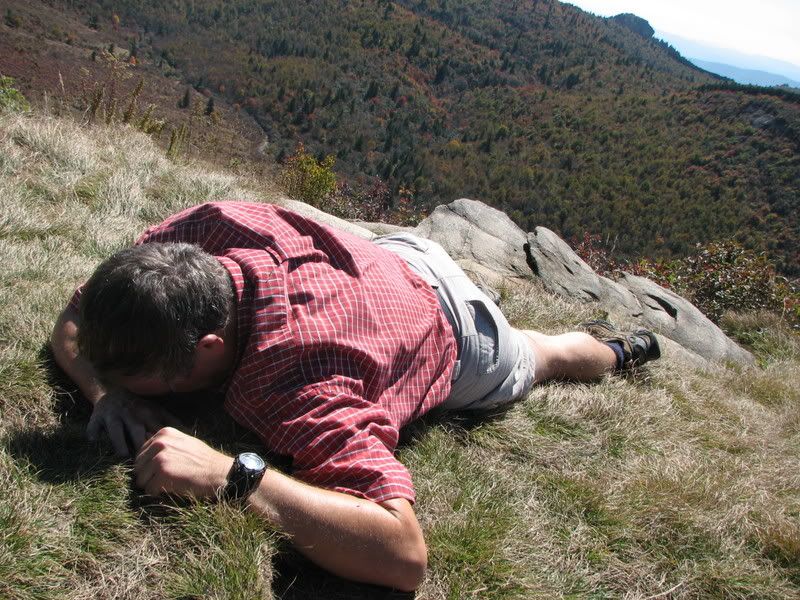
My son took this shot of me between reaching the summit of Sam Knob and heading off for Mount Pisgah:


Oh, damn, I am gettin' old.

Saturday, October 13, 2007

The Genre Coughs up a Good One.

For most of my late youth and almost all of my adult life I have enjoyed reading and writing horror fiction. However, while I have discovered many quality works of horror in the short form, and many skillful practitioners of horror fiction of shorter length, there have been very few novels within that genre that actually achieved what I suspect their authors set out to do.

So, about ten years ago I found myself reading less and less horror, either in the short story form or in the novel format. With the contraction of the magazine markets I really couldn't locate much in the way of short horror fiction, and almost all of the novels I was picking up just left me cold.

And that sent me to looking over my vast library of horror fiction and judging it. I own quite a lot of horror anthologies and collections and I attempted to reread material that had held my interest in earlier times.

On resurrecting this stuff, I found it better left in its pulpy graves. No new authors have appeared recently that have impressed me, at all. I grab horror novels in the shops and read the first chapter or two and…well, just put them back on the shelves.

Today, I walked into a local booksuperstore and walked down the aisles looking for something to buy. I read a lot of non-fiction, so buying something there wasn't going to be a problem. I read a lot of mainstream fiction, so picking out something along those lines that would interest me wasn't going to be much of a stretch. Even science-fiction has produced so many good authors and interesting ideas in the past couple of decades that I can almost always find a good sf novel of recent vintage that won't leave me regretting my purchase.

But I wanted to find a good horror novel, by Crom. Something with teeth. Something with wit. Something with style.

And I actually located a new book by probably the only horror writer who's walked up out of the horror ghetto in the past thirty years who seems to know how to write a good book:

Joe Lansdale.

Unlike too many writers today, the man has style. You don't have to see the name on the cover to know that you're reading a Joe Lansdale book (or short story). And, as I am out of the genre fiction news loop, I didn't realize that he had a new horror novel out there—one LOST ECHOES. I read the jacket blurb and the bare bones plot synopsis and while it didn't scream of innovation, it did grab my interest.

And then I opened it up and the book just fell open and my eyes nailed this line:

As his father said, "If it cost a nickel to shit, we'd have to throw up."

I don't know if Lansdale coined that himself, or if he heard it from one of the east Texas folk with whom he was raised. But whichever, it was a line I'd only be likely to see used (and used right) in a Joe Lansdale novel.

So I bought the book (the last copy on the shelf), and I'll have it read as soon as I get back from bushwhacking to the summit of a NC mile-high peak. Horror fiction seems to have come through with at least one book worth reading today. I reckon there's hope for that steaming, rotten, backwater, closed-up, decrepit, wandering-in-circles, dying genre yet.


Thursday, October 11, 2007

Mixed Feelings.

My initial notice of The Nature Conservancy was as a teenager when I was first beginning to think about what is commonly referred to as the Earth’s ecosystems, the depletion of same, and the negative influence of the Western world’s consumer driven economies.

In those days of my teen years, the early 1970s, I was very much interested in the preservation of large tracts of wild lands. There were various government agencies at that time involved in struggling to preserve such areas, and I was always happy to see legislation passed to buy and save as much wilderness and as much rural land as possible.

However, there began to be a lot of press for many private organizations who were active in protecting some wild places. The news media began to report on these groups, with specific attention given over to The Nature Conservancy. On the face of it, things sounded good. These people had been successful in buying up, or trading for parcels of unique and sensitive lands to lock them up in various ways to prevent them from being developed or exploited for commercial gain. Superficially, it seemed an encouraging development.

But even as a kid I was disturbed by this move away from governmental acquisitions of wild lands and toward a privately funded method of doing so. The first time I recall being truly disturbed by the actions of these private groups was in the description of how they were willing to negotiate and make concessions to gain some small advantages in protecting the core areas of some especially unique ecosystems. This bothered me mainly because, even as a kid, I’d learned that too much of working within the system and giving in to capitalist exploiters was to play into their hands. This was, in fact, a move to emasculate the governmental groups tasked with saving our wild places and making it easy for half-measures by private groups that did nothing much but enable corporations to exploit and ruin vast areas that might otherwise be saved.

To give them credit, the Nature Conservancy has, indeed, protected many wild and unique places in many nations around the world. Some truly rare systems and living organisms owe their continued existence to this group and the people who helm it. But one thing that seems central to their actions is that they generally end up protecting only the heart of a rare and endangered place. Yes, they safeguard the core of a wilderness, but the deals they cut for these small lands generally allow for the further exploitation of the areas around these limited and fragile wildernesses.

And what good does it do to protect a heart when the lungs are allowed to become diseased? What good a heart if kidneys are filled with toxins? What good a heart with livers swimming with poison? What good a heart with limbs lopped off and left to bleed?

The Nature Conservancy goes only so far in what they can do, and what they apparently are willing to do. By using specious arguments in favor of such concepts as “property rights” and “access to free enterprise”, the corporations who make obscene profits via the rape of our collective ownership of the lands that sustain us have empowered themselves to continue this rape at the cost of the rights of the citizens of this world. I have watched while the government has first given away its powers to protect our wild and rural lands, and then completely lost these powers to corporate interests. Wild and natural ecosystems cannot exist and thrive if they are allowed to be surrounded and imprisoned by walls of development and exploitation.

The Nature Conservancy is a good idea, if it had merely been a part of a much larger effort of a National (and International) movement to preserve our wildernesses and farmlands and rural areas as parks and regulated green spaces. Alas, it seems as if the Conservancy has been promoted by the corporate interests who wish to use it to their own advantages at the loss of the people of the nations within whose borders these same corporations do so much damage.

Unfortunately, the Nature Conservancy has ended up being not a part of a larger movement, but the only portion of a failing struggle to sustain life on this globe.


Tuesday, October 09, 2007

The Return of the Creature from 1957.

We went to West Virginia again. I love that place.

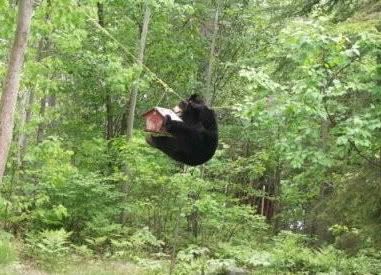
Late and I must go to work tomorrow. Just a quick note that we had much fun and encountered a bear in, appropriately, Beartown State Park as we were finishing up our hike and returning to the parking lot. Here he (she?) is:


Thursday, October 04, 2007

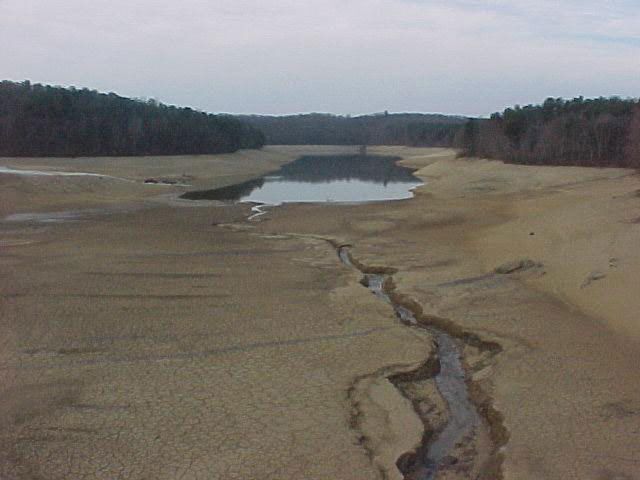
I wrote this poem five years ago just after what I thought was the worst drought I'd ever see here in the South. But here it is 2007, and we're suffering from a drought even worse than the one in 2002.

At any rate, I figured it was appropriate that I repost this poem.

Drought of oh-two
By
James Robert Smith

The clouds gathered,
overhead,
dark. And they muttered
softly, to the Earth’s
upturned face,
like a man telling lies
to a young girl,
promising love.
Then, those clouds,
dark,
like a deceitful lover,
fled over distant hills,
leaving.
And whatever had been planted,
whatever was sown,
in that parched, despairing
Earth
would just have to
make do.


Sunday, September 30, 2007

Heading Back to West Virginia.

My wife and I love West Virginia. The place is almost too beautiful to believe. It's almost like a big secret we keep from the rest of the world, for we rarely encounter crowds in the wild places we like to explore there.

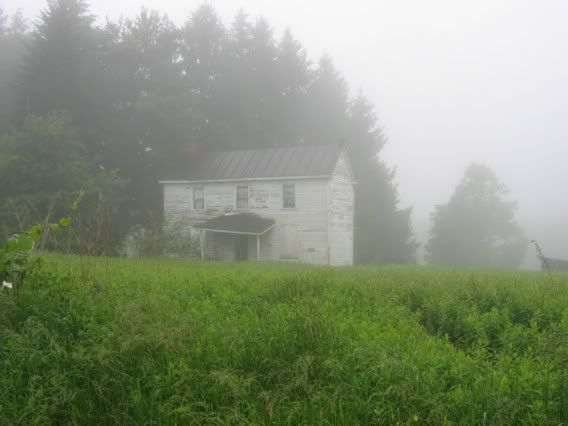
A few years ago we were driving on a very lonely gravel road atop a high mountain ridge. We spotted this vacant ruin of a house in an overgrown field so I stopped to take a photograph of it with my (then) new digital camera.


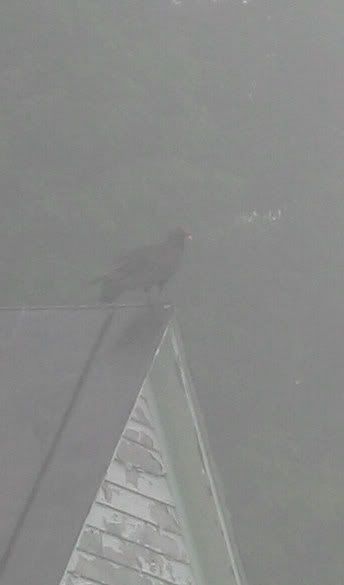
After I climbed back into the truck and was looking at the photo, I noticed a dark spot on the top of the house and used the digital zoom to see what it was. It was this:


This is the kind of strange and wonderful thing I love most about life.

Thursday, September 27, 2007

Another Missed Opportunity.

When I was in West Virginia earlier this year, I toyed with the idea of detouring from my route to go to Webster Springs to see “The Big Sycamore”, a 500-year-old giant sycamore tree around which the town of Webster Springs has officially sanctioned a park. I’d always been told that the sight of this tree was moving to tree-lovers such as myself.

But, we were pressed and I couldn’t budget the time it would take to get to Big Sycamore Park and back along our route homeward. I figured if it had lived for 500 years, then certainly I could wait a few more months until I’d get another chance to see this grand, old tree.

However, on the night of September 1, 2007, some locals who had set up camp in the park and were (according to the evidence later found by police) drinking heavily, decided that it would be fun to burn down The Big Sycamore. To do this, they poured gasoline into the hollow at the base of the tree and set it alight. At this time, it’s not known if the sycamore will survive, or will have to be cut down.

I may have missed my chance to see this giant remnant of the forests that once covered West Virginia. I’m heading up that way in a couple of weeks, and I’ll phone the park officials in Webster Springs to learn if the tree is still around, and if it’s still accessible to those of us who wish to gaze upon a living thing that was 300 years old before even our nation came into being.

As for the monsters who burned The Big Sycamore, I can only hope one of their worthless, drunken number will brag about how they did their filthy best to destroy the tree. And I hope that these human examples of moving excrement can be punished in some way. Alas, we do not allow the public burning of humans, so I will assume these walking bags of puke will merely receive some minor slap.

Tuesday, September 25, 2007

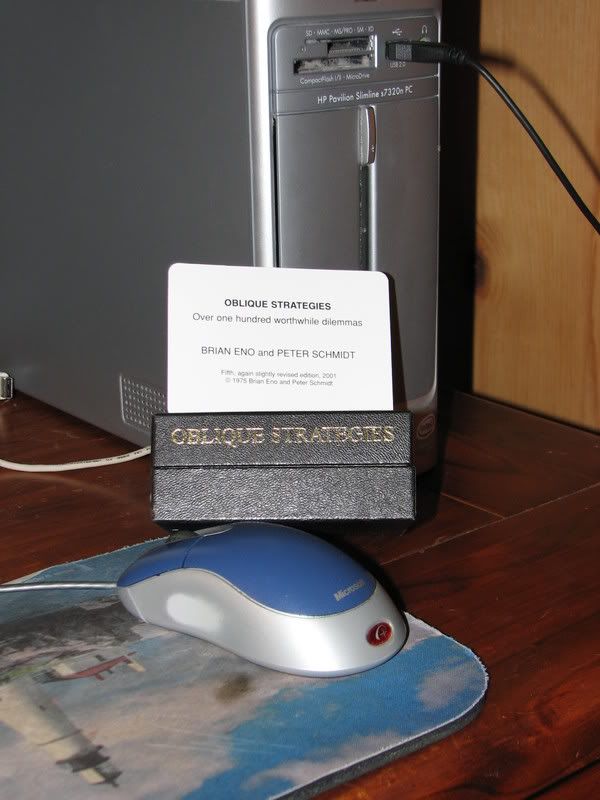
Oblique Strategies

Back in the mid-70s when I was listening to a lot of new music, and when music seemed to me to be much more important than it had ever been or ever would be again, I noticed a liner note on the sleeve of the Brian Eno album, ANOTHER GREEN WORLD. This album at that time meant a lot to me. It wasn't like anything else that I'd heard and I spent hours listening to it. Because of the pleasure I took from this record, I respected Brian Eno without knowing much about him aside from the music and the titles and the lyrics and the sound of his voice.

And, in very small print, almost hidden on the album jacket, was a mention of a set of cards called "Oblique Strategies", created by Brian Eno and Peter Schmidt available for purchase. I was rather poor at the time and didn't have the nescessary funds to buy a set, curious though I was about them.

Years passed, and I slowly learned what the cards were. A unique "problem solving tool" was how they were often described to me by folk who'd seen them. Still fascinated by Eno's musical work, I still desired a set and began to search for one. Unfortunately, they were out of print and it was rumored that when a set did turn up on the market, the price was quite hefty. Once more, I found myself unable to locate (or afford) The Oblique Strategies.

More years passed. I happened to correspond via the internet one day with Neil Gaiman who, having recently worked with Eno on a BBC project, gave me the fellow's email address which I used to request a set of the Strategies. Eno responded to let me know that they were out of print, but that he might have a few sets lying about, and that he would let me know if he could find them. I gave him my home address, etc., and hoped for the best. Alas, no response ever came.

After a few more years, I heard from an acquaintance that a new version of Oblique Strategies was for sale and available from a retailer in the UK. I quickly located the shop and ordered a set. They arrived in due course and:

I let them lie, unopened, in my bedside table.

For two years.

Why? I can't say. I was busy writing short stories and busy writing novels and busy working 40 hours a week for the USPS.


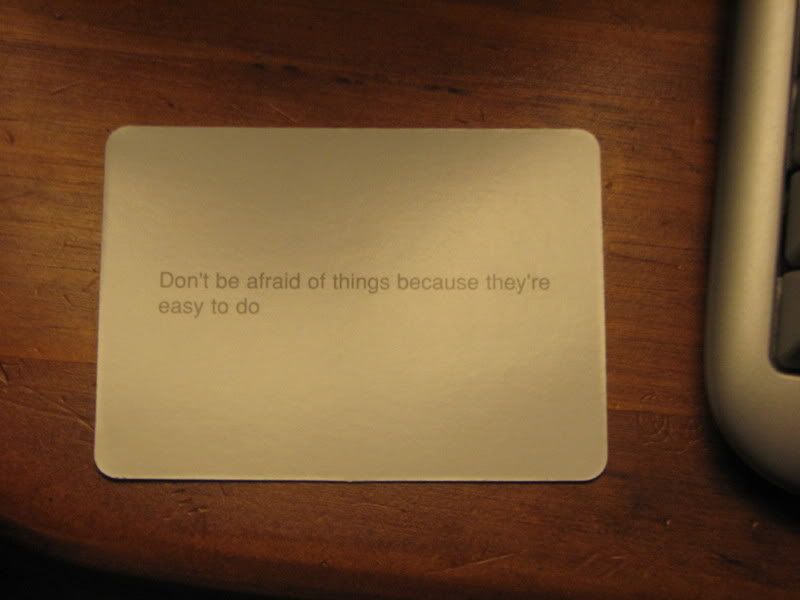
At last, today, having hit another sticking point in my latest novel, I retrieved the set of cards from my bedside table, opened it up, chose a card at random. Here it is:


Don't be afraid of things because they're easy to do

I'll ponder it. Or not.

If you wish a set of this brilliant work of art, you can nab one here.

Tuesday, September 18, 2007

Animals are Persons.

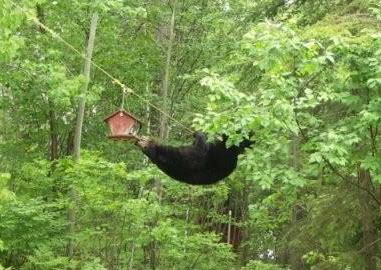
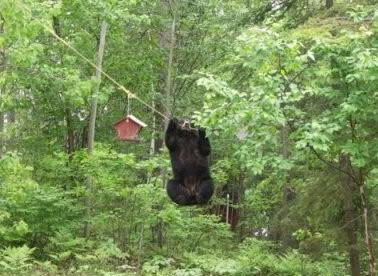
I saw these photos on one of the backpacking forums I frequent (whiteblaze.net). I never failed to be amazed at the personality and individuality of animals. I truly wish people would stop thinking of them as mindless, emotionless automatons.

These photos illustrate a young bear tenaciously pursuing some bird-seed.


Sunday, September 16, 2007

The Disappearing Bird

The Disappearing Bird
A Postal Adventure
By James Robert Smith

Having just completed walking a loop, I was sitting in my postal vehicle, taking a breather and getting ready to take my lunch break. My vehicle was under a small tree, in the shade and I was looking down toward a cul-de-sac. After a little while, I noticed that there was a motion to my left, under a carport--a motion that kept repeating. Directing my attention toward it, I saw a small brown bird that seemed to fall from the door of a large blue sedan parked there.

At first, I thought the bird was flying into the raised window of the car, but actually he was trying to perch on the car and was fluttering to the ground each time. My second thought was that he might be injured, but if that were so, how was he repeatedly flying back up to the car each time he “fell”?

After watching this little bird for a minute longer, I saw what was going on.

He was landing on the door, finding some purchase there, so that he could confront his reflection in the side-view mirror mounted on the door. He would land and look his reflection in the eye. After a bit of this face-off, he would launch himself at the mirror, flutter his wings as he encountered the unexpected obstruction (not a bird!) and then land atop the mirror. There, he would stand a second looking for all the world like a completely confused individual.

“WHERE ARE YOU?!! WHAT IS GOING ON HERE?!! I KNOW YOU ARE HERE!!! WHERE ARE YOU?!!”

I imagined him screaming like madman.

He would land again on the door, sometimes losing his footing and fluttering to the ground (the movement that first attracted me to the sight). Eventually, he would find a solid perch, face his taunting opponent yet again and launch himself at this vanishing bastard.

And there he would be on the top of the mirror.

“WHERE ARE YOU??!! I SHOULD BE STANDING ON YOUR HEAD, BUT I’M NOT!!! WHERE ARE YOU??!! HOW ARE YOU DOING THIS??!!” (The madman’s voice again.)

This went on for the duration of my lunch break in the bright, warm sun (30 minutes). I started my engine and drove away, with the little Madman Bird (I don’t know what he was, but that’s what I’ll call the next one I see) still trying to find his elusive antagonist.


Saturday, September 15, 2007

Qualities I Hadn't Seen

For some reason I cannot name, I never cared for the Beats when I was a young man. My pals and acquaintances would suggest the obvious books to me and I’d take a look at them, quickly grow rather bored with the prose, and put them aside. People kept telling me what a great writer Kerouac was, or what an amazing experience one had in reading William Burroughs, or how gifted a poet was William Ginsberg. It was all dead air to me.

And then, one day, at the age of 44, I picked up my copy of ON THE ROAD by Jack Kerouac. Why? I’m not sure, but I’d have to assume that it was because I’d exhausted all of the unread books in my house (no mean feat, that), and I just really, really needed something to read. So for the sixth or seventh time in my life (but for the first time since I was in my early 30s), I gave Jack Kerouac one more chance.

And it grabbed me. I mean, that book sank its hooks into me way past the barbs and I was landed. I don’t recall looking up from those printed pages for several hours. I couldn’t get enough of that novel and I could not force myself to stop reading the vast road trips of the fictionalized versions of Jack Kerouac and Neal Cassady. I read the book that day and reread it over the course of the next few days.

After that, it was a mad dash to snag as many of Kerouac’s novels as I could find in the bookstores. I’m pretty sure I’ve now read them all, finding some of them brilliant and a few of them tiresome. THE DHARMA BUMS remains my favorite of the lot, and I keep a copy near at hand most of the time and it’s not unusual for me to take the book with me on my backpacking trips into the wilderness areas I like to explore.

In the years since Kerouac’s work “clicked” with me, I went through explorations of the other Beat writers. Burroughs’ QUEER and JUNKY are two very powerful books, although I just don’t dig his cut-out stuff. I can’t dismiss it out of hand as I would have done in my youth, but for now I can’t find anything in it that makes me want to read past the first bits. I may change my mind at some date…find myself bored and with nothing to read. At such a time I may pick up NAKED LUNCH and find that I quite like it. But for now I find that I much prefer Burroughs’ fictionalized novels and essays to those more experimental works for which he’s so well known.

And, by the time I made my way through collections of Ginsberg’s poetry, I realized that I was as fascinated with these fellows as personalities as I was by the talent they exhibited in their fiction and their essays and in their poems. They lived strange lives to my way of thinking. Bizarre and unusual lifestyles that were not hidden at all in a time and place when such behavior could very well have landed any of them in seriously hot water. These guys had guts.

I think that’s what has always impressed me about Kerouac and his pals. It wasn’t necessarily what they did, but the fact that they did these things and lived their lives in the face of such complete resistance. That took a kind of courage I never had, because I’d never been in a position to test myself that way. It’s not easy to stand counter to the society in which one exists. In fact, I can think of nothing more difficult and nothing more frightening.

I adore much of their work, but I think that I admire the courage of the doing as much as the art exhibited in the telling.


Tuesday, September 11, 2007

No Blood for Amy

No Blood for Amy
By
James Robert Smith

A few months after Dan went to work at the McCullough Station, one of the letter carriers there, a woman of rather a butch stature named Amy, “bid out” (that is, she applied for another job at a different post office). She claimed her knees were bothering her so she went to take a much easier route at the Mount Carmel Station, or so Dan was told. He barely knew Amy, had exchanged less than a dozen words with her, and only noted her because she reminded him of a really stocky guy who played nose guard on his high school football team; and that whenever he went to eat at the McDonald’s Restaurant on his route Dan could find Amy sitting in a booth with the only attractive letter carrier in the station, a shapely divorced brunette woman named Faye. Suspicious, yes.

About two months after Amy left the station the carriers were called to the supervisor’s desk for a talk. Instead of the supervisor, though, it was Faye who would be speaking. She appeared to be visibly upset and as she spoke her voice cracked with emotion. Apparently, Amy had cancer. Well, that was certainly awful news, and Dan could appreciate that many of the carriers in that station would be interested to know this since some of them had worked in that single station with Amy for fourteen years. He, however, barely knew her and was eager to get back to his case, his workstation, to get the letters ready to carry.

After the announcement, he figured he’d heard the last of this.

Oh, no.

About a week later, in the midst of getting his letters prepared for the street, the carriers were called to the supervisor’s desk again for a talk. Once more, it was Faye. To keep them abreast of Amy’s progress, or lack of same. Lack, in this case, since it turned out Amy had a really nasty form of cancer and it had not been detected until it was quite advanced. Things did not look good for Amy, Faye informed us, her voice once again cracking with emotion and her pretty, Aryan features puffing up with sadness. Alas.

He was sorry, of course, but eager to get back to work.

A few days after that talk, work was interrupted again for, yes, another speech about Amy. She was unable to work, even in a limited manner, and was at home quickly using up her sick time. Dan rarely used his sick leave and any wise letter carrier accumulates such sick leave just in case he (or she) really needs it. He had hundreds of hours of such, and he knew carriers who had thousands of hours of sick leave. Amy, apparently, had used hers up over the years, rather than saving it, and now needed volunteers to step forward and donate vacation time for her.

He was very covetous of his vacation time, and had plans for each and every hour of it. However, that said, he was willing to donate eight hours to her. And he was ready to get back to work.

A few days after this, they were called to the supervisor’s desk for a talk. Uh-huh, about Amy.

Now, don’t get him wrong; he felt sorry for her. But he barely knew her. He had worked with her for, maybe, six months and had never spoken to her save to say “hello” a few times. And here he was, being forced to endure another talk about her, preventing him from working. And, as anyone who has ever worked for the wonderful USPS will tell you, time is of the essence. One was pressed for it, punished for wasting it, and constantly beaten down over it. He needed to get back to his case to prepare the day’s mail!

This time, they were asking for cash donations for Amy. A box would be set up at the front of the station where they could drop in cash, or checks. Fine. Okay. Just let him get back to work.

A few days later they were called, again (yes, again), to the supervisor’s desk to hear about Amy. Apparently, the take in the box was less than satisfactory for those who had instigated the scheme. So one of the carriers, an old guy named Alan, stood up and said, “You WILL give at least twenty dollars. Each of us WILL give at least that much by payday.” As far as Dan was concerned, Alan should have added “bitch” to the end of each of those two sentences.

They had to realize, of course, that this meant war.

There was no way Dan was now going to donate leave time, nor cash for Amy. He didn’t actually know her, and she was really, really (even in her absence) getting on his nerves.

In addition, over the following days, his work was interrupted too many more times for talks about Amy by this employee or that employee, but usually by Faye, and that each time a request for money or donated vacation time was made. And each time Dan resisted; indeed, he refused. As time passed, he became more and more resentful of this woman who had been for him merely a passing acquaintance, if that. And he was convinced, now, that he never wanted to know her at all. Her cancer-ridden body had become a real pain-in-the-ass for him.

Slowly, as the days dragged on and the bits and bites taken out of his schedule continued to annoy him, he began to ask a few questions about this Amy-person. How long had she worked for the USPS? Almost seventeen years, it turned out; which meant that she earned top pay, more than Dan made, and had had eleven years more than he had to accumulate sick leave. What did her husband do for a living? Well, he was a bank accountant and made more than a postal employee made and he had full benefits. What kind of insurance did Amy have? Indeed, it was better than Dan’s; plus she had fortunately added a cancer-rider to her policy some months before she was stricken.

Dan was starting to get pissed off. Especially considering that his wife had fallen and shattered her arm about the same time Amy had gotten sick and the situation at his house was that his lone salary was now supporting his entire family without the benefit of his wife’s paycheck. In short, his family was financially and medically worse off than Amy’s. When more requests were made at work for dough for Amy, it soon became obvious to those demanding these things from Dan, for Amy, that he was not forthcoming and was not likely to be. And, he realized, his frustration with the whole situation was becoming known in the office, and his reputation as a grouchy asshole was growing exponentially.

He didn’t care.

A day came when Faye appeared for one of her regular whines, to stand before all as she cried and blubbered and announced that the end was near for poor Amy. Dan rolled his eyes and peeled away from the main group of letter carriers to return to his case and the work that waited for him there. In the coming weeks, as soon as he became aware that the stand-up talk was about Amy and not about USPS policy, he would fade from the mass of concerned idiots and continue at his chores.

And then, after a brief vacation, (you better believe he used his vacation time on himself) Dan returned to work to find that Amy, in his absence, had died.

THANK GOD!

You cannot imagine how happy, by this time, that news made him. He was so happy that it was hard to keep a grin from his face. Dan was so happy that he would no longer have to be torn from his labors to hear yet another sob story about the state of Amy’s health or the grief of her husband and teenaged son. In future, he was to be spared from this, and no one would ever again ask him to donate cash or vacation time to the departed Amy.

But Dan’s fellow employees, of course, at this point, felt it very difficult to let go of the cause. He was cursed with, among other things, announcements for Amy’s memorial services; announcements for Amy’s funeral; announcements for a fucking blood drive in honor of Amy! Each time, he was only too, too happy not to oblige. (He kept his leave time, his money, and not one drop of blood left his veins).

And then, seemingly finally, the talks about Amy at the supervisor’s desk came to a halt. No one mentioned Amy anymore. No one asked for a donation of any kind whatsoever to the cause of Amy or her husband or her daughter or her mother or her favorite charity, or her little dog Toto. Occasionally, Dan would hear a snatch of information that made him even happier that he’d given no money to her cause. One of these tidbits being that her husband had shelled out many thousands of dollars for a top-of-the-line casket emblazoned with the logo of her favorite football team! That she had been buried wearing a cowboy hat in honor of her beloved Dallas Cowboys! (Dan was almost curious what her chemo-ravaged face had looked like in the open casket with that silly hat on her shaved head.) The conclusion, however, was that these were not people to whom he would willingly donate anything whatsoever: The Beans of Egypt Maine with a few bucks in their pockets. Dan sighed, ate food, worked, shit, and never thought at all about Amy.

Weeks went by. No one mentioned Amy. Dan didn’t mention Amy. Sometimes when he spoke to Faye, he noticed that she only replied reluctantly and was usually curt. That was okay. She’d spent maybe too much time with Amy and was resentful of Dan’s refusal to donate to the loving cause. He could live with that. He didn’t care. The days of Amy standup talks were in the past.

Until.

Amy’s husband appeared before them at a talk at the supervisor’s desk to thank them for all that they, had done for Amy. Dan supposed the several thousand dollars the crew had raised had helped pay a small percentage of that Dallas Cowboys casket. Faye stood at his side, her face gone all red and puffy with grief for Amy, the linebacker-sized woman gone to that great cancer ward in the sky. When he was done, Dan clapped. Not too loudly, but he wanted to freaking yell and pump his fist and do a goddamned victory dance and high-five the poor bastard who’d been Amy’s husband. This was, he fervently hoped, the period on the running sentence that had been the Ballad of Amy with Cancer.

May it, at last, be ended.

Dan had his fucking doubts.

Thursday, September 06, 2007

The Whites!


The first time I was aware of Mount Washington was after I had become an avid backpacker at the age of 15. I’d meet up with folk who were thru-hiking the Appalachian Trail as I section-hiked the AT in my native state of Georgia, and they would tell of the glorious peaks to be found in North Carolina, Tennessee and in New Hampshire. At home, I searched through the vast stacks of National Geographic magazines in my dad’s bookstore until I dug out all of the issues with photos and stories of the Great Smoky Mountains and the White Mountains.

While I early on got to hike the Smokies, the Whites of New England remained out of reach for me as I was generally always too poor to afford to head up there. And on the rare occasions I was able to get to that part of the country, it was either on business or to meet up with family, both of which precluded me from hiking the Presidential Range.


Back in 2000, I realized I’d better get busy hiking the peaks I’d always wanted to see before I got too old to do so. In that year I flew up to Maine and headed to Baxter State Park to climb Katahdin. But it wasn’t until this year that I was able to arrange a hike of Mount Washington, which had become something of a grail for me.

I have to say, straight up, that although I love my native South dearly, and adore our high country, we have nothing like the mountains of New England. While the Whites are not quite as high as our Smokies, or Blacks, they are, without doubt, the most spectacular mountain range I have experienced on the east coast of the USA. Nothing here in the South compares with them, on a purely visual basis, because of the 4,000-foot tree line in New Hampshire, and because of the amazing gulfs, ravines, and cirques gouged into the geography of the Appalachians by glacial activity. It was something, indeed, for this Georgia-boy to behold.


Having now experienced the grandeur and the hospitality of the New Hampshire high country, it’s our intention to return there at the earliest opportunity. I waited 34 years to finally bag Mount Washington. I promise the time between now and my return to that fantastic peak will be brief.


Sunday, September 02, 2007

Boo, Mars!

Like all readers of science fiction, I grew up dreaming about the colonization of Mars. I read all of the Martian sf out there and hoped to someday see Von Braun’s illustrations of a trip to Mars become reality.

Alas.

Now that we’ve had a number of landers on Mars and the rovers and orbital observers hovering over the Red Planet for years, I’ve come to the conclusion that the place is just a hellish ball of rock not worthy of much attention at all.

The atmosphere is just the tiniest fraction of the Earth’s. And what “air” exists there is extremely toxic. The place has been oxidizing for billions of years, and who knows how poisonous even the soil may be. It may be that the very dirt will react negatively with whatever moisture we bring with us.

And dry! Great Jove, the place is drier than the driest spot on Earth. The entire planet is so cold and so dry that microscopic bits of the toxic soil is wafted into the air in global storms of dust so fine that it’s practically on a kind of molecular level. There’d be no way to even filter that shit! And so cold that carbon dioxide freezes out as a solid onto the surface of the planet from pole to pole.

In addition, Mars seems to be geologically inactive, and has been for quite some time. There are no plate tectonics going on, no current volcanism, and only a boring cycle of airborne sedimentation taking place for the past couple billion years.

I hate to say it, but fuck Mars. As a stopping-off point, it may be worthwhile as a base. But as far as colonizing that hideously cold and dry turdball—it’s a pipe dream.

Alas!