Friday, October 05, 2012

In Chicago Basin

One of the most scenic areas where we camped was the Chicago Basin. It was where we stayed on our last night and full day in the Weminuche. It had ample campsites, plenty of fresh water sources, lots of wildlife, and grand views.

Andy tests out the narrow trail in fresh snow and ice.
 We look down on the opposite side of Columbine Pass. Finally at the top!

Looking back up the trail toward Columbine Pass.
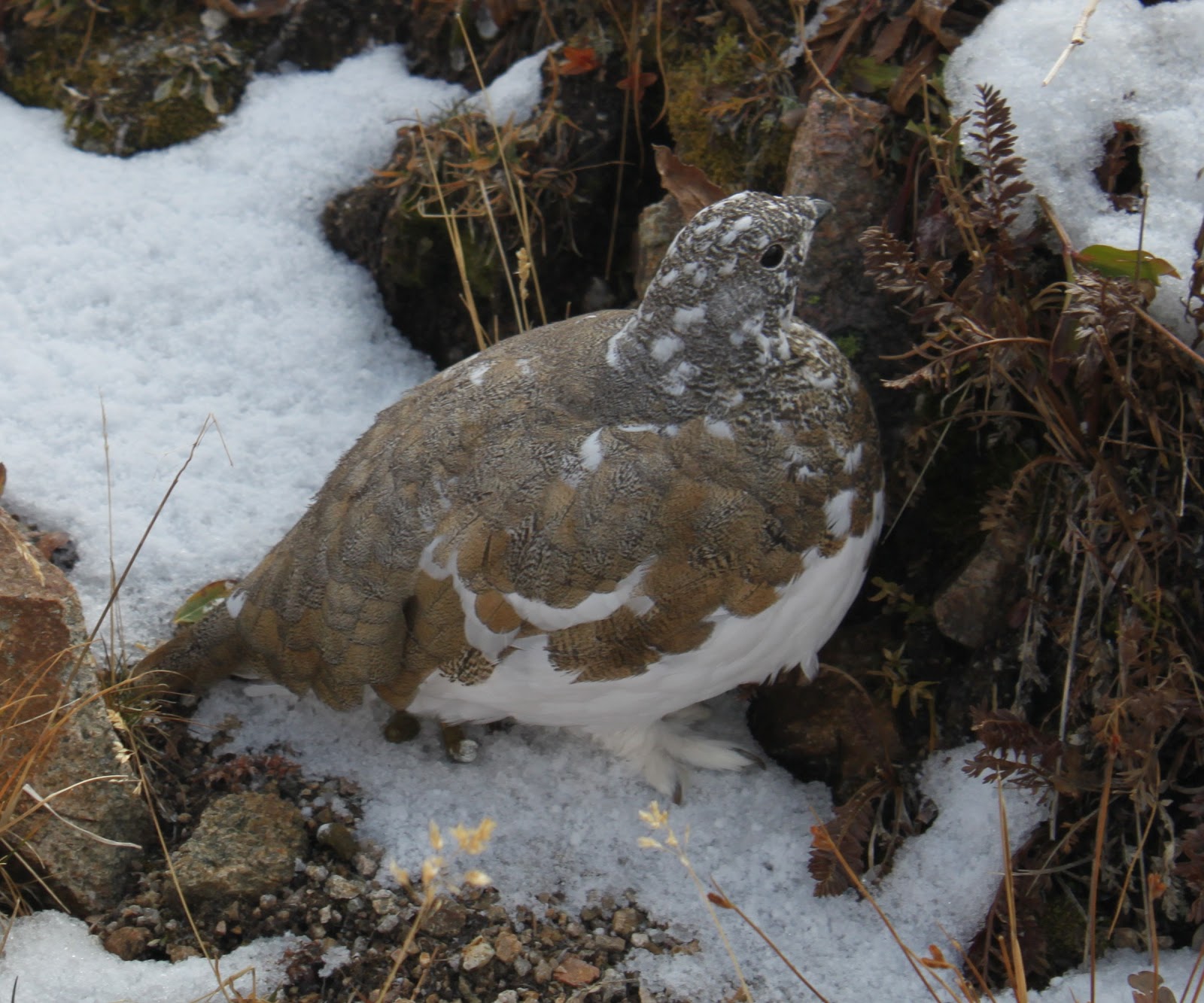
The rare White-tailed ptarmigan, once more.


Andy pauses bedside a rather robust spruce.

This talus field has been stable for a long time--witness the undisturbed lichen-covered surfaces.


The trail takes us to an abandoned mine and miners cabin.

Tracks were still present, and they continued into the old mine shaft.

Looking inside the shaft.

You can't stop looking up at the high peaks and at the walls and forests looming about you.

Big summits everywhere you look.

The trail.

After so much climbing to get over Columbine Pass, it was a relief to descend closer and closer to Chicago Basin.

Our campsite and the view from my own tent.

All I had to do for this view from my sleeping bag was roll back the tent flap.


Funny thing about this video is that I didn't even notice the mule deer right at the beginning of the video until she darted for the trees.


We are visited throughout the day by groups of mule deer.

Morning alpenglow.

Strange colors revealed by erosion.

As we head out of the Basin we continue to drop, headed down to the Needleton Trail head.

One of many waterfalls in the trailside gorge that we passed on the way out.


Worth the trip just for the color.

Thursday, October 04, 2012

Durango & Silverton Train.

Just about the best way to access trail heads into the back country of the Weminuche Wilderness is to use the Durango & Silverton train. The train will drop you off on a scheduled day and pick you up another scheduled day. In our case we hiked a horseshoe-shaped route in which we were dropped off at a northerly trail and picked up later at a southern trail terminus.

Here, then, are photos and video I took of the Durango & Silverton train ride.

Andy Kunkle carrying his pack to the station.


The station.

Overhead racks.

The little details: Kerosene lamps.
 

Looking back!

Old cars going to ruin.

The car that took us in was much more comfortable than the one that picked us up.

Taking on water for the boilers.
 

They dump us off at Elk Creek.
 
Train prepares to leave.

The train leaves us at the trailhead.

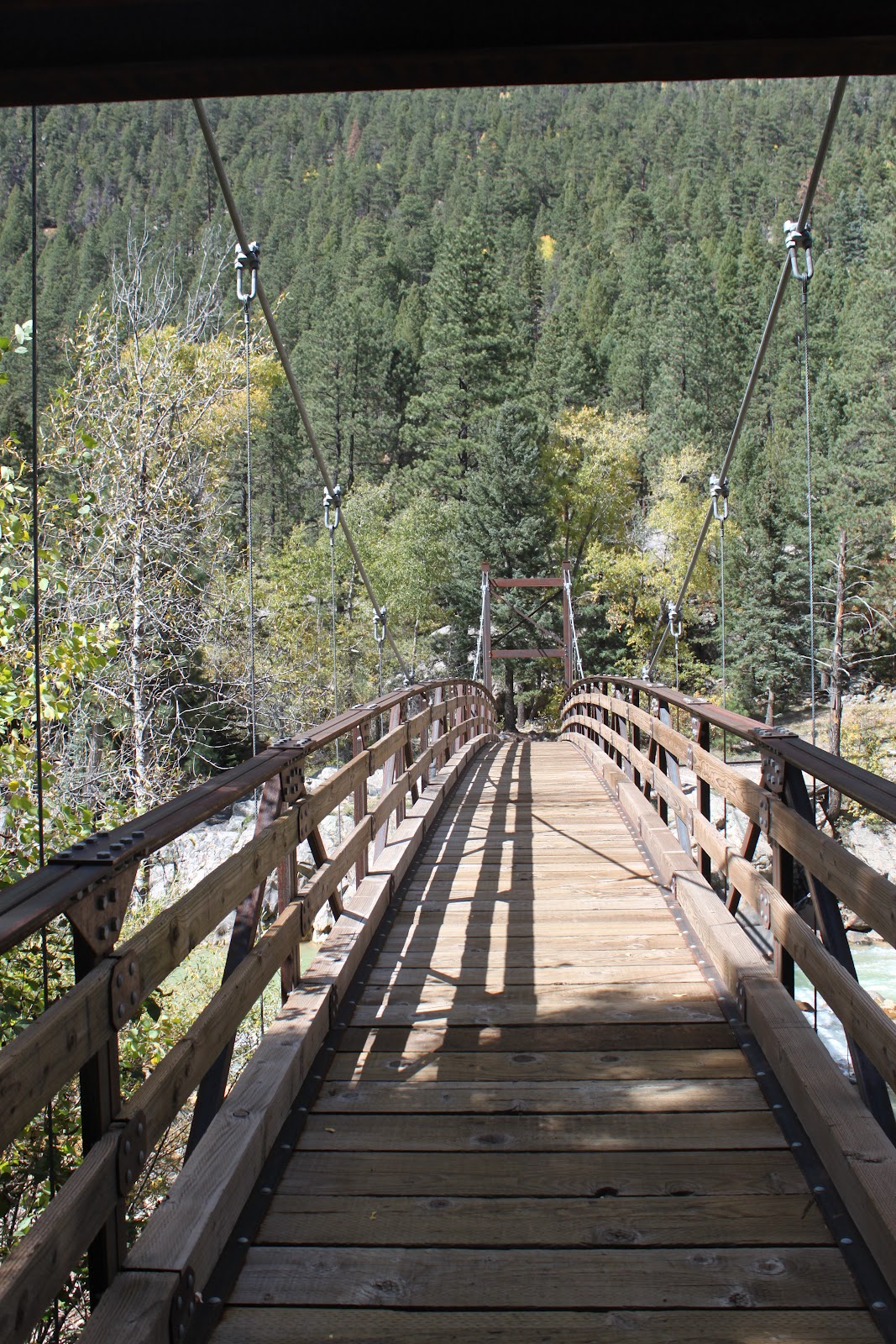
After eight days we cross the footbridge to the Needleton trail head where the train will pick us up.
We picked Bob Johnson to signal the train to stop for us. Andy and I took photos and pictures.

When they picked us up, the conductor politely suggested to us that we might want to ride in the open air car! We had been eight days without a bath wearing pretty much the same filthy clothes. You can imagine his concern for our fellow passengers.


I have no doubt he could smell us across the aisle.
 
You want soap and water? We got soap and water.
 
I took this photo blind by holding the camera behind my back. Priceless. This is Bob Johnson, one of the trio that included me and Andy Kunkle. We stank. We had bought and consumed alcoholic beverages from the concession car. We were foul-smelling and laughing and loud. As you can see, the entire group of passengers had moved to the other side of the car. One guy even has his head out the window (apparently for fresh air, or maybe to vomit). Much hilarity, indeed. (For what it's worth, this trip convinced me that if there was a zombie apocalypse, the human race would not survive.)
 
We arrive back in Durango. The other passengers seemed somehow eager to exit the train.

We say goodbye to the engine.


Wednesday, October 03, 2012

My Tent, the MSR Hubba.

A lot of people have commented on the brief photos of my backpacking tent. So here is some more detailed information about it.

It's produced by MSR and the model is called the Hubba. It's a one-person tent and is extremely light weight, coming in at just over two pounds. There's not much room inside, and it's not much more than a step above a bivy. It does have a nice vestibule where I often store my pack to keep it dry in case of rain.

I can highly recommend the MSR Hubba.

My MSR Hubba all set up. The white material underneath is a Tyvek ground sheet.

One of the views through my vestibule.

Good ol' Bob cozy inside the Hubba.

Looking toward my feet (in my down-filled sleeping bag).

Campsite as night falls.

Snow greets me the next morning. The Hubba stayed very dry inside during snow, rain, sleet. Almost no condensation.


All of that stuff outside the vestible had been inside during the night. My sleeping pad, pillow, sleeping bag liner, sleeping bag, water, camera bag, medicine bag, etc. That was the coldest night of the trip and the rainfly was covered in heavy frost.

Tuesday, October 02, 2012

Critters of the Rockies!

The following are photos I took of critters that we encountered mainly on our hikes (but sometimes at our campsites).


Bull elk. It was the rut and they were bugling.

Cow elk.
 
These ground squirrels were everywhere. They could be total pests.

Uncooperative but gorgeous bird. A western Jay? Stellar jay?


I had left my telephoto lens behind for weight considerations. Big mistake.

Soon-to-be-endangered Pika. Glad I got to finally see them.


Gorgeous White-tailed ptarmigan.

First good photo I was able to snap of a marmot.

Cutthroat trout. He is not suspended in air. The water of the glacial lake was just that clear.


Monday, October 01, 2012

Colorado Rockies

The trip was not uneventful. Later, after I've had time to digest the experience, I'll write about it in some detail. But for now I will illustrate some of my impressions.

Some people can go from living a few hundred feet above sea level to the high Rockies and feel no negative effects from altitude. I am not one of those people. When I hiked peaks in Yellowstone a few years ago that were well over 10,000 feet in elevation I had not trouble at all. This gave me a false sense of safety. What I found in Colorado was that I hit a kind of wall at around 11,000 feet. Generally around 11,300 feet or so I would feel the classic effects of altitude sickness. I did not get headaches, but I did get severe nausea and shortness of breath. This slowed me down to a crawl and the only reason I did not retreat was due to pure stubbornness.

The rewards to pushing on were great. Amazing views and a sense of accomplishment. The punishments for continuing to crawl higher up the slopes were many and varied. There was the physical sickness, the biting cold, the frequent storms, and even occasional depression. It was only as we ended our trip that I felt that I'd finally acclimated myself to the high elevations at which we were hiking (11,000 to almost 13,000 feet above sea level).

So one thing that I learned is that I will either have to train hard the next time I head into the high country, and/or spend more time acclimating my body to high altitude before tackling difficult walks and climbs.


Heading toward the higher country through the willows.
An abandoned miner's shack at around 12,000 feet above sea level. The nearby rocks were pierced with old mining shafts. I suspect this shed was over 100 years old.

A piece of an old wood-burningstove that probably kept the miners warm once upon a time.
At the pass. What appears to be a road is actually the Continental Divide Trail.
Brilliant aspens in full Fall color lined the trails and slopes as we hiked.

A cow and bull moose visited the beaver pond where we were camped.