Carole and I had four hours to explore the island. Egmont Key is not a huge place, and we saw most of what we wanted to see in the time we had (we were dependent on the schedule of the ferry), but you could easily spend far more time than we had and still leave things left undone. There is a large wildlife sanctuary on the far end of the key that is mostly off limits to humans. The only access is by walking in from the land--the beaches are completely restricted access on that side. If we'd had more time I would have hiked into the sanctuary to get a closer look at the bird life there.As it was we still did not scope out all of the ghost town. The streets form a bit of a maze and we left some of them as mysteries for another trip on another day. That is one thing that really floored me about Egmont--the size of the town that once supported the fort. Since the number of folk taking the ferry the day we went was small we mostly felt that we had the entire ghost town to ourselves. In fact, we never once encountered another person as we strolled those palm-lined brick roads.
 The site of one of the larger buildings in the old Egmont Key village.
 Carole walking down the lonely street. We kept our eyes peeled for more gopher tortoises, but we never saw any in the interior of the island, but that's where most of them live.
 I couldn't get over the beauty of those brick roads lined with palms.
 This was one of the most intact buildings on the key. It was a warehouse until the town burned in 1925 (fire set intentionally by Federal law enforcement during an alcohol/illegal immigrant raid).
 Scenes like this make me want to take advantage of the right to camp overnight on the island. You can stay overnight if you apply for a free permit to do so.
 This building is the only old one on the island that is in good repair. It was restored by a local historical society, but we were told that some branch of the government (we were never sure if it was Federal or State) is agitating to tear it completely down.
 Since there are absolutely no public facilities on Egmont Key at all, this would be an ideal museum/visitors center/bathroom building. I hope they don't tear it down.
 Part of a rail system on the bay side of Egmont Key. I think this was a loading/unloading port.
 Part of an old warehouse beside the short rail system.
 Oleander blossom with ever-present love bugs. The love bugs were everywhere. In places the air was thick with them.
 The military cemetery. Almost all of the graves were Civil War era and all but a couple of the deaths were due to Yellow Fever and other such maladies. Only one gravestone mentioned a gunshot death.
 Just beyond the cemetery you come back to the lighthouse and ranger abode. What a posting, eh?! Live on a Florida Gulf Coast key with an entire island all to yourself! The ranger did look like a happy guy the couple of times we encountered him.
 Self-portrait at the lighthouse. For some reason, the US military came to the island in the 1940s and removed the housing around the light. The light is still there, but the metal housing was removed and destroyed. The local historical society has been given permission to restore it and they're trying to raise the funds to do so.
 After we toured the island we went out to the beach to lie around and soak up some rays. Click on this image to see it in fuller size.
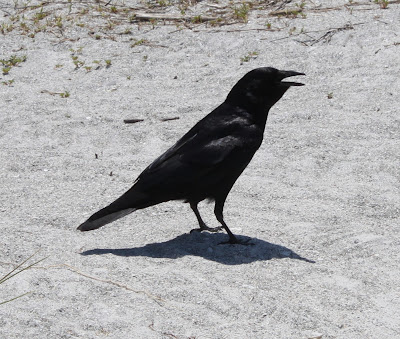 This dirtbag dogged us, waiting for a chance to strike and steal some of our stuff. Crows are complete assholes when you're at the beach. Watch your stuff!!!
 I took a walk way down the beach while Carole relaxed. This was one of the old gun emplacements that has fallen into the sea as the island erodes back into the Gulf. We figured that about one third of the island has vanished since its days as an active military installation. The old power plant is far out in the ocean, now, and has been for about three decades.
 A gull takes up a post on what looks to have been an old cistern.
 This sign is for visitors who arrive via private boats. Neither the State guys who run 3/4 of the island nor the Feds who run the other 1/4 want your dogs or cats on this wildlife preserve. Either leave them at home or aboard yer boats!
 When I passed the old concrete towers I could see the osprey parents feeding the big chicks, so I went back for a closer look.
 One of the rather serious looking osprey chicks.
 The other osprey chick. Somehow one chick was on one tower and one on the other. Did one fly off the nest and get stuck on the other tower? Not sure. What I can say is that the other tower did not seem to have a proper nest on it. Chick, yes. Nest, no.
 Alas, we had to leave Egmont Key. I got this view of the vast bridge over part of the bay on the way back to the mainland.
 This is actually a cell phone tower in the middle of the bay. Obviously the brown pelicans love this place! Seeing this, I have to remind myself that brown pelicans came close to extinction due to the effects of DDT just a few decades ago.
 And just as we got back to the dock, we were rewarded with seeing a pod of bottlenose dolphins fishing the surf!
A couple of days after we'd checked in to our campsite at Fort DeSoto Park near Tampa/St. Pete, we hopped on the ferry that takes you over to Egmont Key. The island is accessible only by water and is the site of a former military fort that was expanded with a complete town just prior to and following the Spanish-American War. These days no one but a state park ranger lives on the island, but in its day the town was vast, complete with a movie theater, shops, bank, homes, warehouses, barns, a power plant, etc. Most of the structures from the days as a military base are gone, and even the fortified concrete gun implacements are deteriorating. Some of the concrete fortifications have even fallen into the sea due to the severe beach erosion. From what I can gather, the island has shrunk by about a third since its days as an important Florida fort. The power plant now lies far out to sea where it has been flooded for more than a quarter of a century and is now covered in soft corals. What does remain of the town of Egmont Key are the main forts, many foundations, some standing walls and towers, a light house, and a maze of truly spectacular brick streets that take up the central part of the island. If you're in the area, you should definitely take the time to gain access to the park to see what remains of this relic of the Spanish-American War. There is a tremendous wealth of bird life on Egmont Key, and it's also a refuge for the threatened Gopher tortoise. When we arrived at the pier to board the ferry, we saw this pair of green parrots on the line above us. I assume that these are invasive birds, as I don't ever recall seeing parrots in Florida before this.
 This is the pier where the ferry picked us up. There's a gangway leading down to a floating dock. For some reason I forgot to take a photo of the ferry.
 The young manatee that we passed as we were heading out to Egmont Key.
 Carole aboard the passenger ferry. The couple behind her were amateur birders/herpetologists. They were there specifically to see the gopher tortoises on the island.
 Getting closer to Egmont Key.
  A loggerhead sea turtle that was passing us as we approached Egmont Key. He did not care for us at all, took a breath and dove for cover.
 The main dock at the light house and the ranger's residence. We didn't tie up there. Instead the captain just grounded the ferry and lowered a gangplank and we marched down to the beach.
 Carole at the light house.
  Almost as soon as we got off the boat we encountered this gopher tortoise munching on grass. He was quite friendly and kept walking up to us. I suspect some visitors habitually feed him.
 I got this shot while standing in the shade of the light house.
  This is one of the first forts you encounter on the trail leading toward the beach.
 Sign warning hikers off of protected areas.
  Some of the native plants colonizing the dunes around the old fortifications.
 The second fort.
  People obviously spent some amount of time in some of the fort rooms. Several had fireplaces installed.
 Concrete trail leading down to the last and most accessible fort.
 Carole at the final fort. This is the only fort you're allowed to climb.
 This view reminded me of some Mayan ruin.
 On top you can see old gun turrets, and wonderful views of the Gulf.
  The love bugs were everywhere! At times you literally could not breathe through your mouth, else you'd ingest them.
 The weather was very pleasant, but I'm sure these concrete hallways would be cool and inviting on a hot summer day.
 Headed back down the trail toward the site of the old town.
 Foundations are all that remain of the administrative buildings, homes, and shops.
 These old towers had osprey nests with chicks in them.
 Part of the old sewer system. For its day, it was state of the art.
  From descriptions, I'd thought that the brick streets were brief and a single lane near the center of the town. I was wrong. They were wide and varied and extensive, running for miles throughout the island. The town had been much larger than I'd been led to believe.
 Carole took this of me standing in one of the main streets. (More details in later posts...)
This fellow was on the sewage hose outside of our travel trailer. Looks like an anole, but I've never seen this coloration on one of those! Unlike most wildlife I encounter, he sat still for a portrait.
This guy was walking around the picnic area at Alexander Springs Recreation Area. The black vultures were really bold there. "I love dead stuff! Even more, I loved James Robert Smith's new zombie novel, THE LIVING END! Buy a copy now. It's got dead stuff in it!" (Comes in Kindle, too!)
Everyone talks about the western parks as the be-all end-all of North American megafauna. I think Florida stacks up favorably against those places. Not quite the tonnage, on average, but damned if I don't see more wildlife here in Florida than I have anywhere else I've been. I took this shot from a boat we took to Egmont Key today. I swear manatees have to be the sweetest, most innocent mammals on the planet.
I took this shot yesterday afternoon at our campsite at Fort De Soto Park near Tampa/St. Pete. The bird life here in phenomenal. This is an osprey. It was scoping the water for fish. I got lucky with the telephoto lens. "Buy THE FLOCK by James Robert Smith. Best novel I've ever read!" King of the Ospreys.
 The site of one of the larger buildings in the old Egmont Key village.
 Carole walking down the lonely street. We kept our eyes peeled for more gopher tortoises, but we never saw any in the interior of the island, but that's where most of them live.
 I couldn't get over the beauty of those brick roads lined with palms.
 This was one of the most intact buildings on the key. It was a warehouse until the town burned in 1925 (fire set intentionally by Federal law enforcement during an alcohol/illegal immigrant raid).
 Scenes like this make me want to take advantage of the right to camp overnight on the island. You can stay overnight if you apply for a free permit to do so.
 This building is the only old one on the island that is in good repair. It was restored by a local historical society, but we were told that some branch of the government (we were never sure if it was Federal or State) is agitating to tear it completely down.
 Since there are absolutely no public facilities on Egmont Key at all, this would be an ideal museum/visitors center/bathroom building. I hope they don't tear it down.
 Part of a rail system on the bay side of Egmont Key. I think this was a loading/unloading port.
 Part of an old warehouse beside the short rail system.
 Oleander blossom with ever-present love bugs. The love bugs were everywhere. In places the air was thick with them.
 The military cemetery. Almost all of the graves were Civil War era and all but a couple of the deaths were due to Yellow Fever and other such maladies. Only one gravestone mentioned a gunshot death.
 Just beyond the cemetery you come back to the lighthouse and ranger abode. What a posting, eh?! Live on a Florida Gulf Coast key with an entire island all to yourself! The ranger did look like a happy guy the couple of times we encountered him.
 Self-portrait at the lighthouse. For some reason, the US military came to the island in the 1940s and removed the housing around the light. The light is still there, but the metal housing was removed and destroyed. The local historical society has been given permission to restore it and they're trying to raise the funds to do so.
 After we toured the island we went out to the beach to lie around and soak up some rays. Click on this image to see it in fuller size.
 This dirtbag dogged us, waiting for a chance to strike and steal some of our stuff. Crows are complete assholes when you're at the beach. Watch your stuff!!!
 I took a walk way down the beach while Carole relaxed. This was one of the old gun emplacements that has fallen into the sea as the island erodes back into the Gulf. We figured that about one third of the island has vanished since its days as an active military installation. The old power plant is far out in the ocean, now, and has been for about three decades.
 A gull takes up a post on what looks to have been an old cistern.
 This sign is for visitors who arrive via private boats. Neither the State guys who run 3/4 of the island nor the Feds who run the other 1/4 want your dogs or cats on this wildlife preserve. Either leave them at home or aboard yer boats!
 When I passed the old concrete towers I could see the osprey parents feeding the big chicks, so I went back for a closer look.
 One of the rather serious looking osprey chicks.
 The other osprey chick. Somehow one chick was on one tower and one on the other. Did one fly off the nest and get stuck on the other tower? Not sure. What I can say is that the other tower did not seem to have a proper nest on it. Chick, yes. Nest, no.
 Alas, we had to leave Egmont Key. I got this view of the vast bridge over part of the bay on the way back to the mainland.
 This is actually a cell phone tower in the middle of the bay. Obviously the brown pelicans love this place! Seeing this, I have to remind myself that brown pelicans came close to extinction due to the effects of DDT just a few decades ago.
 And just as we got back to the dock, we were rewarded with seeing a pod of bottlenose dolphins fishing the surf!


