I used to collect limited edition books. I would buy nice limited edition hardcovers from such  publishers as Arkham House and Donald Grant and Dark Harvest, etc. Specialty publishers produce easily the most beautiful hardback books on the market. However, I soon discovered a nasty secret about the folk who collect such things:Unlike me, they don't read these books.
 I love to read my books. That's what they're for! But after a while it dawned on me that many of the people who purchase the limiteds are anal-retentive condition freaks who would panic at the very thought of human hands touching their books! Yeah, I know what you're thinkin':That's totally and completely insane, Bob!Yeah. Yer right. It is.So after a while I just couldn't stand the thought of buying these books and knowing that one is not supposed to actually read these small print runs volumes; these finely bound editions in slipcases with tipped-in sheets and autographs by the author, by the illustrator, by the lady who proofread the damned thing, by the guy who swept the office when everyone else went home. Why was I buying these things if I'm not supposed to crack the covers (AAIIEEE!) and put my fingers on the pages and lay my eyes on lines that human eyes are not meant to see?So, realizing how silly this all was, I stopped "collecting" limited edition books. And then I sold off every single one that I owned. Out went the Arkham House books. Away with the Donald Grant books! Off to auction houses with my Gnome Press novels and my Carcosa volumes and the rest.Except for one.
 In all of those books, there was one with which I could not part. It was just too damned gorgeous. Yes, I realize that beauty is in the eye of the beholder, and believe it when I say I read and enjoy all of my books. But this one was just way too perfect to hand off to some other buyer, no matter if I could buy groceries for a month with the profits.It was my Arkham House copy of 3 TALES OF HORROR by H.P. Lovecraft, illustrated by Lee Brown Coye, and edited (after a fashion) by August Derleth. This book is perfection, to me. The cover is wonderful to behold. The contents are a trio of Lovecraft's finest nightmares. The execution of print and paper and binding are unequaled in any book I have ever owned.
 There is no way that I would ever part with this book. It will be with me until I croak.
Then my wife or my son can sell it.Until then, however, it remains with me. The place of honor for 3 TALES OF OF HORROR by HP Lovecraft (illustrated by Lee Brown Coye) on my oak office desk.Buy a copy of my latest novel, THE LIVING END!
 Available in trade paperbackand in Kindle!Available soon in Nook format!
Over the years I have, at times, found myself in various stages of economic hardship. In most of  these times, I always owned certain "collectibles" that I could sell off when I had to. I could spend endless days pining away for various rare comics, pieces of original art, rare books, and what-have-you.But all during those years, the one book that I could never bring myself to toss into the box with the other stuff I was hauling off to the bookshop or the convention was a single volume published by Arkham House Books. It was:H.P. LOVECRAFTTHREE TALES OF HORRORILLUSTRATED BYLEE BROWN COYEFor someone who was as interested in weird fiction as I was, there was no more perfect volume than this one. First of all, it was written by Howard Philips Lovecraft who may not have been a genius, but he was certainly brilliant and he was certainly a true artist. What elevated his fiction into the realm of art (and, perhaps, genius) was that he wrote supernatural fiction for atheists.It's true.My various religionist friends who also enjoy HPL's work hate it when I point this out, but they can't argue against it effectively. Lovecraft was himself an adamant atheist. But fiction with a supernatural element was a guilty pleasure for him. So he set about writing stories that contained the things we would normally think of as ghosts and demons and gods, but which had about them a certain kind of scientific logic. He succeeded completely in this effort, and weird fiction was left with the kind of story even an atheist could enjoy--and without guilt.And this book contains three of HPL's finest works. Some would say his three best: "The Colour Out of Space", "The Dunwich Horror", and "The Thing on
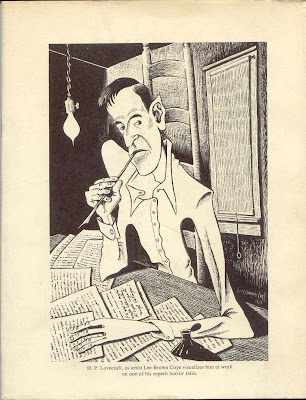 the Doorstep". In the long years since I first discovered Lovecraft's work, I don't enjoy reading most of his fiction anymore. It's tedious stuff, mainly, and it's easy to make light of his heavy prose and sometimes comical use of adjectives. But there is, at its base, some stuff that has stood the test of time and which succeed in horrifying the reader. These three tales do just that.In addition to all of that, this book was illustrated by Lee Brown Coye. Coye, sadly, is recalled by few these days. Along with HPL, he was probably the only other creator to be published by Weird Tales Magazine who was also something of a genius. Coye's genius lay mainly with his use of pen & ink and his uncanny ability to twist both human anatomy and natural geometry into shapes not intended by genetics. The fact that he was highly familiar with both anatomy and the workings of nature made his attempts so hideously effective. He has remained, after decades, my very favorite illustrator of weird fiction. Some have come close to achieving what Coye could do, but none have equalled his skill or his sheer power.For these reasons I could never bear to part with this book. In moments of economic stress I would take it down from whatever shelf upon which it was displayed...and no matter how bad things had become, I could never bear to part with this single volume. Each time I would look at it, read some of Lovecraft's phrases, and gaze at Coye's amazing illustrations. And each time I would slide it back to its place on the shelf and there it would remain. As it does today.
 publishers as Arkham House and Donald Grant and Dark Harvest, etc. Specialty publishers produce easily the most beautiful hardback books on the market. However, I soon discovered a nasty secret about the folk who collect such things:
 I love to read my books. That's what they're for! But after a while it dawned on me that many of the people who purchase the limiteds are anal-retentive condition freaks who would panic at the very thought of human hands touching their books! Yeah, I know what you're thinkin':


 The place of honor for 3 TALES OF OF HORROR by HP Lovecraft (illustrated by Lee Brown Coye) on my oak office desk.


