Yesterday I went on a short hike at Morrow Mountain State Park. I sometimes visit that park when I can't get away to the real mountains. It's less than sixty miles away and I can be there in about an hour if traffic is light getting out of the Charlotte metro area. The small mountain range there is called The Uwharries. Practically speaking, they are not mountains at all, but rather a range of low hills that persist due to a resistant layer of cap rock consisting of rhyolite and quartz. The range is considered one of the oldest on the planet at over 500 million years. Morrow Mountain, around which the park is set, was an important site to the Native American tribes that settled here thousands of years ago. Rhyolite fractures in a manner similar to flint and is excellent for making edged tools such as arrowheads, knives, axes, scrapers, drills, and the like. If you go to the summit of Morrow Mountain today you will find that it is covered in flakes of rhyolite, each and every one of them the result of tool production long, long ago. The hike I took was one I had skipped in the past--a 4.1 mile loop called the Fall Mountain Trail. It takes you from the shores of Lake Tillery and over the top of Fall Mountain. It's an interesting hike with a change in vegetation--the flood-plain at the lake shore up to the rocky mountaintop with forests of oak and beech. A number of fires have run through the forest over the past few years and you get the impression of walking through a mature forest because all of the understory has removed through fire, wind, and ice storms. The forest is actually not old or even mature, at all. But because of the fires and storms it is wide and open. In years past I would encounter a lot of wildlife in the park, but my last few trips there have been rather barren affairs when it comes to wildlife. In fact, I didn't see so much as a butterfly. I heard some locusts in the trees, and a woodpecker was having his way with a tree somewhere nearby, but I saw absolutely nothing living. I think I heard a lizard scurrying away at one point, but didn't see it. I suppose the forest floor has been scoured clean of food and so no wildlife. The oaks were, however, dropping vast numbers of acorns, so if there are any deer, squirrels, or bear still around they will have plenty to eat this season. My original plan was to hike the Fall Mountain Trail and then go do a couple of other, shorter trails. But the heat became oppressive and I ended up only doing the one trail. One interesting thing that I noted as I climbed the mountain was that the lower and intermediate slopes were rich with quartz, but the highest ridges and summits were full of rhyolite. Some kind of layering there, but I don't know the reason for it.
Park entrance.
I'm pretty sure this building was constructed by the CCC. I do know they had a camp here and built a quarry to harvest local stone for building materials. It's vacant now and the park office is now in the interior of the park.
Along the shore of Lake Tillery near the start of the trail.
Just after I left the flood plain and began to climb the slopes.
You vant rhyolite? Ve got rhyolite.
I had to detour around a number of big trees like this on the trail. Some were victims, I think, of the remnants of Hurricane Harvey, Irma both of which created some windstorms through this area.
This is the only spot I have found in the Uwharries that makes me feel like I'm actually in the mountains.
I stopped for a quick peek at the overlook on the summit of Morrow Mountain before I left the park.
Stuarts Knob is a minor summit even in the relatively low-profile hills around it. The only reason I even noticed it is that it's obvious from the lakeside below the cabin where my wife and I stayed in Fairy Stone State Park this month. It's an attractive enough little mountain, but at less than 1400 feet above sea level it's really just an Appalachian foothill to the much higher summits just a few miles to the west. But I got out the park trail map and noted that there were a couple of trails that take you almost to the top and decided to hike up there and see what it was like. What I found was a series of well maintained trails that were dotted with historical markers and discovered that the area had been ecologically raped and exploited in the recent past. Go back less than 100 years and you'd hardly have recognized the profile of this little mountaintop. It underwent a long period (in human terms) of exploitation that denuded it of trees and forest cover and then was heavily mined for the rich iron deposits that lay actually on its flanks and then below its surface. By the late 1800s the forests were utterly gone, and by 1920 the iron deposits had played out. Even the town that once lay at its foot vanished once the capitalists and industrialists had had their way with the place. By the 1930s the land had been allowed to lay as the humans had left it. Enter the Civilian Conservation Corps who chose it as a spot to begin the effort at rehabilitation and the site of a new state park of Virginia. Erosion was mitigated, mines were sealed up, trails were laid down, trees were encouraged to regenerate. Today, walking the slopes of this hill you would be hard pressed to understand the extent of the destruction that had once laid waste to its environs. Beneath the canopy of a vast hardwood forest you can find places where colliers had once felled and carbonized the trees to make charcoal. One can spot the massive grooves where the earth was moved in vast amounts in the practice of surface mining to get at the iron almost at the top of the ground. And there are sealed mine entrances to mark the places where men and machines once combined to shear out the guts of the little mountain. Mother Nature can recover if she is allowed to heal. But only if.
Stuarts Knob as it appeared from the lakeside below our cabin.
This was the location of a collier site. Where men would take the trees they'd felled and slowly bake them, transforming the wood into charcoal which would be sold for 5 cents per bushel.
The mountain was covered in these deep "grooves", the result of early surface mining where the readily available iron ore was taken from the hill. When this played out the traditional shaft mining began.
A GoPro video I made at the summit of Stuarts Knob.
The entrance to one of the mine shafts, now sealed.
Once again--as if I needed to be reminded--we were faced with how much we owe to the works of the old Civilian Conservation Corps. The Sherando Lake Recreation Area where we spent a full day of enjoying ourselves under a clear blue sky is itself the product of the labor of the CCC. You can't stand anywhere in this recreation area without witnessing the results of their work.
There are two lakes here, both dammed and created by the CCC. There are a number of structures, one of which is absolutely spectacular and which was built by the Corps. It serves as a bathhouse, a picnic pavilion (with TWO huge fireplaces), a vending building, and a camp store selling ice, matches, and anything else you may have forgotten on your way to enjoying a cookout at the park.
What is always foremost in my mind when I see these places built by the CCC is that when they arrived here there probably wasn't much to see but the ruined lands denuded by timber companies. I doubt that there were many trees here more than a decade or so in age. The southern Appalachians were pretty much totally denuded of forest cover by the 1930s, and I will assume this spot was no different. It wasn't just to build lakes and campgrounds that the CCC busied themselves. They were also instrumental in laying the groundwork for the restoration of our native forests that had been so terribly ruined by the timber companies.
The main bathhouse, built by the CCC.
Trees, buildings, facilities, brought to you by the sweat of the CCC.
Two enormous fireplaces in the pavilion.
Carole under the pavilion. Look at that floor!
This guy had a really neat pontoon boat, complete with electric trolling motor.
Bottom of the spillway. The creek below here is a stocked trout stream.
Staircase leading up the spillway to the top of the dam.
Water going over the top of the spillway.
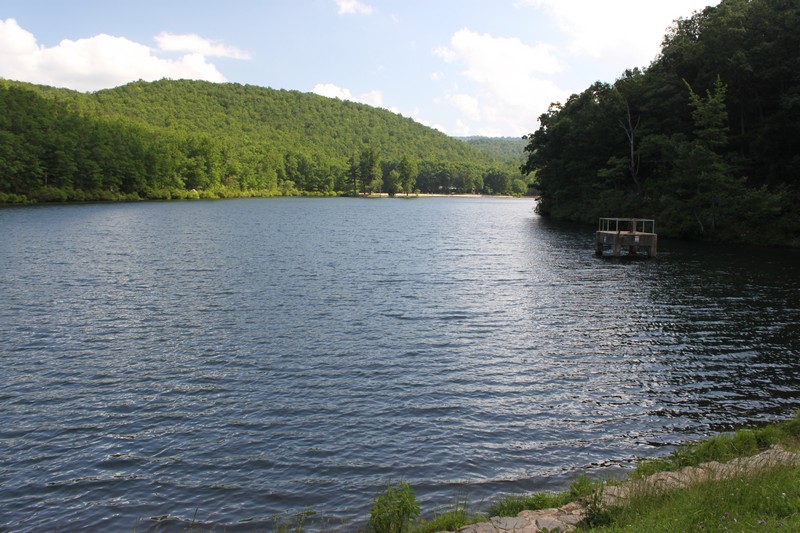
I forgot to take a good photo of the dams in the recreation area. But I did manage to remember to take a shot from atop the dam looking out on the lake.
I took this one mainly to illustrate the detailed and meticulous rock work on the retaining walls.
Almost everywhere I go hiking or backpacking or camping in our National Parks, National Forests, or State Parks I generally encounter the work of the old Civilian Conservation Corps. Everyone who enjoys our wild and rural lands tends to know what the CCC was. But a lot of folk don't know.
The CCC was implemented by the Franklin Roosevelt administration to provide work for the vast numbers of unemployed men in the USA during the Great Depression. And it was the kind of work that would create infrastructure for our parklands that would last, quite frankly, for many, many decades. It has now been almost 100 years since the start of work by those CCC boys and the trails and walls and ponds and shelters and buildings that they constructed are still with us and still in use.
It would be nice to see the CCC reconstituted and people put to work again doing the kinds of things that were done in those desperate years of the 1930s and early 40s. It was socialism at its finest and it worked well for all. And this is why it will likely not be put into operation again; not as long as corporate interests run our nation. But maybe some day.
Here are some photographs of a building constructed in Florida by the Civilian Conservation Corps. It's still in use and can be seen in O'Leno State Park.
Think of the dances!
The kind of finishing touches only folk in the CCC thought about.