Tuesday, May 14, 2013

BOIDS!

Today...just birds. I really have to finish these writing projects! All of these photos were taken on our recent Florida vacation to visit first and second magnitude fresh water springs.

Great egret.

Lesser blue heron.

Lesser blue heron (in the weeds).

Another Great egret.

One of the tallest birds in North America: Great blue heron.

The Limpkin.

Barred owl.

Another Great blue hero. As top dog, they are everywhere on the waterways.

One of our two vulture species: the Black buzzard.
"Adieu!"

Monday, May 13, 2013

I Knew It Was Snake Before I Picked It Up.

After pursuing a career working for the big publishers in comics I had managed to get my toe in the door. So I had figured that with the door opened a bit I could force my foot in there and argue my case through that slim crack of opportunity. And that door had not only NOT opened a sliver more, it had been slammed in the old face and a barricade apparently erected on the other side to keep me out.

Alas.

I figured things couldn't possibly get any worse.

Soon, there was injury to be added to insult.

One thing the folk at Marvel had learned long ago was that you could reprint previously published
material in collected formats and sell them all over again. But it wasn't quite like the old days when they did that without paying the original creators. By the 1980s they paid for reprints, albeit at a lower rate. Also, they paid royalties if the sales of a particular book went over a certain number. I had received royalty payments for my HELLRAISER story that had appeared in issue #2 of the book. By the time my later stories appeared, in #5 and #6, the sales figures had apparently fallen below that threshold. I never did receive royalty payments on those.

Well, Marvel/Epic did begin to produce reprint editions of the HELLRAISER stories. My yarn, "Divers Hands" from issue #2 made it into the first volume of collected stories. Featuring my creation, the cenobite called Hunger. And I got a check for that story--at a reduced rate since it was a reprint. But I did get paid.

After banging the old noggin against the reinforced doors at Marvel and DC I continued to hold out hope that I could make some money by writing for the industry. Hardly a week went by when I wasn't working on some kind of pitch or script to try to break in once again. In the meantime I was continuing to make the bulk of my living as a dealer in new and collectible comics, heading off to conventions all over the US to do so. And one day I walked into the dealer's room at a comic convention and one of my colleagues was setting up shop. As I was looking at his offerings of new books I saw a stack of HELLRAISER titles I had never seen. These were hardback, apparently leatherbound limited editions. They were also sealed so that I couldn't see the contents, but I quickly discovered that at least one of the volumes (there were two different ones that day) had at least one story that I had written.

However, I had not received a dime in compensation. And I had not received even one contributor's copy. I was pissed, and I was also puzzled. So, when I got home I made calls to
Marvel until I got in touch with the fellow who was filling the shoes of the editor to whom I had originally sold.

"Hey," says I. "There's a hardcover HELLRAISER book out with my work and I haven't received any notice or any compensation. What's going on?"

"Oh. Those," said the editor. "Those aren't books."

"What? What do you mean 'they're not books'?"

"Those are merchandise. As merchandise, the only ones who receive payment would be Mr. Barker and New Line Cinema."

Silence from me.


"So, I'm busy," says the new editor. "Anything else I can help you with?"

Click.


Well, I reckon this is what I should have expected. As I said, it wasn't as if I wasn't warned. And it wasn't as if I didn't know the history of Marvel and DC. If they can rip off guys like Jerry Siegel and Joe Shuster, Jack Kirby and Steve Ditko, then why would they hesitate for one second to rip off a bunch of minor authors writing Hellraiser stories for a title they knew would run its course in quick order and soon be defunct?

You see, I was blind to all that. Basically, what I wanted to do was write superhero stories based on characters created by men who had largely been raped and robbed by Marvel Comics. What the Hell was I thinking? In fact, though, I hadn't been thinking, at all. The only thing that I wanted was to write for a living, working for the very company that ripped off its creators and celebrated the men who did the thieving. I hadn't paused one goddamned second to think of the victimization of Jack Kirby and Steve Ditko.

Not long after this, brooding on the whole, sorry situation, I walked away from comics. Although I had only very briefly and very peripherally worked in comics as a writer, I had experienced mainly nothing but the negative side of things. In the small presses, (except for Steve Bissette's TABOO), I had encountered publishers who paid late, or failed to pay at all, or lied to keep from paying me for work I had done for them. Among the larger publishers I had encountered the Big Professional Circle Jerk that blocked almost everyone not working in the publisher's offices. When I had happened upon those very few editors who were willing to look at outside work (Dan Chichester, Stuart Moore, etc.), those fellows were removed or chose to go on to other things, leaving me without an objective contact.

In the years since, I have worked from time to time in the small press. The experiences there have not been good, either. One publisher made quite a profit on one book I wrote (and which was penciled and inked by friends of mine), but never paid any of us for the work, claiming that the issue lost money (an obvious lie considering the book's sales). Eventually I even stopped submitting to the independent presses, finding them to be nothing more than smaller versions of the liars and thieves at the big publishing houses.

It was a hard lesson. But in a way I had asked for it. All during this time Jack Kirby was struggling to get his hands on the thousands of pages of original artwork that was in the possession of the company that had stolen so much of his intellectual property. These monsters were holding that art as ransom unless he would further sign away all rights that he had to his creations. This company who did these things to the likes of Jack Kirby and Steve Ditko--the men who had created the freaking company in the first place--and I was trying to work for them?! To create for them? To pour my time and sweat and ingenuity into their bank accounts?

I got what I bloody well deserved, I reckon. In the years since the HELLRAISER franchise was cancelled at Marvel, at least some of my work for that title has since been reprinted by an outfit called Checker Books, for which I received no payment at all. In addition, I suspect that I have had my work reprinted by the new publisher of the HELLRAISER business, BOOM! Studios, and apparently they aren't legally obligated to pay me, either.

One thing, though. When I compared notes with others who had created stuff for HELLRAISER--those guys had signed contracts. Somewhere along the line, corporate Marvel must have gotten their wires crossed. I never received any contracts. Not once. They paid me, sure. But I never got a contract.

If that someday came up to bite them like a gnat, I wouldn't be disappointed.


Sunday, May 12, 2013

It Wasn't As If I Wasn't Warned.

Around the time that I was selling the stories to Marvel, I was asked to submit a pitch to a gaming company that was doing role-playing games that would be combined with comic books. This actually sounded like a lot of fun to me because I had been involved for a time participating in and studying role-playing games and I figured the two would be a good fit. So I submitted a pitch.

The editor was a well-known comics writer who had landed the gig of editing for this new enterprise. If my memory serves me, that would have been Steven Grant. (Again, so much water has passed under the bridge since that it might have been someone else...but that's the name that is foremost in my mind. I have exchanged email with Grant about this--and he says that he indeed worked with TSR-West, but as a creative director and not editor.)


Portrait of the author as a young man (taken around the time this stuff was happening).

I pitched a Lovecraftian work that I called "Void's Herald". The editor (whomever he was) liked what he saw and asked for a script. So, I got to work on that and wrote a script for the first installment which was approved. Contracts were drawn up and I was waiting for delivery. The pay rate for this one would have been $20,000 for me. That might not sound like a ton of money, but it was 2/3 of what I was making at my regular job at the time (operating comic book shops), so to me it was a lot of money. I figured it would get me closer to my goal of being able to go full-time as a writer.

Then, one day as I was working on the project, the phone rang. It was the editor. He told me that the editing biz was not for him and that he'd turned in his resignation. But that I shouldn't  worry because my contract was on his desk and the new editor would be sending it right out.

One thing that I definitely do recall is that the new guy in charge was Roger Slifer. He never did send that contract. I finally got in touch with him (after some difficulty) and he told me that he was not going to go with the script and pitch and that I was not going to receive the contract. I asked for a kill fee for the time and effort that I'd put into the project, and he told me he'd look into it, but that never happened either. And, of course, this is where I first learned about the world of the professional circle-jerk:

These are the cliques of writers and editors who routinely passed work from one to the other, keeping the game a closed system. This was a particularly severe problem at Marvel. It was hard to make a decent living just being an editor at some of these firms (including Marvel) so the editors (almost all of whom were either writers or hoped to be writers) passed gigs among one another to generate more income. Because of this, it was extremely difficult to break in at places like Marvel--due to the editorial circle-jerk being played there. I had been fortunate in meeting Dan Chichester, who was actively looking outside the New York area for writing talent for HELLRAISER. I was about to get a sick lesson in this situation.

Soon, Slifer had handed off the writing jobs to established professionals with whom he'd worked before. The circle-jerk was on. I was out.

Shortly after this, Dan Chichester called to let me know that he, too, was giving up the editorial gig at Marvel. But he assured me that the pitches I'd made for more HELLRAISER yarns were in the new editor's hands and he was sure things would be okay.

They were not.

The new editor never responded to my pitches. The later jobs seemed to be going in-house, and I stopped paying attention.

In the meantime, I had also made a number of pitches to both Marvel and DC and Harris Publications on several established titles. JONAH HEX, SWAMP THING, VAMPIRELLA. I came close with HEX, but the editor with whom I'd been speaking was cut loose and I found myself talking to a stranger again, who was not interested in talking to a writer who was farther away than the next cubicle.

A good opportunity did arise when I was offered a shot at writing the comic book adaptation of INTERVIEW WITH THE VAMPIRE. I spoke with the editor and expressed interest and enthusiasm (I'd genuinely enjoyed the novel when it first appeared). So I wrote up a pitch which was accepted. I then began the process of breaking the novel down into sections to be scripted and was in the midst of that when I opened a trade journal one day to see an ad for the upcoming title...which was being scripted by someone not named James Robert Smith. I tried to get in touch with the editor to ask what had happened...but the calls were never returned.

As you can see...Things were not going well.

Along the way I was trying to keep my hand in wherever I could, and sold scripts here and there to other small publishers. Scripts were still being produced and I was still making a little money from the form. But it looked as if the dream of working full-time as a writer was just not going to happen.

And, of course, Stephen Bissette had warned me all along about the comic book industry. I had been told about the way things were run, and the way companies treated their creators. Yes, it didn't matter how bitterly men like Jack Kirby and Steve Ditko had been treated, there was always new talent ready to leap for the chance to work on the things that had been stolen from those men. I knew this because...Hell! I was one of those guys! There was nothing I wanted more in those days than to write stories based on the creations of Jack Kirby!

And it was about this time that I got a rude lesson in what corporations can do to creators. Even minor ones such as myself.

Continued tomorrow...

The 9th and final issue of TABOO. Edited by Stephen R. Bissette and published by Denis Kitchen. This issue contains my story "The New Ecology of Death" which is the basis for my next novel (appearing soon) of the same title. Steve Bissette is the only person with whom I worked in my time in comics who had any sense of decency at all. Publishing in general is a tough business, but the comics industry is a cesspool of liars and thieves. To have worked with Stephen Bissette was a great pleasure and a genuine stroke of luck. The rest of them were, basically, criminals.


Saturday, May 11, 2013

Breaking Into Comics

When I was a young man--in my 20s--and establishing my professional and semi-professional credentials as a writer of short stories, I decided to try to break into the comic book business.

This seemed almost too easy for me. First of all, I had grown up reading comic books. My parents owned used bookstores and soon after opening his first one, my dad found that he had accumulated around a quarter of a million old comics. So in short order I had at my disposal just about every comic book published between 1955 and 1967. And I loved comics. I genuinely adored the format and it appealed to me on just about every level. So in just purely terms of immersion, I was already about as learned as a youth could be about comics.

Fast forward a couple of decades and I was becoming enough of a professional writer that I could call myself that according to the bylaws of the Horror Writers Association. I'd sold enough short fiction at the level of five cents per word (or higher) to become a full, voting member of that then-new organization.

So...comics. Why not? I'd been surrounded by them as a kid, and I was still surrounded by them because I owned several comic book shops at that time. All I had to do was learn how to write a comic book script and research the markets and I was pretty sure that I could break in as a pro.

At that time the comic book market was changing, but had not undergone the throes of death and re-birth that the industry would later suffer. It seemed a solid bedrock kind of market and I was ready to try my hand at it. What I initially wanted to see was an actual comic book script so that I could know how to proceed.

And I finally got my hands on one. But not just any one. It was a partial script for a SWAMP THING issue by Alan Moore. Holy crap! That thing was dense! Moore used hundreds of words of script to describe a single panel! It was as if he was leaving almost nothing to the artists! Was this the way they were all done? Not only didn't I think I could produce a script like that, I didn't want to create that kind of script!

Over the course of the next few weeks I got my hands on other scripts by other professional comic book writers. And every one was different. No two of them was the same. One script that was given to me was written by J.M. DeMatteis (but Mr. DeMatteis says he never wrote in that style...so the artist must have mentioned the wrong name!). In that one (and I don't know how some of his other scripts looked) he used two words to describe five pages of action. The words? 'Everybody fights'. In that one, he was leaving almost everything up to the artist! (The artist on that script explained to me that the writer was using something called the Marvel Method, and he would go in and dialog everything once the story was basically told by the artist.) Man! I could do that!


While I was trying to figure out how to write a script, I sold my first story to a comic book anthology! That's right. I didn't yet know how to write a script--that is, I knew how some people did it, but I hadn't done one yet. And here I'd submitted several short stories to Steve Bissette's TABOO project, and Mr. Bissette had picked one for publication! I approached a comic artist I knew who was looking for work and asked if he wanted to do it. He did it and ended up doing the adaptation based on my story. I had decided to take a smaller cut of the pay rather than risk producing a lousy script. I wasn't ready to commit at that point and just let the artist cut the story down into panels.

But soon after that I sold another one and had written enough experimental script pages that I felt ready to tackle the job. I was pleased with the result and felt more confident about the format of scripting. Like every other writer out there, I was pretty much making up my own rules for scripting and making a go of it. It worked, and that's what mattered most. It certainly didn't look like one of Alan Moore's epic scripts, but it did the job.

After a few sales to TABOO and other smaller press publications (Fantaco and New Comics were two of
the publishers I'd sold to), Steve dropped my name to editor Dan Chichester at Marvel.
Chichester was editing the new CLIVE BARKER'S HELLRAISER book there and was actively looking for storytellers to team with artists. At Marvel you were expected to submit very brief pitches as stories and if the editor was interested he either agreed to let you have a go at a full script, or accepted the pitch as it was. However, I had two unsold short stories that I thought could be reworked into the Hellraiser mythos and asked Dan if it would be okay if I submitted those whole-cloth. He agreed, liked them, and soon I found myself having sold those, plus another pitch.

Feeling confident in my script-writing ability at that point, I got to to work and turned in the three scripts. Dan liked them, Marvel cut the checks, and I soon had the biggest payday of my fledgling career. I was making $50 a page for scripts. That was acceptable to me and I felt that, with my toe in the door, I could produce some pitches for some superhero books. Because that's where I really wanted to be. Writing Hellraiser yarns was cool...

But what I really wanted to do was write comics about Ben Grimm.

More, tomorrow.

Friday, May 10, 2013

My Career in Comics

Must run. But I realized that in all the years I've been here on the Internet, I've never really spoken much about my time pursuing a career in comics. I'll try to correct that this week. In the meantime, just an image teaser:


In the meantime, pick up a copy of my novel, WITHERING, a unique take on the bloody monster wreaking havoc!

WITHERING


Thursday, May 09, 2013

Rainbow Springs--What Once Was.

In the decades between the time Florida was popularized as a tourist destination and the time Disney changed the face of tourism in the state, there were hundreds of various amusement parks there. Many of these parks had been based around the first and second magnitude springs that had ended up in private hands. In fact, many of the greatest freshwater springs in Florida were privately owned, and of those number, quite a few had amusement parks built around them.

Some of these amusement parks were fairly low-key, counting on the vast pools of water to attract the ticket-buyers. But others were far more complex with rides, additional gardens, glass-bottom boats, zoos, and other attractions. One of the more detailed of these parks was Rainbow Springs.

In its day, Rainbow Springs was a major tourist attraction in Florida. People came not only to see the amazing first magnitude spring billowing the millions of gallons of pure, fresh water, but to also take in the rest of the attraction. To paraphrase Richard Attenborough in JURASSIC PARK, someone "spared no expense". The infrastructure of the amusement park, although long since moth-balled, is still impressive on modern review.

Among the things that the park had was a fairly impressive small zoo. Many parts of this zoo are still standing, and quite solidly at that. Of course the enclosures have been mainly taken down and there are no more exotic creatures in them, but the walls and outlines can be seen. In addition, there was a huge aviary there; one can still see the massive steel and concrete anchors that once held up the gigantic metal skeleton and nets.

A part of the park now is called "the Butterfly Garden" and is planted with native flora to attract butterflies. But up until the park was closed as a commercial concern, that area had a corral and was home to a western-style rodeo.

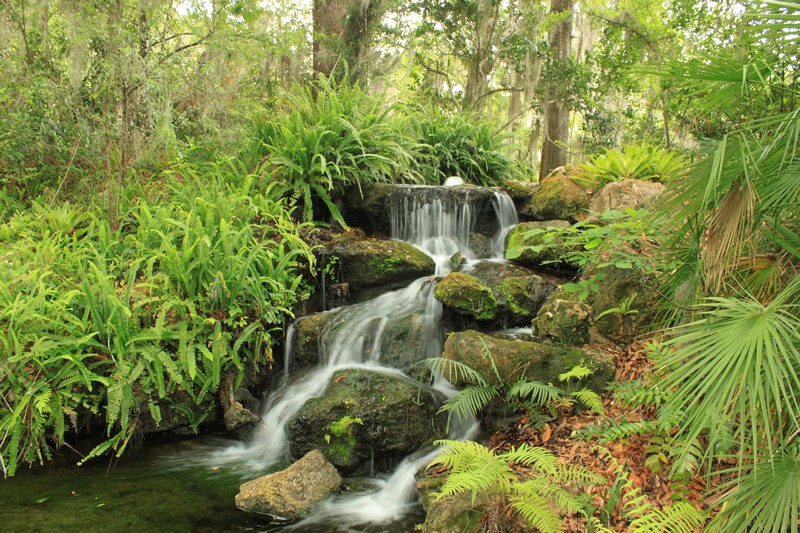
And in various places around the park there are waterfalls. The owner had added to the already hilly terrain of the slope above the head spring to create towers of earth and rock. These were specifically engineered and landscaped to create a surface upon which waterfalls were constructed. Some of these artificial waterfalls are very impressive. The water is pumped to the highest points to big clear pools where gravity takes it back down over rocky overhangs producing waterfalls suitable for even the hills of North Carolina. To me, this is one of the most impressive things about the faded ghost of the old amusement park.

Today, most of the flash is gone--the zoo, the rodeo, the aviary, and the rides that included the glass-bottom boats and a rather unique submarine that had been built to allow visitors to sit below water level as the craft took them on a circuit around the massive Rainbow Spring. But you can still see the substrate upon which all of this was built. Like almost all of the other amusement parks that were based around Florida's gorgeous freshwater springs, this one ended up in the hands of the people of Florida where it can be enjoyed by everyone for a couple of bucks, instead of an expensive admission ticket.

So the rapacious Disney corporation was good for one thing--it was obviously instrumental in causing all of these great springs to end up in the hands of the State of Florida.

(And here is a site with a little bit of information on old Lost Florida.)

Rainbow Springs, the natural feature around which the old park was constructed.

Waterfalls? Really? (Well, not really.)

The trails and boardwalks are renovated when needed, but are built on the same template laid down by the private owners from decades before.

One of the largest of the fake waterfalls.

This was my favorite of the fake waterfalls.

The main center of the old amusement park is still in use. Here are the park offices, a shop where you can buy State Park stuff, and a bit of a burger/sandwich/ice cream joint and dining area where you can enjoy your food.

Some of these man-made waterfalls really are quite pretty.

Brick laid decades ago still serves perfectly today.

This was once a pool that held some kind of aquatic critters. Now it's a giant planter.


Wednesday, May 08, 2013

Journey to Gum Slough.

One day Carole went into the park office to ask the rangers about some good places to go kayaking to find out of the way springs. One ranger is particular seemed to know quite a lot about the various locations of lesser known springs and told us that a good one was Gum Slough (pronounced "slew"). It was about 30-minute drive to an out-of-the-way boat launch. So we decided this was going to be our destination for the day and loaded up with directions and headed out.

Without a lot of trouble we found the boat launch (that was indeed located out in the sticks), and were soon underway. The water of the main channel we were traveling was dark and shallow. Around us was mainly forest, with a few old fishing shacks and some camps built into the forest on the left bank. About thirty minutes into the paddle we noticed a park area on the left bank and headed over to see it.

We were very surprised to find what is apparently a National Forest group camp. It consisted of a large maintained open grassy field surrounded by thick forests with two small sandy beaches appropriate for swimming or launching boats and kayaks. There are also picnic tables and a very clean vault toilet. Deciding that this place was too pretty to just view and leave, we got out our lunches and ate there at a picnic table close to the water's edge. The weather was good--partly cloudy with mild temperatures--and we were not bothered by bugs. We had pleasant meal and we took some photos of the camp and the views along the waterway and then we jumped back aboard our kayaks and continued on our way to find Gum Slough.

After paddling for no more than ten minutes beyond the camp we looked down to note that the water had gone from dark and murky to suddenly clear blue and clean, and rather deeper. Peering to our left, we could see that we had obviously reached Gum Slough and the influx of clear fresh water from the spring heads that were waiting to be seen far upstream into the dense jungle beyond.

So we turned and headed upstream on Gum Slough.

The stream was a weird one to me. The water was mainly shallow and only occasionally opened up into deep pools, always crystal clear. The farther upstream we went the more intense the current became and I found myself very much wanting to see the spring that had produced this run. Around us the forest pressed in close, and the way was full of downed trees and limbs, most of which we were able to float above. I could see where some enterprising group had come in to saw away and remove the worst of the deadfall, but not all of it. Later, we found out that a kayak club maintains the stream, but leaves as much debris in the water as necessary to keep out motorboats. My hat's off to this clever group!

As we paddled along we saw some wildlife. Mainly birds and fish, with a spectacular Barred owl who landed on the limb of a hardwood above to stare down at us with what seemed a disapproving glare. We pushed on, anxious to see the head spring.

But, eventually, we had to face the fact that we could not make it all the way to the end of the spring run. The debris in the waterway was just too heavy--even for kayaks--for the drought had left the stream level just too low to allow us to float over the deadfall in the water. With a great deal of disappointment, we finally faced the fact that we would have to turn around without reaching the main spring.

After that we just took our time fighting our way back along the wood-choked stream. Too soon we were back out on the main channel and paddling back toward the boat launch without having reached our destination. But that's okay. We saw a lot of wildlife, including some otters, and having not reached the headwaters of Gum Slough give us a reason to return for another attempt.

The Fish Camp just beyond where we put into the river.

Panorama of the river.

I know some people get into the whole religion thing. But this was just way too creepy for me.

The ever present Black buzzards. They are everywhere we go in Florida.

Lesser Blue Heron.

The National Forest group camp we stumbled upon.

Picnic table where we had lunch. Nice, clean vault toilet beyond.

Quickly after reentering the river we reach the clear water of Gum Slough and are anxious to see the spring that births it.

Birdsong greets us as we head upstream into wilderness.


This wonderful Barred owl stood on a perch and looked down on us.

This is the low water level that robbed us of our goal.

Carole precedes me downstream as we head back out to the main channel.


The dark water of the main channel.

I love the ever-present Great blue heron. They are tremendous predators. People don't realize what effective hunters they are, preying on not just fish but turtles, snakes, mammals, and even young alligators. The theropod predator still lives with us!

Tuesday, May 07, 2013

On the Silver River

I had thought that most of the rivers and spring runs produced by the very large freshwater springs in Florida were immune to drought. But they are also influenced by periods of low rainfall. We witnessed this one our trip, most dramatically on the Silver River which appears full cloth from the mouth of the tremendous Silver Springs.

We found that the level of the river was down by about two feet from our last visit here. But the spring is so vibrant and produces such a tremendous volume of water that the current remains very powerful and the river very deep. It was still chock-a-block with wildlife and even at low ebb is still an impressive waterway.

I was happy to see that the feral monkeys are still thriving along the wild state park property. These rhesus monkeys are here because of various escapes from old movie sets and a monkey habitat that was once part of a private park somewhere along the river. Various enterprising monkeys took off on their own, and a large number--from what I've read--got loose after a hurricane destroyed their enclosure. Thus, the area is now home to several hundred feral monkeys. I've been told that the State of Florida has done studies on the impact of this invasive species on the local environment and found them largely harmless inhabitants and have chosen to leave them alone. I like that.

Like most of the other major springs in Florida, Silver Springs was destined to end up in the hands of the public, which is as it should be. It always bothered me that so many of these great places had been locked up in private property. But the old parks that had been built around these magnificent springs began to decline in attendance when Disney sucked all the air out of the room. Silver Springs was one of the last to give in to the fading audience of idiot tourists but is, at last, being transferred to state ownership.

We almost immediately noticed that the Silver River was running lower than normal.

Strange to see so much root system exposed.

As you can see here, the water was at least two feet below normal.

We saw a large group of feral rhesus monkeys. The young one at the bottom had just caught and eaten some kind of bug, so the other one was interested as they searched for more bits of mobile protein to ingest.
This guy was on the bank, same side as the monkey group, about forty or fifty feet down from them.


Even in low water the Silver River is an impressive spring run.

Some extra color.

More color.

I'm not exactly sure what these are, but I think they may be snail eggs.


The exposed root system and series of cypress knees looked like a picket fence arranged to protect the tree from the flow of the river.

Monday, May 06, 2013

First Day on the Spring Runs.

We began our vacation by leaving rather later than we intended and loading up in the dark. I drove as far as I could and we pulled into a rest area somewhere in Georgia where we climbed into our trailer and went to sleep. Generally, we try to start our trailer vacations this way because it helps to cut the stress of driving long distances.

The next day we headed out at the crack of dawn and got to our campsite at Rainbow Springs State Park. We chose this park for several reasons, among them the fact that the campground had full hookups (water, electric, and sewer), and that it was central to a number of the springs we had chosen to visit. The first day there we got my kayak (to add to Carole's), and just mainly scoped out what we were going to do over the next few days.

The weather was pretty good to us. Temperatures were unseasonably mild, the bugs were likewise mild, and we hardly had to use the air-conditioner in the trailer at all. What was a bit strange is that this part of Florida is apparently in a pretty bad drought, so the levels of the rivers and streams was down quite a bit. This would have some impact on us later on.

I have to say...getting away from cities I am reminded more and more how disconnected I have become from society at large. You can have your crowds and your craziness. My preference remains what we have left of Mother Nature in her wild state. Give me the forests and creeks, the mountains and waterfalls. I'll watch the critters move through the trees and the rest of you can rub elbows in the city streets.

This was our campsite at the Rainbow Springs State Park. It looks rather exposed, but in fact it was shaded for most of the day, getting full sun only in the later afternoon.

We wasted no time in getting out on the Rainbow River. The day we paddled it, though, was a Saturday, and the river was rather crowded. Unfortunately not just with other kayakers and canoe enthusiasts, but with your gas-belching power boats.

There are almost always lots of turtles on the rivers and spring runs. They don't let you get close, though, so you have to take photos with telephoto settings.

I know this is a lousy shot...but it's almost impossible to take photos of river otters. This one was fishing and he caught a fish while I watched. Gobbled it right down, too, on the fly.

A barred owl we saw on the ride upstream. We saw a lot of barred owls this trip. I don't know if it was the luck of the draw, or if there are just a lot more of them now.

Good ol' Snowy egret.

Carole in her Wilderness Pungo 120 kayak as we paddle down the Rainbow River.

Sunday, May 05, 2013

Home!

We're back from vacation. The cats have forgiven us.

I'll post more tomorrow. Now to rest.

My old stand-by, the Great blue heron. They're always on the waterways.


Despite appearances, these spring boils are not thermal. Merely clear, fresh water welling up from the limestone and bubbling through the very fine white and brown sands.